
Level:
Correct: 0
Incorrect: 0
Marks: 0/0
Exam Practice
Course:
Topics:
OCR GCSE Physics (Paper 2) Smart practice A mixed round aimed at your weak spots
Avg
score:
–
Topics
done:
0/30

Electron arrangements and radiation

Practise 14 exam-style questions on Electron arrangements and radiation for OCR GCSE Physics (Paper 2). Write your answer as you would in the exam and get it marked in seconds against the mark scheme, point by point, with the Study Helper on hand if you get stuck.

  • 14 questions
  • 1–6 marks each
  • Instant marking
  • No sign-up needed
14 questions, marked as you go

Sample questions with model answers

Here are 4 of the questions in this topic, each with a model answer, an explanation of why it earns the marks and the mark scheme an examiner would use.

Question 1

1 mark

X-rays pass through the air in a hospital X-ray room. Some of the atoms in the air are ionised.

Which statement describes what happens to each of these atoms?

Choose your answer.

  • A It gains an electron and becomes a negative ion.
  • B It loses a proton and becomes a negative ion.
  • C It loses an inner electron and stays neutral.
  • D It loses an outer electron and becomes a positive ion.

Model answer

D

Explanation

Ionisation by radiation means an atom loses one or more outer electrons. Electrons are negative, so the atom is left with more positive protons than negative electrons: it becomes a positive ion. The nucleus, and so the number of protons, does not change.

Mark scheme
  1. 1 mark

    D / It loses an outer electron and becomes a positive ion.

    The only correct answer is D: when an atom is ionised by radiation, an outer electron leaves the atom, so the atom has more protons than electrons and becomes a positive ion. A is not correct because ionisation by radiation removes an electron rather than adding one; B is not correct because protons are in the nucleus and are not removed when an atom is ionised; C is not correct because an atom that loses any electron is no longer neutral, and it is the outer electrons that are lost. ALLOW the letter or the option. If more than one option is given, do not award the mark.
Question 2

2 marks

A polythene rod is rubbed with a dry cloth. Electrons move from the atoms in the cloth to the rod, so the cloth becomes positively charged.

When ultraviolet shines on some atoms, the atoms are ionised.

Give one way in which ionising an atom with ultraviolet is similar to what happens to the atoms in the cloth.
Give one way in which it is different.

Model answer

Similarity: in both cases atoms lose outer electrons, so they are left with more protons than electrons and become positively charged.
Difference: when an atom is ionised, the energy to remove the electron comes from absorbing ultraviolet, but the atoms in the cloth lose electrons because the cloth is rubbed against the rod.

Explanation

Charging by rubbing and ionisation by radiation both involve atoms losing negative electrons, which leaves them positive, because protons never move. The difference is how it happens: radiation supplies the energy in ionisation, while in static charging the electrons are transferred from one object to another by friction.

Mark scheme
  1. 1 mark

    similarity: in both, atoms lose (outer) electrons and become positively charged (positive ions)

    ALLOW in both, the atoms are left with more protons than electrons. ALLOW in both, electrons (not protons) move. If more than one answer is given, a wrong one cancels a right one (this applies to the similarity and to the difference). For the difference, 1 mark for any one of points 2 and 3, max 1.

  2. 1 mark

    difference: in ionisation the energy to remove the electron comes from the radiation (ultraviolet) that is absorbed, but in the cloth it comes from rubbing (friction)

    ALLOW ionisation needs radiation, but charging the cloth needs rubbing / contact between two objects.

  3. 1 mark

    difference: in ionisation the electron simply leaves the atom (it becomes a free electron), but from the cloth the electrons are transferred onto another object (the rod)

    ALLOW the cloth gives its electrons to the rod, but the ionised atom does not give its electron to a particular object. Max 1 for points 2 and 3 together.

Question 3

2 marks

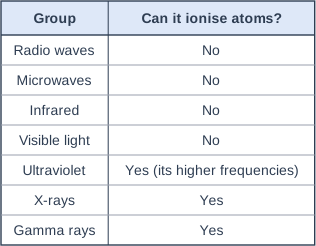
A student reads about which groups of the electromagnetic spectrum can ionise atoms. The table shows what she found.

Use the table to describe the pattern between the position of a group in the spectrum and whether it can ionise atoms.
Name the group in the table with the lowest frequency that can ionise atoms.

Table with columns "Group", "Can it ionise atoms?". Group: Radio waves; Can it ionise atoms?: No | Group: Microwaves; Can it ionise atoms?: No | Group: Infrared; Can it ionise atoms?: No | Group: Visible light; Can it ionise atoms?: No | Group: Ultraviolet; Can it ionise atoms?: Yes (its higher frequencies) | Group: X-rays; Can it ionise atoms?: Yes | Group: Gamma rays; Can it ionise atoms?: Yes.

Model answer

Only the groups at the high-frequency (short-wavelength) end of the spectrum, ultraviolet, X-rays and gamma rays, can ionise atoms. Radio waves, microwaves, infrared and visible light, which have lower frequencies, cannot. Ultraviolet is the group with the lowest frequency that can ionise atoms.

Explanation

Look at where the 'yes' groups are in the spectrum: they are all at the high-frequency, short-wavelength end. To ionise an atom, radiation must give an outer electron enough energy to leave the atom, and only these high-frequency groups can do this. Of the three, ultraviolet has the lowest frequency, as it is next to visible light.

Mark scheme
  1. 1 mark

    only the groups with the highest frequencies / shortest wavelengths (ultraviolet, X-rays and gamma rays) can ionise atoms; the lower-frequency groups (radio waves to visible light) cannot

    ALLOW the groups towards the gamma-ray end of the spectrum can ionise / the groups from ultraviolet onwards can ionise. ORA (allow the reverse argument). DO NOT ALLOW a list of the 'yes' groups without any reference to frequency, wavelength or position in the spectrum.

  2. 1 mark

    ultraviolet

    ALLOW UV / ultra-violet. DO NOT ALLOW gamma rays (the highest frequency) or visible light. DO NOT ALLOW more than one group.

Question 4

4 marks

In 1912, Victor Hess took instruments up in a balloon to a height of more than 5 km. He found that more atoms in the air are ionised high above the ground than near the ground. This led to the discovery of cosmic rays, radiation that reaches the Earth from space.

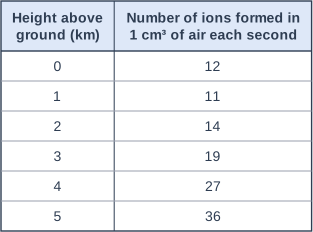
A scientist makes similar measurements using a weather balloon. The table shows her results.

Describe how the number of ions formed changes with height. Use data from the table.
Suggest why more atoms are ionised high above the ground than near the ground.

Table with columns "Height above ground (km)", "Number of ions formed in 1 cm³ of air each second". Height above ground (km): 0; Number of ions formed in 1 cm³ of air each second: 12 | Height above ground (km): 1; Number of ions formed in 1 cm³ of air each second: 11 | Height above ground (km): 2; Number of ions formed in 1 cm³ of air each second: 14 | Height above ground (km): 3; Number of ions formed in 1 cm³ of air each second: 19 | Height above ground (km): 4; Number of ions formed in 1 cm³ of air each second: 27 | Height above ground (km): 5; Number of ions formed in 1 cm³ of air each second: 36.

Model answer

The number of ions formed falls slightly from 12 to 11 between the ground and 1 km, and then increases as the height increases, reaching 36 at 5 km. At 5 km three times as many ions are formed as at ground level, and the increase gets bigger with each kilometre. More atoms are ionised higher up because the radiation that ionises them comes from space. As it travels down through the atmosphere, the air absorbs some of it, so more of the radiation reaches the air high above the ground than reaches the air near the ground.

Explanation

Describe the overall trend first and then support it with numbers from the table, such as comparing the values at 0 km and 5 km. The stem tells you the radiation comes from space, so the higher you go, the less air it has passed through and the less of it has been absorbed. More radiation means more atoms lose outer electrons and become ions.

Mark scheme
  1. 1 mark

    as the height increases, the number of ions formed increases (after a small decrease between 0 km and 1 km)

    ALLOW more ions are formed higher up. ORA (allow the reverse argument). Do not insist on the small decrease for this point.

  2. 1 mark

    uses data to support the trend: for example, at 5 km the number is three times the number at ground level (36 compared with 12) / it falls from 12 to 11 between 0 km and 1 km and then rises to 36 at 5 km / it increases more quickly at greater heights

    Any correct use of the data that describes the change scores this point. ALLOW the increase each kilometre gets bigger (3, 5, 8, 9). DO NOT ALLOW a quotation of one value on its own.

  3. 1 mark

    the radiation that ionises the atoms comes from space, above the atmosphere (cosmic rays)

    ALLOW the radiation comes from above / from outside the Earth. IGNORE it is colder / there is less oxygen higher up.

  4. 1 mark

    the air absorbs some of the radiation as it travels down, so more radiation reaches the air high up than the air near the ground

    ALLOW higher up the radiation has passed through less air / less of it has been absorbed / the air there is closer to the source. ALLOW, as an extra idea, that radiation from rocks in the ground explains the higher value at 0 km, but this does not replace this point.

Ready to try the rest? Every answer you write is marked against the mark scheme, so you can see exactly where the marks are.

Study Helper Hints first, answers after you try

Stuck on this one? Ask for a hint and I’ll point you in the right direction, without giving the answer away. Once you’ve checked your answer, I’ll show you how the marks are awarded.