Level:
Correct: 0
Incorrect: 0
Marks: 0/0
Exam Practice
Course:
Topics:
OCR GCSE Physics (Paper 2) Smart practice A mixed round aimed at your weak spots
Avg
score:
–
Topics
done:
0/30

Practical skills: analysing and evaluating results

Practise 15 exam-style questions on Practical skills: analysing and evaluating results for OCR GCSE Physics (Paper 2). Write your answer as you would in the exam and get it marked in seconds against the mark scheme, point by point, with the Study Helper on hand if you get stuck.

  • 15 questions
  • 1–6 marks each
  • Instant marking
  • No sign-up needed
15 questions, marked as you go

Sample questions with model answers

Here are 4 of the questions in this topic, each with a model answer, an explanation of why it earns the marks and the mark scheme an examiner would use.

Question 1

1 mark

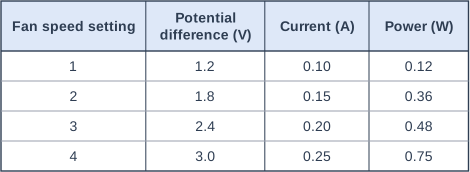
A student connects a small model wind turbine to a resistor. She points an electric fan at the turbine and measures the potential difference across the resistor and the current in it at four fan speed settings. She then calculates the power output for each setting.

The table shows her results. One of her values for the power has been calculated wrongly.

Use the equation: power = potential difference × current

Which value of power is wrong?

Choose your answer.

  • A 0.12 W
  • B 0.36 W
  • C 0.48 W
  • D 0.75 W
Table with columns "Fan speed setting", "Potential difference (V)", "Current (A)", "Power (W)". Fan speed setting: 1; Potential difference (V): 1.2; Current (A): 0.10; Power (W): 0.12 | Fan speed setting: 2; Potential difference (V): 1.8; Current (A): 0.15; Power (W): 0.36 | Fan speed setting: 3; Potential difference (V): 2.4; Current (A): 0.20; Power (W): 0.48 | Fan speed setting: 4; Potential difference (V): 3.0; Current (A): 0.25; Power (W): 0.75.

Model answer

B (0.36 W: it should be 1.8 × 0.15 = 0.27 W)

Explanation

Checking each row with power = potential difference × current shows that three values are right and one is not: 1.8 V × 0.15 A = 0.27 W. Checking calculated values in this way finds mistakes before a graph is drawn or a conclusion is made. A wrong value that does not stand out from the pattern can only be found by working it out again.

Mark scheme
  1. 1 mark

    B / 0.36 W

    The only correct answer is B: 1.8 V × 0.15 A = 0.27 W, not 0.36 W (0.36 W is 1.8 × 0.20, so she may have used the current from the next row). A is not correct because 1.2 × 0.10 = 0.12 W, which is right. C is not correct because 2.4 × 0.20 = 0.48 W, which is right. D is not correct because 3.0 × 0.25 = 0.75 W, which is right. ALLOW the letter or the option. If more than one option is given, do not award the mark.
Question 2

2 marks

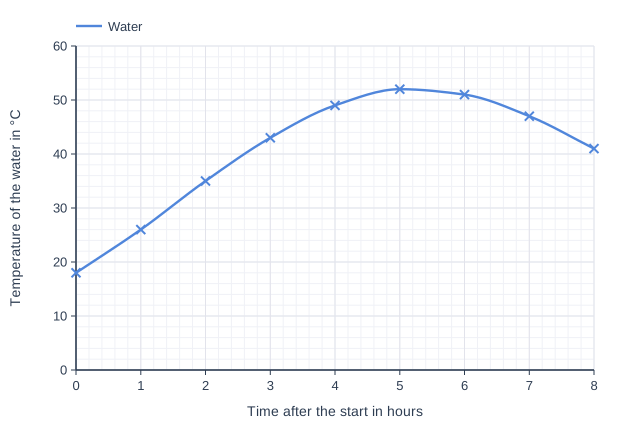
A student makes a model solar water heater from black plastic pipe inside a box with a glass lid. On a sunny day she puts it outside and measures the temperature of the water in it every hour.

The graph shows her results.

Use the graph to find:
• the temperature of the water 2.5 hours after the start
• the length of time for which the temperature of the water was above 45 °C.

Line graph of temperature of the water in °C (y-axis, 0 to 60) against time after the start in hours (x-axis, 0 to 8). "Water" is a smooth curve through (0, 18), (1, 26), (2, 35), (3, 43), (4, 49), (5, 52), (6, 51), (7, 47), (8, 41).

Model answer

Temperature 2.5 hours after the start: 39 °C
The temperature first rose above 45 °C at about 3.3 hours and fell below 45 °C again at about 7.3 hours, so it was above 45 °C for about 4 hours.

Explanation

To read a value between two plotted points, go up from 2.5 hours on the time axis to the curve, then across to the temperature axis. For the second part, go across from 45 °C: the curve crosses this line twice, on the way up (at about 3.3 hours) and on the way down (at about 7.3 hours). The length of time above 45 °C is the difference between these two times, about 4 hours.

Mark scheme
  1. 1 mark

    any value from 38 to 40 (°C)

    ALLOW any value from 38 °C to 40 °C.

  2. 1 mark

    any value from 3.7 to 4.3 hours / about 4 hours (from about 3.3 hours to about 7.3 hours)

    ALLOW any value from 3.7 to 4.3 hours (220 to 260 minutes). DO NOT ALLOW a single time such as 3.3 hours or 7.3 hours on its own (a time when the temperature passed 45 °C, not a length of time).

Question 3

2 marks

A student looks at the power ratings of 40 different microwave ovens on sale in a large shop.

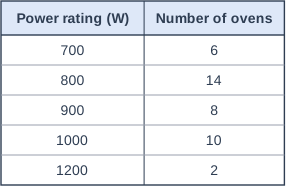
The table shows how many of the 40 ovens have each power rating.

Calculate the mean power rating of the 40 ovens. Then give the mode.

Table with columns "Power rating (W)", "Number of ovens". Power rating (W): 700; Number of ovens: 6 | Power rating (W): 800; Number of ovens: 14 | Power rating (W): 900; Number of ovens: 8 | Power rating (W): 1000; Number of ovens: 10 | Power rating (W): 1200; Number of ovens: 2.

Model answer

Total of all 40 power ratings = (700 × 6) + (800 × 14) + (900 × 8) + (1000 × 10) + (1200 × 2)
= 4200 + 11 200 + 7200 + 10 000 + 2400 = 35 000 W
Mean = 35 000 ÷ 40 = 875 W
Mode = 800 W (the most common power rating: 14 ovens)

Explanation

Each row of the table says how many ovens have that power rating, so multiply each rating by its number of ovens and add the results to get the total for all 40 ovens; dividing by 40 gives the mean. The mode is the value that occurs most often, which is the rating (800 W), not the number of ovens (14). Taking the mean of the five ratings without using the numbers of ovens gives 920 W, which is wrong.

Mark scheme
  1. 1 mark

    mean = [(700 × 6) + (800 × 14) + (900 × 8) + (1000 × 10) + (1200 × 2)] ÷ 40 = 35 000 ÷ 40 = 875 (W); or a correct final answer of 875 W with no working

    An answer of 875 W with no working scores this mark. ALLOW 0.875 kW. DO NOT ALLOW (700 + 800 + 900 + 1000 + 1200) ÷ 5 = 920 W (the number of ovens with each rating has not been used) or 40 ÷ 5 = 8.

  2. 1 mark

    mode = 800 (W)

    DO NOT ALLOW 14 (this is the number of ovens with the most common rating, not the rating).

Question 4

4 marks

An advert for an electric hot-water dispenser says:

'Gives you a 250 ml cup of boiling water in 10 seconds!'

The dispenser has a 3.0 kW heater. It heats cold water at 20 °C as the water flows through it.

• mass of 250 ml of water = 0.25 kg
• specific heat capacity of water = 4200 J/kg °C

Use the equations:
change in thermal energy = mass × specific heat capacity × change in temperature
energy transferred = power × time

Use calculations to explain whether the advert's claim can be true.

Model answer

Energy needed = mass × specific heat capacity × change in temperature = 0.25 × 4200 × (100 − 20) = 84 000 J
Energy the heater supplies in 10 s = power × time = 3000 × 10 = 30 000 J
(Time needed = 84 000 ÷ 3000 = 28 s)

The claim cannot be true. In 10 s the heater supplies only 30 000 J, about a third of the 84 000 J needed, so the water would need at least 28 s to reach 100 °C. Even this assumes that all of the energy goes into the water; some is wasted heating the dispenser and the surroundings, so the real time would be longer still.

Explanation

To test a claim with data, work out what the physics allows. Raising 0.25 kg of water by 80 °C needs 84 000 J, but a 3.0 kW heater (3000 J each second) supplies only 30 000 J in 10 s. So the claim fails even for a heater with no wasted energy. Remember to change 3.0 kW into 3000 W before using energy = power × time.

Mark scheme
  1. 1 mark

    energy needed = 0.25 × 4200 × (100 − 20) = 84 000 J; or a correct final answer of 84 000 J with no working

    An answer of 84 000 J with no working scores marking point 1 only. ALLOW 84 kJ.

  2. 1 mark

    energy supplied in 10 s = 3000 × 10 = 30 000 J / time needed = 84 000 ÷ 3000 = 28 s; or a correct final answer of 30 000 J or 28 s with no working

    An answer of 30 000 J (in 10 s) or 28 s (time needed) with no working scores marking point 2 only. ALLOW ECF from a wrong energy needed. An answer of 28 000 s or 30 J (kilowatts not converted to watts) does not score this mark, but ALLOW ECF from it for marking points 3 and 4.

  3. 1 mark

    the claim cannot be true: in 10 s the heater supplies only 30 000 J, about a third of the 84 000 J needed / the water needs at least 28 s to boil, which is much longer than 10 s

    The judgement must be supported by a correct comparison (ALLOW ECF). DO NOT ALLOW 'the claim is true'.

  4. 1 mark

    even this assumes that all the energy goes into the water (100% efficient); some energy heats the dispenser and the surroundings, so it would take even longer

    ALLOW 'energy is wasted / dissipated, so the real time is more than 28 s'.

Ready to try the rest? Every answer you write is marked against the mark scheme, so you can see exactly where the marks are.

Study Helper Hints first, answers after you try

Stuck on this one? Ask for a hint and I’ll point you in the right direction, without giving the answer away. Once you’ve checked your answer, I’ll show you how the marks are awarded.