
Level:
Correct: 0
Incorrect: 0
Marks: 0/0
Exam Practice
Course:
Topics:
OCR GCSE Physics (Paper 2) Smart practice A mixed round aimed at your weak spots
Avg
score:
–
Topics
done:
0/30

Energy stores, transfers and conservation

Practise 15 exam-style questions on Energy stores, transfers and conservation for OCR GCSE Physics (Paper 2). Write your answer as you would in the exam and get it marked in seconds against the mark scheme, point by point, with the Study Helper on hand if you get stuck.

  • 15 questions
  • 1–6 marks each
  • Instant marking
  • No sign-up needed
15 questions, marked as you go

Sample questions with model answers

Here are 4 of the questions in this topic, each with a model answer, an explanation of why it earns the marks and the mark scheme an examiner would use.

Question 1

1 mark

Some electric cars use regenerative braking. When the car slows down, its motor works as a generator and charges the car's battery.

Apart from thermal stores, which energy store increases as the car slows down on a level road?

Choose your answer.

  • A the chemical store of the battery
  • B the elastic potential store of the tyres
  • C the gravitational potential store of the car
  • D the kinetic store of the car

Model answer

A (the chemical store of the battery)

Explanation

As the car slows down, its kinetic store decreases. With ordinary brakes almost all of this energy ends up in thermal stores, but with regenerative braking some of it is transferred by a current back into the chemical store of the battery, so it can be used again.

Mark scheme
  1. 1 mark

    A / the chemical store of the battery

    The only correct answer is A: energy from the kinetic store of the car is transferred by the current from the generator to the battery, so the chemical store of the battery increases. B is not correct because the tyres are not being stretched or squashed any more than before, so their elastic store does not build up; C is not correct because the road is level, so the height of the car does not change; D is not correct because the car is slowing down, so its kinetic store decreases. ALLOW the letter or the option. If more than one option is given, do not award the mark.
Question 2

2 marks

A footballer kicks the ball into the goal. The net stretches as it stops the ball.

Name the energy store of the ball that decreases and the energy store of the net that increases as the net stops the ball.

Model answer

The kinetic store of the ball decreases, and the elastic potential store of the net increases.

Explanation

An object that is stretched or squashed elastically stores energy in its elastic potential store. As the net stretches, energy from the kinetic store of the ball is transferred to the elastic potential store of the net (and some to thermal stores).

Mark scheme
  1. 1 mark

    the kinetic store (of the ball) decreases

    1 mark for each of marking points 1 and 2. ALLOW kinetic energy. DO NOT ALLOW gravitational, elastic or chemical for this mark. IGNORE thermal. If more than one store is given for the ball, a wrong one cancels a right one.

  2. 1 mark

    the elastic (potential) store (of the net) increases

    ALLOW elastic potential energy / strain energy. DO NOT ALLOW kinetic, chemical or gravitational. IGNORE thermal. If more than one store is given for the net, a wrong one cancels a right one.

Question 3

2 marks

A mug of hot tea is left in a closed, well-insulated room. Treat the room and everything in it as a closed system.

After two hours, the tea has cooled down to the temperature of the room.

A student says: 'The energy in the tea has been used up, so the total energy in the room has gone down.'

Explain why the student is wrong.

Model answer

In a closed system no energy enters or leaves, and energy cannot be created or destroyed, so the total energy in the room stays the same. The energy has not been used up: it has been transferred by heating from the thermal store of the tea to the thermal stores of the mug, the air and the other things in the room, which increase by the same amount that the tea's store decreases.

Explanation

Energy is never used up. When the tea cools, its thermal store decreases, but the energy spreads out into the thermal stores of its surroundings, so in a closed system the total stays the same.

Mark scheme
  1. 1 mark

    the total energy in the room stays the same, because it is a closed system / energy cannot be created or destroyed

    ALLOW there is no net change in the total energy. ALLOW reference to the law of conservation of energy.

  2. 1 mark

    energy is transferred (by heating) from the thermal store of the tea to the thermal stores of the air / the mug / the room, which increase by the same amount

    ALLOW the energy has spread out into the surroundings. DO NOT ALLOW 'the energy is lost' with no destination.

Question 4

4 marks

An electric tram takes energy from an overhead wire to run its electric motor. It uses friction brakes to stop.

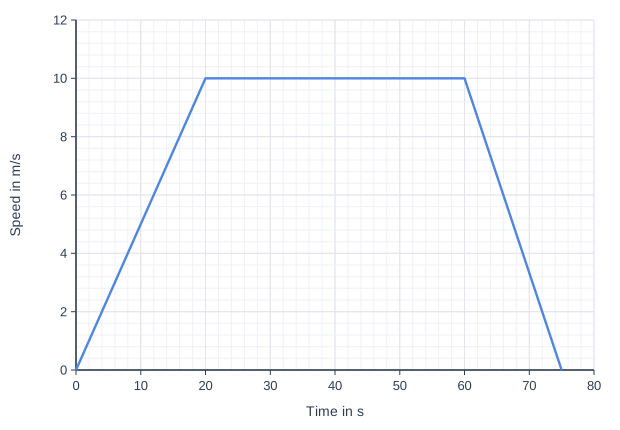
The graph shows how the speed of the tram changes as it travels between two stops.

Describe the changes in the energy stores of the tram and its surroundings, and how energy is transferred:
• from 0 s to 20 s
• from 20 s to 60 s
• from 60 s to 75 s.

Line graph of speed in m/s (y-axis, 0 to 12) against time in s (x-axis, 0 to 80). The line joins the points (0, 0), (20, 10), (60, 10), (75, 0).

Model answer

From 0 s to 20 s the speed of the tram increases, so its kinetic store increases. Energy is transferred by an electric current from the overhead wire to the motor, which does work on the tram (some energy also heats the motor and the surroundings).

From 20 s to 60 s the speed is constant at 10 m/s, so the kinetic store stays the same. The motor still transfers energy, but the driving force only balances friction and air resistance, so the work done ends up in the thermal stores of the air, the track and the motor.

From 60 s to 75 s the tram slows down and stops, so its kinetic store decreases to zero. The friction brakes do work on the wheels, so the energy is transferred to the thermal stores of the brakes, which then heat the surroundings.

Explanation

Read the graph in three parts: a rising line means speeding up, a flat line means a constant speed and a falling line means slowing down. The kinetic store depends on speed, so it increases, stays the same and then decreases. At a constant speed the energy supplied is dissipated to thermal stores by work done against resistive forces, and when the tram brakes, the energy from its kinetic store goes to the thermal stores of the brakes.

Mark scheme
  1. 1 mark

    0 s to 20 s: the speed increases, so the kinetic store of the tram increases (energy is transferred by an electric current from the overhead wire to the motor, which does work on the tram)

    1 mark for each of marking points 1 to 4. ALLOW energy is transferred electrically / by work done when a current flows, as long as the kinetic store is said to increase. IGNORE 'the tram speeds up' with no energy store.

  2. 1 mark

    20 s to 60 s: the speed is constant, so the kinetic store of the tram stays the same

    ALLOW the kinetic store does not change. DO NOT ALLOW the kinetic store increases or decreases in this stage.

  3. 1 mark

    20 s to 60 s: the energy transferred from the supply is used to do work against friction and air resistance, so the thermal stores of the surroundings (the air, the track and the motor) increase

    ALLOW the driving force balances the resistive forces (the resultant force is zero), so the energy supplied is dissipated to thermal stores. ALLOW the energy is dissipated / spread out to the surroundings.

  4. 1 mark

    60 s to 75 s: the kinetic store of the tram decreases (to zero), and the friction brakes do work, so the thermal stores of the brakes (and the surroundings) increase

    Both the decrease in the kinetic store and the increase in thermal stores are needed for this mark. ALLOW energy is transferred by heating from the hot brakes to the surroundings. ALLOW some energy is transferred by sound.

Ready to try the rest? Every answer you write is marked against the mark scheme, so you can see exactly where the marks are.

Study Helper Hints first, answers after you try

Stuck on this one? Ask for a hint and I’ll point you in the right direction, without giving the answer away. Once you’ve checked your answer, I’ll show you how the marks are awarded.