
Level:
Correct: 0
Incorrect: 0
Marks: 0/0
Exam Practice
Course:
Topics:
Edexcel GCSE Combined Science (Biology Paper 2) Smart practice A mixed round aimed at your weak spots
Avg
score:
–
Topics
done:
0/30

Thyroxine and negative feedback

Practise 13 exam-style questions on Thyroxine and negative feedback for Edexcel GCSE Combined Science (Biology Paper 2). Write your answer as you would in the exam and get it marked in seconds against the mark scheme, point by point, with the Study Helper on hand if you get stuck.

  • 13 questions
  • 1–6 marks each
  • Instant marking
  • No sign-up needed
13 questions, marked as you go

Sample questions with model answers

Here are 4 of the questions in this topic, each with a model answer, an explanation of why it earns the marks and the mark scheme an examiner would use.

Question 1

1 mark

The thyroid gland releases thyroxine when it is stimulated by another hormone.

Which hormone stimulates the thyroid gland to produce thyroxine?

Choose your answer.

  • A TSH
  • B TRH
  • C FSH
  • D adrenalin

Model answer

A - TSH

Explanation

TSH (thyroid stimulating hormone) is released by the pituitary gland and carried in the blood to the thyroid gland, where it stimulates the production of thyroxine. Its name tells you its target.

Mark scheme
  1. 1 mark

    A / TSH (1)

    The only correct answer is A. B is not correct because TRH acts on the pituitary gland, causing it to release TSH; it does not act on the thyroid gland. C is not correct because FSH acts on the ovaries. D is not correct because adrenalin prepares the body for fight or flight and does not control the thyroid gland. Accept the letter or the option. If more than one option is given, do not award the mark.
Question 2

2 marks

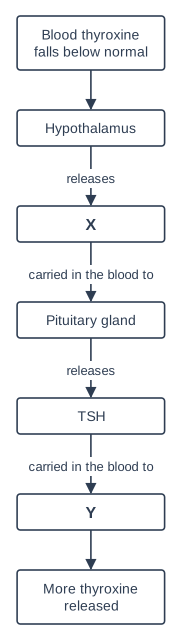
Figure 1 shows how the body responds when the concentration of thyroxine in the blood falls below normal.

Name hormone X.

Name gland Y.

Flow chart of 7 boxes joined by arrows, read from top to bottom. The first box is "Blood thyroxine falls below normal", which leads to "Hypothalamus", which leads (along an arrow labelled "releases") to box X, which leads (along an arrow labelled "carried in the blood to") to "Pituitary gland", which leads (along an arrow labelled "releases") to "TSH", which leads (along an arrow labelled "carried in the blood to") to box Y, which leads to "More thyroxine released".

Model answer

X is TRH.
Y is the thyroid gland.

Explanation

Low thyroxine stimulates the hypothalamus to produce TRH (X), which causes the pituitary gland to release TSH. TSH acts on the thyroid gland (Y), which produces more thyroxine. Confusing TRH with TSH, or the thyroid gland with thyroxine, are common errors.

Mark scheme
  1. 1 mark

    (X =) TRH (1)

    accept thyrotropin-releasing hormone; do not accept TSH

  2. 1 mark

    (Y =) thyroid gland (1)

    accept thyroid; do not accept thyroxine / hypothalamus / pituitary

Question 3

2 marks

When the concentration of thyroxine in the blood returns to normal, thyroxine has effects on the hypothalamus and on the pituitary gland.

Describe these effects.

Model answer

Thyroxine inhibits the release of TRH from the hypothalamus, and it inhibits the production of TSH by the pituitary gland.

Explanation

When thyroxine is back to normal it switches off its own stimulus: it inhibits the release of TRH from the hypothalamus and the production of TSH by the pituitary gland. This stops thyroxine rising too high. Each effect must be matched to the right gland.

Mark scheme
  1. 1 mark

    thyroxine inhibits / reduces the release of TRH from the hypothalamus (1)

    accept stops the hypothalamus releasing TRH; do not accept thyroxine inhibits TSH release from the hypothalamus

  2. 1 mark

    thyroxine inhibits / reduces the production / release of TSH by the pituitary gland (1)

    accept less TSH is produced by the pituitary gland because of thyroxine; do not accept 'thyroxine stimulates the pituitary gland'

Question 4

4 marks

Grace has an underactive thyroid gland. At week 0 she started taking thyroxine tablets every day.

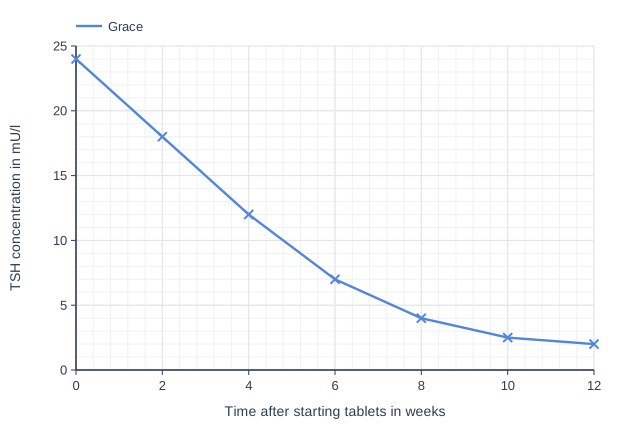
The graph shows the concentration of TSH in Grace's blood over the next 12 weeks.

Calculate the percentage decrease in Grace's TSH concentration from week 0 to week 8.

Explain why her TSH concentration fell.

Line graph of TSH concentration in mU/l (y-axis, 0 to 25) against time after starting tablets in weeks (x-axis, 0 to 12). "Grace" joins the points (0, 24), (2, 18), (4, 12), (6, 7), (8, 4), (10, 2.5), (12, 2).

Model answer

Percentage decrease = (24 - 4) ÷ 24 × 100 = 20 ÷ 24 × 100 = 83%
The tablets raised the concentration of thyroxine in Grace's blood. Thyroxine inhibits the release of TRH from the hypothalamus and the production of TSH by the pituitary gland, so by negative feedback less TSH was released and its concentration fell.

Explanation

Before treatment, Grace's low thyroxine was not inhibiting TRH and TSH, so her TSH was very high. Once the tablets raised her thyroxine, it inhibited TRH and TSH again. Percentage decrease = decrease ÷ starting value × 100; dividing by the final value is the usual error.

Mark scheme
  1. 1 mark

    (24 - 4) ÷ 24 × 100 / 20 ÷ 24 × 100 (1)

    An answer of 83 % with no working scores marking points 1 and 2

  2. 1 mark

    83 (%) (1)

    accept 83.3 / 83.33; allow values that round to 83; do not accept 500 (dividing by 4) or 16.7 (4 ÷ 24 × 100) - wrong methods score 0

  3. 1 mark

    the tablets increase the concentration of thyroxine in her blood (1)

    Points 3, 4 and 5: max 2. accept her thyroxine level returns to normal

  4. 1 mark

    thyroxine inhibits the production / release of TSH (by the pituitary gland) (1)

    accept negative feedback reduces TSH release; do not accept thyroxine inhibits the thyroid gland

  5. 1 mark

    thyroxine inhibits the release of TRH (from the hypothalamus) so the pituitary gland is stimulated less (1)

    accept less TRH so less TSH

Ready to try the rest? Every answer you write is marked against the mark scheme, so you can see exactly where the marks are.

Study Helper Hints first, answers after you try

Stuck on this one? Ask for a hint and I’ll point you in the right direction, without giving the answer away. Once you’ve checked your answer, I’ll show you how the marks are awarded.