
Level:
Correct: 0
Incorrect: 0
Marks: 0/0
Exam Practice
Course:
Topics:
Edexcel GCSE Combined Science (Biology Paper 2) Smart practice A mixed round aimed at your weak spots
Avg
score:
–
Topics
done:
0/30

Exchange surfaces and surface area to volume

Practise 16 exam-style questions on Exchange surfaces and surface area to volume for Edexcel GCSE Combined Science (Biology Paper 2). Write your answer as you would in the exam and get it marked in seconds against the mark scheme, point by point, with the Study Helper on hand if you get stuck.

  • 16 questions
  • 1–6 marks each
  • Instant marking
  • No sign-up needed
16 questions, marked as you go

Sample questions with model answers

Here are 4 of the questions in this topic, each with a model answer, an explanation of why it earns the marks and the mark scheme an examiner would use.

Question 1

1 mark

The alveoli in the lungs are adapted for the exchange of gases by diffusion.

Which feature of the alveoli helps to keep a steep concentration gradient of oxygen between the air and the blood?

Choose your answer.

  • A a good blood supply
  • B a moist lining
  • C millions of alveoli
  • D walls one cell thick

Model answer

A a good blood supply

Explanation

Blood flowing through the capillaries around the alveoli constantly carries oxygenated blood away and brings deoxygenated blood, so the oxygen concentration in the blood stays lower than in the air in the alveoli. Breathing also helps by bringing in fresh air. The other options are real adaptations, but they help diffusion in other ways: a large surface area (C) and a short diffusion distance (D).

Mark scheme
  1. 1 mark

    A / a good blood supply (1)

    The only correct answer is A. B is not correct because a moist lining lets oxygen dissolve before it diffuses, but does not keep the gradient steep; C is not correct because millions of alveoli give a large surface area, not a steep gradient; D is not correct because walls one cell thick give a short diffusion distance, not a steep gradient. Accept the letter or the option. If more than one option is given, do not award the mark.
Question 2

2 marks

In a fish, gas exchange takes place in the gills.

Each gill is made of many thin filaments. Each filament is covered in many tiny folds. The walls of the folds are only one or two cells thick, and the folds contain a dense network of capillaries. Water flows over the gills all the time.

Suggest how two of these features make gas exchange in the gills efficient.

Model answer

The many filaments and folds give the gills a large surface area for oxygen to diffuse into the blood. The walls of the folds are only one or two cells thick, so the diffusion distance between the water and the blood is short.

Explanation

Gills are adapted in the same ways as alveoli: a large surface area, a short diffusion distance, and a blood supply (and flow of water) that keeps a steep concentration gradient. Each mark needs a feature from the question linked to how it helps diffusion. A common error is to list features without saying how each one helps.

Mark scheme
  1. 1 mark

    many filaments / folds give a large surface area (for diffusion) (1)

    Any two from the four points; max 2. Each mark needs the feature and how it helps. Ignore 'more space' unqualified.

  2. 1 mark

    thin walls (one or two cells thick) give a short diffusion distance (1)

    Accept 'gases diffuse a short distance between the water and the blood'.

  3. 1 mark

    the dense capillary network / blood flow carries oxygen away / brings carbon dioxide, so a steep concentration gradient is maintained (1)

    Accept 'good blood supply keeps the oxygen concentration in the blood low'.

  4. 1 mark

    water flowing over the gills brings more oxygen / removes carbon dioxide, so a steep concentration gradient is maintained (1)

    Accept 'keeps the oxygen concentration in the water next to the gills high'.

Question 3

3 marks

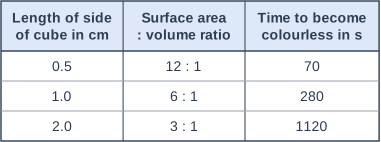
A student made cubes of agar jelly containing an indicator. The indicator is pink, but it becomes colourless when acid reaches it. She put cubes of different sizes into dilute hydrochloric acid and timed how long it took for each cube to become completely colourless.

The table shows her results.

Describe the relationship between the surface area : volume ratio of a cube and the time taken for it to become colourless.

Explain the results.

Table with columns "Length of side of cube in cm", "Surface area : volume ratio", "Time to become colourless in s". Length of side of cube in cm: 0.5; Surface area : volume ratio: 12 : 1; Time to become colourless in s: 70 | Length of side of cube in cm: 1.0; Surface area : volume ratio: 6 : 1; Time to become colourless in s: 280 | Length of side of cube in cm: 2.0; Surface area : volume ratio: 3 : 1; Time to become colourless in s: 1120.

Model answer

The larger the surface area : volume ratio, the shorter the time taken for the cube to become colourless. When the ratio halves from 6 : 1 to 3 : 1, the time increases four times, from 280 s to 1120 s.
The acid moves into the jelly by diffusion through the surface of the cube. A small cube has a large surface area compared with its volume, so more acid enters for each cm³ of jelly, and its centre is closer to the surface, so the acid has a shorter distance to diffuse.

Explanation

The cubes model organisms of different sizes: as size increases, the surface area : volume ratio falls and the distance to the centre increases, so diffusion alone takes much longer to reach every part. This is why large organisms need exchange surfaces and a transport system. A common error is to describe only cube size and time without the ratio, or to say the larger cube has a smaller surface area (it has a larger one, but a smaller one compared with its volume).

Mark scheme
  1. 1 mark

    the larger the surface area : volume ratio, the shorter the time (to become colourless) (1)

    Marking point 1 is for the description; then any two from marking points 2, 3 and 4 for the explanation; max 3. Accept ORA: the smaller the ratio, the longer the time. Accept a correct description using the data, e.g. 'when the ratio halves from 6 : 1 to 3 : 1, the time increases four times, from 280 s to 1120 s'. Accept 'smaller cubes have a larger ratio and become colourless faster'. Ignore 'bigger cubes take longer' if the ratio is not mentioned.

  2. 1 mark

    the acid moves into the cube by diffusion (through its surface) (1)

    Reject osmosis / active transport. Ignore 'the acid is absorbed'.

  3. 1 mark

    a smaller cube has a larger surface area compared with its volume, so more acid enters for each cm³ of jelly (1)

    Accept 'more surface for the acid to diffuse through for the amount of jelly it has to reach'. Ignore 'a larger surface area' unqualified (the larger cube has the larger surface area).

  4. 1 mark

    the centre of a smaller cube is closer to its surface / the acid has a shorter distance to diffuse (to reach the centre) (1)

    Accept e.g. 'the acid only has to travel 0.25 cm to the centre of the 0.5 cm cube but 1.0 cm in the 2.0 cm cube'.

Question 4

4 marks

Pulmonary fibrosis is a lung disease. Scar tissue builds up in the walls of the alveoli and in the tissue between the alveoli and the capillaries.

People with pulmonary fibrosis often become breathless when they walk up stairs.

Explain why people with pulmonary fibrosis become breathless when they walk up stairs.

Model answer

The scar tissue makes the barrier between the air in the alveoli and the blood in the capillaries thicker, so oxygen has a longer distance to diffuse and less oxygen diffuses into the blood each minute. Walking up stairs increases the rate of respiration in the leg muscles, so they need more oxygen, but not enough oxygen reaches the muscle cells for aerobic respiration. The person breathes faster and more deeply to try to get more oxygen into the blood and to remove carbon dioxide.

Explanation

Alveoli are efficient because the air and the blood are separated by a very thin barrier; scar tissue makes this barrier thicker, so diffusion of oxygen into the blood is slower. During exercise the muscles need more oxygen, so the shortage is noticed most then, and breathing rate increases to compensate. A common error is to stop at 'less oxygen' without linking it to respiration in the muscles.

Mark scheme
  1. 1 mark

    the barrier between the air and the blood is thicker / the diffusion distance (for oxygen) is longer (1)

    An explanation linking four from the five points; max 4. Accept 'the walls of the alveoli are thicker'. Ignore 'the alveoli are blocked / damaged' unqualified.

  2. 1 mark

    so oxygen diffuses into the blood more slowly / less oxygen enters the blood per minute (1)

    Accept 'less gas exchange'. Accept 'less oxygen is absorbed into the blood' (e.g. because the lungs are stiffer and take in less air). Reject osmosis.

  3. 1 mark

    walking up stairs increases the (muscles') demand for oxygen / the muscles respire faster (1)

    Accept 'more energy is needed by the leg muscles'.

  4. 1 mark

    so not enough oxygen reaches the (muscle) cells for (aerobic) respiration (1)

    Accept 'less aerobic respiration / less energy is released'. Accept 'the muscles respire anaerobically / lactic acid builds up'.

  5. 1 mark

    the person breathes faster / more deeply to try to get more oxygen into the blood / to remove carbon dioxide (1)

    Accept 'carbon dioxide also diffuses out of the blood more slowly, so it builds up'. Ignore 'they need more air' unqualified.

Ready to try the rest? Every answer you write is marked against the mark scheme, so you can see exactly where the marks are.

Study Helper Hints first, answers after you try

Stuck on this one? Ask for a hint and I’ll point you in the right direction, without giving the answer away. Once you’ve checked your answer, I’ll show you how the marks are awarded.