
Level:
Correct: 0
Incorrect: 0
Marks: 0/0
Exam Practice
Course:
Topics:
Edexcel GCSE Combined Science (Biology Paper 2) Smart practice A mixed round aimed at your weak spots
Avg
score:
–
Topics
done:
0/30

Core practical: rate of respiration

Practise 14 exam-style questions on Core practical: rate of respiration for Edexcel GCSE Combined Science (Biology Paper 2). Write your answer as you would in the exam and get it marked in seconds against the mark scheme, point by point, with the Study Helper on hand if you get stuck.

  • 14 questions
  • 1–6 marks each
  • Instant marking
  • No sign-up needed
14 questions, marked as you go

Sample questions with model answers

Here are 4 of the questions in this topic, each with a model answer, an explanation of why it earns the marks and the mark scheme an examiner would use.

Question 1

1 mark

A student wants the drop of coloured liquid in a respirometer to move a greater distance for the same volume of oxygen used, so that the distance can be measured more precisely.

Which change should the student make?

Choose your answer.

  • A use more soda lime
  • B use a wider capillary tube
  • C use a larger boiling tube
  • D use a narrower capillary tube

Model answer

D - use a narrower capillary tube.

Explanation

The volume of oxygen used equals the distance moved by the drop multiplied by the cross-sectional area of the capillary tube. For the same volume, a smaller cross-sectional area (a narrower tube) means a longer distance, which can be measured with a smaller percentage error. A wider tube does the opposite.

Mark scheme
  1. 1 mark

    D / use a narrower capillary tube (1)

    The only correct answer is D. A is not correct because more soda lime does not change the volume of oxygen used, so the drop moves the same distance; B is not correct because in a wider tube the same volume of oxygen gives a shorter movement of the drop; C is not correct because a larger boiling tube contains more air but the volume of oxygen used by the organisms, and so the distance moved, is the same. In a narrower capillary tube the same volume fills a longer length, so the drop moves further. Accept the letter or the option. If more than one option is given, do not award the mark.
Question 2

2 marks

Chloe used a respirometer to measure the rate of respiration of germinating seeds at 25 °C.

Before she started timing the movement of the coloured liquid, she left the respirometer standing in the water bath at 25 °C for 10 minutes.

Explain why Chloe left the respirometer in the water bath for 10 minutes before she started timing.

Model answer

Leaving the respirometer in the water bath lets the air and the seeds inside the tube reach 25 °C. If the air was still warming up or cooling down when she started timing, it would expand or contract and move the coloured liquid, so the movement would not be caused only by the oxygen used in respiration.

Explanation

The respirometer measures a small change in gas volume, and gas volume also changes with temperature. Waiting until the tube is at the water-bath temperature (equilibration) means the movement measured is caused by oxygen uptake alone. Answers that just say 'to warm the seeds up' need to link this to the water bath temperature or to the effect on the gas volume.

Mark scheme
  1. 1 mark

    so that the air (and seeds) inside the tube reach the temperature of the water bath / 25 °C (1)

    An explanation linking two from the three points; max 2. Accept to let the temperature in the tube become constant / equilibrate. Ignore 'so the seeds can warm up' unless linked to the temperature of the water bath.

  2. 1 mark

    otherwise the air would expand or contract as its temperature changed, moving the coloured liquid (so the movement would not be caused only by oxygen uptake) (1)

    Accept a change in temperature changes the volume of the gas in the tube / would give a false reading. Accept so that any movement measured is due only to respiration.

  3. 1 mark

    so the seeds' rate of respiration becomes steady at 25 °C (before measuring) (1)

    Accept to let the seeds acclimatise / adjust to the new temperature.

Question 3

3 marks

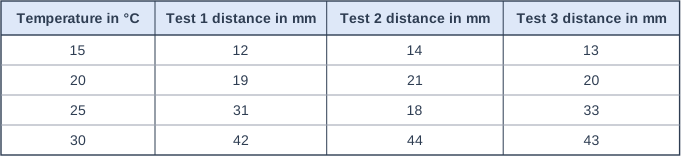
Hana used a respirometer to measure the distance moved by the coloured liquid in 10 minutes at different temperatures. She used the same mass of germinating mung beans each time and did three tests at each temperature.

The table shows her results.

Calculate the mean rate of movement of the coloured liquid at 25 °C, in mm per minute. Do not include the anomalous result.

Table with columns "Temperature in °C", "Test 1 distance in mm", "Test 2 distance in mm", "Test 3 distance in mm". Temperature in °C: 15; Test 1 distance in mm: 12; Test 2 distance in mm: 14; Test 3 distance in mm: 13 | Temperature in °C: 20; Test 1 distance in mm: 19; Test 2 distance in mm: 21; Test 3 distance in mm: 20 | Temperature in °C: 25; Test 1 distance in mm: 31; Test 2 distance in mm: 18; Test 3 distance in mm: 33 | Temperature in °C: 30; Test 1 distance in mm: 42; Test 2 distance in mm: 44; Test 3 distance in mm: 43.

Model answer

The anomalous result at 25 °C is 18 mm, so it is left out.
Mean distance = (31 + 33) ÷ 2 = 32 mm
Mean rate = 32 ÷ 10 = 3.2 mm per minute

Explanation

An anomalous result does not fit the pattern of the repeats (18 mm is far below 31 and 33 mm), so it is left out before the mean is calculated. The rate is the mean distance divided by the time (10 minutes). Common errors are including the anomaly (giving 2.7 mm per minute) or forgetting to divide by the time.

Mark scheme
  1. 1 mark

    (mean distance =) (31 + 33) ÷ 2 = 32 (mm) (1)

    An answer of 3.2 (mm per minute) with no working scores 3 marks. The anomalous result is 18 (mm, test 2). A mean that includes the anomalous result, (31 + 18 + 33) ÷ 3 = 27.3, is a wrong method and scores 0 for this point.

  2. 1 mark

    (rate =) 32 ÷ 10 (1)

    ecf: award this mark for their mean distance correctly divided by 10, e.g. 27.3 ÷ 10 = 2.73.

  3. 1 mark

    3.2 (mm per minute) (1)

    Accept 3.20. Do not accept 2.7 / 2.73 for this mark.

Question 4

4 marks

Callum investigated the effect of temperature on the rate of respiration of germinating peas. This is his method.

- Put some germinating peas into a respirometer (he used a different number of peas at each temperature).
- Heat a beaker of water with a Bunsen burner to the chosen temperature, then turn off the Bunsen burner.
- Stand the respirometer in the beaker of water.
- Measure the distance moved by the coloured liquid in 1 minute.
- Do this once at each temperature: 15 °C, 20 °C, 25 °C and 30 °C.

Explain two improvements Callum could make to his method.

Model answer

First, Callum should use the same mass of germinating peas at each temperature, because a larger mass of peas uses more oxygen, so the mass must be controlled so that only the temperature affects the results.

Second, he should use a thermostatically controlled electric water bath instead of heating a beaker with a Bunsen burner, because once the Bunsen burner is turned off the water cools down, so the peas would not stay at the chosen temperature while he measures.

Explanation

An 'explain two improvements' question needs each improvement and the reason it improves the investigation. Callum's method has several faults: an uncontrolled mass of peas, a temperature that falls as the beaker cools, a very short measuring time and no repeats. Answers such as 'repeat it' with no mean or reason, or 'make it a fair test' without saying which variable, gain little credit.

Mark scheme
  1. 1 mark

    use the same mass of peas at each temperature (1)

    An explanation linking two improvements, each with its reason; max 4. Credit at most two improvements. Accept other valid improvements with a matching reason (1 mark each), e.g. leave the respirometer in the water for a few minutes before timing (1) so that the air in the tube reaches the water temperature and is not expanding or contracting (1). For this point, accept the same number of peas of the same size.

  2. 1 mark

    because the mass of peas affects the volume of oxygen used, so only the temperature should change (1)

    Dependent on the improvement immediately before it. Accept so that it is a fair test / so that the results at different temperatures can be compared, if linked to the mass of peas.

  3. 1 mark

    use a thermostatically controlled (electric) water bath / check and adjust the temperature with a thermometer during the measurement (1)

    Accept keep the water at a constant temperature.

  4. 1 mark

    because the water in the beaker cools down after the Bunsen burner is turned off, so the temperature would not stay at the chosen value (1)

    Dependent on the improvement immediately before it. Accept so that the temperature stays constant during the measurement.

  5. 1 mark

    measure the movement for longer, e.g. 10 minutes (1)

    Accept measure for a set time of several minutes.

  6. 1 mark

    because the drop moves further, so the percentage error in measuring the distance is smaller (1)

    Dependent on the improvement immediately before it. Accept so that the measurement is more accurate / more precise because 1 minute gives a very small movement.

  7. 1 mark

    repeat each temperature (at least three times) and calculate a mean (1)

    Ignore 'repeat it' without a mean or more than once.

  8. 1 mark

    so that anomalous results can be identified (and left out) / so the results are more repeatable (1)

    Dependent on the improvement immediately before it. Accept to make the results more reliable.

Ready to try the rest? Every answer you write is marked against the mark scheme, so you can see exactly where the marks are.

Study Helper Hints first, answers after you try

Stuck on this one? Ask for a hint and I’ll point you in the right direction, without giving the answer away. Once you’ve checked your answer, I’ll show you how the marks are awarded.