
Level:
Correct: 0
Incorrect: 0
Marks: 0/0
Exam Practice
Course:
Topics:
Edexcel GCSE Combined Science (Biology Paper 2) Smart practice A mixed round aimed at your weak spots
Avg
score:
–
Topics
done:
0/30

Aerobic and anaerobic respiration

Practise 14 exam-style questions on Aerobic and anaerobic respiration for Edexcel GCSE Combined Science (Biology Paper 2). Write your answer as you would in the exam and get it marked in seconds against the mark scheme, point by point, with the Study Helper on hand if you get stuck.

  • 14 questions
  • 1–6 marks each
  • Instant marking
  • No sign-up needed
14 questions, marked as you go

Sample questions with model answers

Here are 4 of the questions in this topic, each with a model answer, an explanation of why it earns the marks and the mark scheme an examiner would use.

Question 1

1 mark

Which of these describes cellular respiration in living cells?

Choose your answer.

  • A endothermic, only when active
  • B exothermic, only when active
  • C exothermic, all the time
  • D endothermic, all the time

Model answer

C - exothermic, all the time.

Explanation

Respiration is an exothermic reaction: it releases energy, some of it as heat. It happens continuously in every living cell, because cells always need energy for metabolic processes such as active transport and making new molecules, even when the organism is resting. A common misconception is that respiration only happens during exercise, or (in plants) only at night.

Mark scheme
  1. 1 mark

    C / exothermic, all the time (1)

    The only correct answer is C. A is not correct because respiration releases energy to the surroundings, so it is exothermic, and it happens all the time, not only when the organism is active; B is not correct because, although respiration is exothermic, it happens continuously, even when an organism is resting or asleep; D is not correct because respiration is exothermic, not endothermic. Accept the letter or the option. If more than one option is given, do not award the mark.
Question 2

2 marks

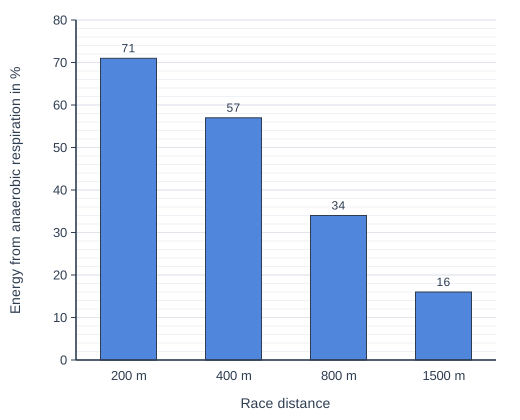
Sports scientists estimated the percentage of the energy for running that came from anaerobic respiration in races of different distances. The bar chart shows their estimates for a group of highly trained athletes.

(Data: Spencer and Gastin, 2001.)

In a 400 m race, one athlete's muscles used 120 kJ of energy released by respiration.

Calculate how much more energy came from anaerobic respiration than from aerobic respiration in this race.

Bar chart of energy from anaerobic respiration in % for each race distance: 200 m 71, 400 m 57, 800 m 34, 1500 m 16.

Model answer

Anaerobic: 57 % of 120 kJ = 0.57 × 120 = 68.4 kJ
Aerobic: 100 − 57 = 43 %, so 0.43 × 120 = 51.6 kJ
Difference = 68.4 − 51.6 = 16.8 kJ

Explanation

Read the anaerobic percentage for the 400 m race (57 %) from the bar chart; the rest of the energy (43 %) came from aerobic respiration. The difference is 14 % of 120 kJ = 16.8 kJ. A common error is to stop after finding the anaerobic energy (68.4 kJ) or to subtract 57 from 120.

Mark scheme
  1. 1 mark

    a correct first step, e.g. (anaerobic =) 0.57 × 120 = 68.4 (kJ) (1)

    award full marks for the correct answer with no working. Accept as the first step: (aerobic =) 0.43 × 120 = 51.6 (kJ), or the difference in percentages 57 − 43 = 14 (%). An answer of 68.4 (kJ) on its own scores 1 mark.

  2. 1 mark

    16.8 (kJ) (1)

    Accept 68.4 − 51.6 = 16.8 / 0.14 × 120 = 16.8. Accept 17 (kJ).

Question 3

3 marks

Bioethanol is a fuel made using yeast. Yeast cells are added to a glucose solution in a large tank. The tank is sealed so that air cannot get in, but it has a valve that lets gas out.

Explain why the tank is sealed so that air cannot get in.

Model answer

Sealing the tank keeps out oxygen, so the yeast cells have to respire anaerobically. Anaerobic respiration in yeast breaks glucose down into ethanol and carbon dioxide; the carbon dioxide escapes through the valve and the ethanol stays in the tank. If oxygen could get in, the yeast would respire aerobically, breaking the glucose down completely to carbon dioxide and water, so no ethanol would be made.

Explanation

Yeast respires aerobically when oxygen is available and anaerobically (fermentation) when it is not. Only anaerobic respiration produces ethanol, so oxygen must be kept out. A common error is to give lactic acid as the product - that is anaerobic respiration in animal cells.

Mark scheme
  1. 1 mark

    (without air there is) no oxygen, so the yeast respire anaerobically (1)

    An explanation linking the three points. Accept the yeast carry out fermentation. Ignore 'to keep the yeast warm' / 'to keep out microorganisms' (not the reason asked for).

  2. 1 mark

    anaerobic respiration in yeast produces ethanol (and carbon dioxide) (1)

    Accept glucose → ethanol + carbon dioxide. Do not accept 'produces lactic acid'.

  3. 1 mark

    if oxygen got in, the yeast would respire aerobically, producing carbon dioxide and water / no ethanol (1)

    Accept with oxygen the glucose would be completely broken down to carbon dioxide and water / less ethanol would be made. Ignore 'oxygen would kill the yeast'.

Question 4

4 marks

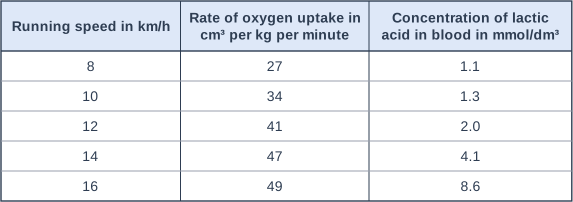
Tomasz did a running test on a treadmill in a sports laboratory. His rate of oxygen uptake and the concentration of lactic acid in his blood were measured at different running speeds. Tomasz ran at each speed for 4 minutes.

The table shows the results.

Explain the changes in the rate of oxygen uptake and in the concentration of lactic acid as Tomasz's running speed increased.

Table with columns "Running speed in km/h", "Rate of oxygen uptake in cm³ per kg per minute", "Concentration of lactic acid in blood in mmol/dm³". Running speed in km/h: 8; Rate of oxygen uptake in cm³ per kg per minute: 27; Concentration of lactic acid in blood in mmol/dm³: 1.1 | Running speed in km/h: 10; Rate of oxygen uptake in cm³ per kg per minute: 34; Concentration of lactic acid in blood in mmol/dm³: 1.3 | Running speed in km/h: 12; Rate of oxygen uptake in cm³ per kg per minute: 41; Concentration of lactic acid in blood in mmol/dm³: 2.0 | Running speed in km/h: 14; Rate of oxygen uptake in cm³ per kg per minute: 47; Concentration of lactic acid in blood in mmol/dm³: 4.1 | Running speed in km/h: 16; Rate of oxygen uptake in cm³ per kg per minute: 49; Concentration of lactic acid in blood in mmol/dm³: 8.6.

Model answer

As Tomasz runs faster, his muscles contract faster and need more energy, so the rate of aerobic respiration increases and his oxygen uptake rises from 27 to 49 cm³ per kg per minute. Between 14 and 16 km/h the oxygen uptake only increases by 2 cm³ per kg per minute, because oxygen cannot be supplied to his muscles any faster. Up to 12 km/h the lactic acid concentration stays low, because nearly all the energy comes from aerobic respiration. Above 12 km/h the lactic acid concentration rises rapidly, from 2.0 to 8.6 mmol/dm³, because aerobic respiration cannot release energy fast enough, so his muscle cells also respire anaerobically, producing lactic acid.

Explanation

Look for the pattern in each column and link it to the type of respiration: oxygen uptake shows aerobic respiration, lactic acid shows anaerobic respiration. When oxygen uptake levels off, the extra energy for faster running must come from anaerobic respiration, so lactic acid builds up. Answers that only describe the numbers, without linking them to respiration, cannot gain full marks.

Mark scheme
  1. 1 mark

    the rate of oxygen uptake increases as speed increases (from 27 to 49 cm³ per kg per minute) (1)

    An explanation linking four from the seven points; max 4. Max 2 for descriptions of the data (points 1, 3, 5 and 6) without any explanation (points 2, 4 or 7).

  2. 1 mark

    because his muscles need more energy (to contract faster), so there is more aerobic respiration (1)

    Accept the rate of aerobic respiration increases. Ignore 'to make / produce more energy'.

  3. 1 mark

    the rate of oxygen uptake levels off / increases only a little between 14 and 16 km/h (1)

    Accept it only increases by 2 cm³ per kg per minute from 14 to 16 km/h.

  4. 1 mark

    (at high speeds) oxygen cannot be supplied to the muscles any faster / his maximum rate of oxygen uptake is reached (1)

    Accept aerobic respiration cannot release energy fast enough (because oxygen is limited).

  5. 1 mark

    the concentration of lactic acid stays low / changes very little up to 10 or 12 km/h (1)

    Accept almost all the energy at low speeds comes from aerobic respiration.

  6. 1 mark

    the concentration of lactic acid increases rapidly above 12 km/h (from 2.0 to 8.6 mmol/dm³) (1)

    Accept it more than quadruples between 12 and 16 km/h.

  7. 1 mark

    because more anaerobic respiration is needed (to release the extra energy), which produces lactic acid (1)

    Accept more of the energy comes from anaerobic respiration. Do not accept 'anaerobic respiration produces lactic acid and carbon dioxide'.

Ready to try the rest? Every answer you write is marked against the mark scheme, so you can see exactly where the marks are.

Study Helper Hints first, answers after you try

Stuck on this one? Ask for a hint and I’ll point you in the right direction, without giving the answer away. Once you’ve checked your answer, I’ll show you how the marks are awarded.