
Level:
Correct: 0
Incorrect: 0
Marks: 0/0
Exam Practice
Course:
Topics:
Edexcel GCSE Combined Science (Biology Paper 2) Smart practice A mixed round aimed at your weak spots
Avg
score:
–
Topics
done:
0/30

Hormones, endocrine glands and adrenalin

Practise 14 exam-style questions on Hormones, endocrine glands and adrenalin for Edexcel GCSE Combined Science (Biology Paper 2). Write your answer as you would in the exam and get it marked in seconds against the mark scheme, point by point, with the Study Helper on hand if you get stuck.

  • 14 questions
  • 1–6 marks each
  • Instant marking
  • No sign-up needed
14 questions, marked as you go

Sample questions with model answers

Here are 4 of the questions in this topic, each with a model answer, an explanation of why it earns the marks and the mark scheme an examiner would use.

Question 1

1 mark

Some endocrine glands release hormones that control the release of hormones from other endocrine glands.

Which gland releases hormones that control several other endocrine glands?

Choose your answer.

  • A pancreas
  • B adrenal gland
  • C thyroid gland
  • D pituitary gland

Model answer

D - pituitary gland

Explanation

The pituitary gland, at the base of the brain, releases hormones such as TSH, which stimulates the thyroid gland, and FSH and LH, which act on the ovaries. Because it controls other glands it is sometimes called the 'master gland'.

Mark scheme
  1. 1 mark

    D / pituitary gland (1)

    The only correct answer is D. A is not correct because the pancreas releases insulin and glucagon, which act mainly on the liver, not on other glands. B is not correct because the adrenal glands release adrenalin, which acts on organs such as the heart and liver. C is not correct because the thyroid gland releases thyroxine, which controls metabolic rate; it is itself controlled by TSH from the pituitary gland. Accept the letter or the option. If more than one option is given, do not award the mark.
Question 2

2 marks

Oestrogen is produced by the ovaries. One of its target organs is the uterus.

Explain why oestrogen is described as a hormone.

Model answer

Oestrogen is a chemical messenger that is produced by an endocrine gland, the ovaries. It is released into the blood and carried in the plasma to its target organ, the uterus, where it has its effect.

Explanation

A hormone is a chemical made by an endocrine gland, released into the blood and carried to target organs, which respond to it. Answers need both the gland and transport in the blood; 'carried by nerves' confuses hormones with nerve impulses.

Mark scheme
  1. 1 mark

    it is a chemical (messenger) produced / released by a (endocrine) gland / the ovaries (1)

    An explanation linking two from the three points; max 2. ignore 'it is made in the body' with no gland

  2. 1 mark

    it is released into / carried in the blood (plasma) (1)

    accept transported in the bloodstream; do not accept carried along nerves

  3. 1 mark

    it acts on / affects a target organ (the uterus) (1)

    accept it causes a response in another part of the body

Question 3

3 marks

A woman has a tumour that has damaged her pituitary gland. Tests show that her thyroid gland and her ovaries are also releasing less of their hormones than normal, although neither of these glands is damaged.

Explain why damage to the pituitary gland reduces hormone release from the thyroid gland and the ovaries.

Model answer

The pituitary gland releases TSH, which is carried in the blood to the thyroid gland and stimulates it to release thyroxine. It also releases FSH and LH, which travel in the blood to the ovaries and stimulate them, for example FSH causes the ovaries to produce oestrogen. With the pituitary gland damaged, less TSH, FSH and LH are released, so the thyroid gland and the ovaries are stimulated less and release less of their hormones.

Explanation

The pituitary gland controls other endocrine glands through the hormones it releases: TSH acts on the thyroid gland, and FSH and LH act on the ovaries. So damage to the pituitary gland reduces the output of glands that are themselves healthy. Confusing TRH (from the hypothalamus) with TSH is a common error.

Mark scheme
  1. 1 mark

    the pituitary gland releases TSH (1)

    An explanation linking three from the four points; max 3. accept thyroid stimulating hormone; do not accept TRH (made in the hypothalamus)

  2. 1 mark

    TSH stimulates the thyroid gland to release thyroxine (so less thyroxine is released) (1)

    accept TSH acts on the thyroid gland

  3. 1 mark

    the pituitary gland releases FSH / LH which stimulate the ovaries (to release oestrogen / progesterone or to mature and release eggs) (1)

    accept FSH stimulates the ovaries to produce oestrogen; accept LH stimulates ovulation

  4. 1 mark

    (pituitary) hormones are carried in the blood to the thyroid gland and ovaries (target organs) / less of these hormones reach the target glands (1)

    accept the thyroid gland and ovaries are target organs of pituitary hormones

Question 4

4 marks

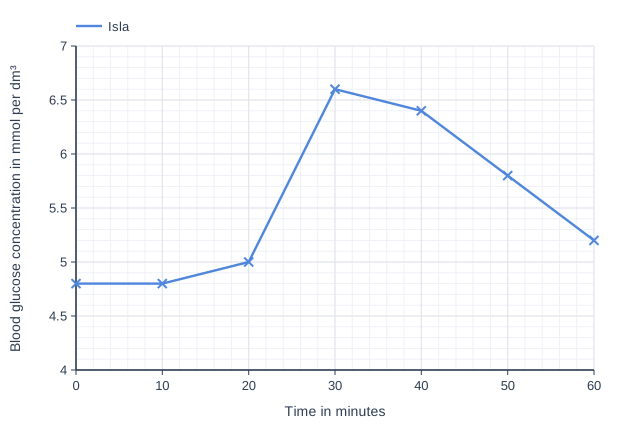
Isla is a violinist. As part of a study, she wore a sensor that measured her blood glucose concentration while she waited to perform in a competition. At 20 minutes she was told that she would play next. She did not eat or drink anything during the hour.

The graph shows her blood glucose concentration.

Calculate the mean rate of increase in her blood glucose concentration between 20 minutes and 30 minutes, in mmol per dm³ per minute.

Explain why her blood glucose concentration increased even though she had not eaten.

Line graph of blood glucose concentration in mmol per dm³ (y-axis, 4 to 7) against time in minutes (x-axis, 0 to 60). "Isla" joins the points (0, 4.8), (10, 4.8), (20, 5), (30, 6.6), (40, 6.4), (50, 5.8), (60, 5.2).

Model answer

Rate of increase = (6.6 - 5.0) ÷ (30 - 20) = 1.6 ÷ 10 = 0.16 mmol per dm³ per minute
Isla was nervous about performing, so her adrenal glands released adrenalin. Adrenalin stimulates the liver to convert stored glycogen into glucose, which is released into the blood, so her blood glucose concentration rose even though she had not eaten.

Explanation

Rate = change in concentration ÷ time taken, using the values at 20 and 30 minutes read from the graph; dividing the time by the change is a common error. The rise without food comes from the liver: adrenalin causes it to break down glycogen into glucose and release it into the blood, providing glucose for respiration in the muscles. Mixing up glycogen, glucose and glucagon is a very common error.

Mark scheme
  1. 1 mark

    (6.6 - 5.0) ÷ (30 - 20) / 1.6 ÷ 10 (1)

    An answer of 0.16 mmol per dm³ per minute with no working scores marking points 1 and 2; the correct change in concentration, 1.6 (mmol per dm³), seen scores this point

  2. 1 mark

    0.16 (mmol per dm³ per minute) (1)

    do not accept 6.25 (10 ÷ 1.6, time divided by the change - a wrong method scores 0) or 0.18 (using 4.8 at 0 minutes instead of the value at 20 minutes - scores 0); award 1 mark for an answer with a power of ten error, e.g. 0.016

  3. 1 mark

    (she was nervous / stressed so) adrenalin was released (by the adrenal glands) (1)

    Points 3, 4 and 5: max 2. do not accept adrenaline produced by the kidneys

  4. 1 mark

    adrenalin stimulates the liver to convert glycogen into glucose (1)

    accept glycogen is broken down into glucose in the liver; do not accept glucose converted into glycogen; do not accept 'glucagon' for glycogen

  5. 1 mark

    the glucose is released into the blood (1)

    accept so blood glucose concentration rises

Ready to try the rest? Every answer you write is marked against the mark scheme, so you can see exactly where the marks are.

Study Helper Hints first, answers after you try

Stuck on this one? Ask for a hint and I’ll point you in the right direction, without giving the answer away. Once you’ve checked your answer, I’ll show you how the marks are awarded.