
Level:
Correct: 0
Incorrect: 0
Marks: 0/0
Exam Practice
Course:
Topics:
Edexcel GCSE Combined Science (Biology Paper 2) Smart practice A mixed round aimed at your weak spots
Avg
score:
–
Topics
done:
0/30

Blood and blood vessels

Practise 15 exam-style questions on Blood and blood vessels for Edexcel GCSE Combined Science (Biology Paper 2). Write your answer as you would in the exam and get it marked in seconds against the mark scheme, point by point, with the Study Helper on hand if you get stuck.

  • 15 questions
  • 1–6 marks each
  • Instant marking
  • No sign-up needed
15 questions, marked as you go

Sample questions with model answers

Here are 4 of the questions in this topic, each with a model answer, an explanation of why it earns the marks and the mark scheme an examiner would use.

Question 1

1 mark

Red blood cells have several adaptations for carrying oxygen.

Which adaptation gives a red blood cell a large surface area for oxygen to diffuse into the cell?

Choose your answer.

  • A haemoglobin
  • B no nucleus
  • C a biconcave shape
  • D a flexible membrane

Model answer

C a biconcave shape

Explanation

A red blood cell is a disc that is thinner in the middle than at the edge (biconcave). This shape gives it a large surface area compared with its volume, so oxygen diffuses in and out quickly, and no part of the cell is far from the surface. The other options are real adaptations of red blood cells but do different jobs.

Mark scheme
  1. 1 mark

    C / a biconcave shape (1)

    The only correct answer is C. A is not correct because haemoglobin is the protein that binds to oxygen, not a feature of the cell's shape; B is not correct because having no nucleus gives more room for haemoglobin, not a larger surface; D is not correct because a flexible membrane lets the cell squeeze through narrow capillaries. Accept the letter or the option. If more than one option is given, do not award the mark.
Question 2

2 marks

Platelets are small fragments of cells found in the blood.

A person with a low platelet count bruises easily, and small cuts on their skin bleed for a long time.

Explain why.

Model answer

Platelets help the blood to clot at a wound. With fewer platelets, clots form more slowly, so blood keeps leaking from damaged blood vessels - out of a cut, or under the skin, where it forms a bruise.

Explanation

When a blood vessel is damaged, platelets collect at the site and help to form a clot that seals it. A low platelet count means clotting is slower, so even small injuries bleed for longer. A common error is to confuse platelets with white blood cells, which defend against pathogens.

Mark scheme
  1. 1 mark

    platelets help the blood to clot (1)

    An explanation linking the two points. Accept 'platelets form a plug / clot at a wound'. Reject 'platelets fight infection'.

  2. 1 mark

    so with fewer platelets clots form more slowly / bleeding (from damaged blood vessels) does not stop quickly (1)

    Accept 'blood leaks out of damaged blood vessels under the skin for longer, causing bruises'. Ignore 'the blood is thinner'.

Question 3

3 marks

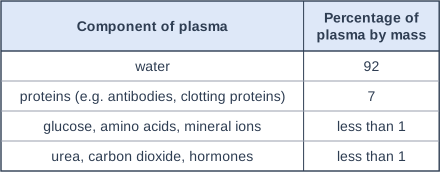
Plasma is the liquid part of the blood. The table shows the typical composition of human blood plasma.

Explain how the composition of plasma is related to its function. Use information from the table in your answer.

Table with columns "Component of plasma", "Percentage of plasma by mass". Component of plasma: water; Percentage of plasma by mass: 92 | Component of plasma: proteins (e.g. antibodies, clotting proteins); Percentage of plasma by mass: 7 | Component of plasma: glucose, amino acids, mineral ions; Percentage of plasma by mass: less than 1 | Component of plasma: urea, carbon dioxide, hormones; Percentage of plasma by mass: less than 1.

Model answer

Plasma is 92% water, so many substances can dissolve in it and be carried around the body in solution. For example, dissolved glucose and amino acids are carried from the small intestine to the body's cells, and the waste product urea is carried from the liver to the kidneys. The 7% proteins include antibodies, which help to defend the body against pathogens.

Explanation

The function of plasma is transport, and it can transport substances because it is mostly water, which acts as a solvent. Each mark needs a link between something in the table and what it is transported for, or where it is taken. A common error is to list the substances without saying what plasma does with them.

Mark scheme
  1. 1 mark

    plasma is mostly water (92%), so substances can dissolve in it (1)

    An explanation including three from the eight points; max 3. Accept 'water is a solvent'. Ignore '92% water' without a link to dissolving or carrying.

  2. 1 mark

    (dissolved) glucose / amino acids are transported (from the small intestine) to the (body) cells (1)

    Accept 'carries dissolved food molecules to cells for respiration / growth'.

  3. 1 mark

    (dissolved) urea is transported (from the liver) to the kidneys (1)

    Reject 'urea to the lungs'. Ignore 'carries waste' unqualified.

  4. 1 mark

    (dissolved) carbon dioxide is transported (from the body cells) to the lungs (1)

    Reject 'carbon dioxide to the kidneys'.

  5. 1 mark

    hormones are transported (from glands) to their target organs (1)

    Accept a named hormone, e.g. insulin to the liver.

  6. 1 mark

    the proteins include antibodies, which (bind to pathogens and) help to defend the body (against disease) (1)

    Reject 'antibodies engulf pathogens'.

  7. 1 mark

    the proteins include clotting proteins, which help the blood to clot (at a wound) (1)

    Accept 'clotting proteins help platelets to form a clot'.

  8. 1 mark

    plasma is a liquid, so it flows and carries the blood cells and platelets around the body (1)

    Accept 'red blood cells, white blood cells and platelets are suspended in plasma'.

Question 4

4 marks

In sickle cell disease, many red blood cells are crescent-shaped (sickle-shaped) instead of being biconcave discs. Sickle cells are stiff and sticky. They are destroyed after about 10 to 20 days, instead of about 120 days for normal red blood cells.

Explain two reasons why the tissues of a person with sickle cell disease may not receive enough oxygen.

Model answer

Sickle cells are stiff and sticky, so they cannot squeeze through narrow capillaries and can block them. Less blood then flows to the tissues beyond the blockage, so the cells there do not receive enough oxygen.
Sickle cells are also destroyed after only 10 to 20 days, much faster than they can be replaced, so the person has fewer red blood cells. There is less haemoglobin in the blood, so less oxygen is carried to the tissues.

Explanation

Normal red blood cells are flexible discs that bend to pass through capillaries narrower than themselves, and they last about 120 days. The two problems in the question are the stiff, sticky cells blocking capillaries and the shortened life of the cells causing anaemia; each mark pair needs the reason and its effect on oxygen supply. References to the surface area of sickle cells are not needed and are ignored.

Mark scheme
  1. 1 mark

    sickle cells cannot squeeze / bend through (narrow) capillaries / they stick together and block capillaries (1)

    An explanation linking two reasons, each with its consequence; max 2 for each reason; max 4. Accept 'they are not flexible, so they get stuck in small blood vessels'. Ignore references to the surface area of sickle cells.

  2. 1 mark

    so less blood flows to the tissues / less oxygen is delivered to the cells beyond the blockage (1)

    Linked to the blocking of capillaries. Accept 'cells beyond the blockage are starved of oxygen'.

  3. 1 mark

    sickle cells are destroyed quickly, so the person has fewer red blood cells (anaemia) (1)

    Accept 'red blood cells are not replaced fast enough, so there are fewer of them'.

  4. 1 mark

    so there is less haemoglobin / the blood carries less oxygen (1)

    Linked to fewer red blood cells. Accept 'less oxygen can be transported'.

Ready to try the rest? Every answer you write is marked against the mark scheme, so you can see exactly where the marks are.

Study Helper Hints first, answers after you try

Stuck on this one? Ask for a hint and I’ll point you in the right direction, without giving the answer away. Once you’ve checked your answer, I’ll show you how the marks are awarded.