
Level:
Correct: 0
Incorrect: 0
Marks: 0/0
Exam Practice
Course:
Topics:
Edexcel GCSE Combined Science (Biology Paper 2) Smart practice A mixed round aimed at your weak spots
Avg
score:
–
Topics
done:
0/30

Core practical: quadrats and belt transects

Practise 16 exam-style questions on Core practical: quadrats and belt transects for Edexcel GCSE Combined Science (Biology Paper 2). Write your answer as you would in the exam and get it marked in seconds against the mark scheme, point by point, with the Study Helper on hand if you get stuck.

  • 16 questions
  • 1–6 marks each
  • Instant marking
  • No sign-up needed
16 questions, marked as you go

Sample questions with model answers

Here are 4 of the questions in this topic, each with a model answer, an explanation of why it earns the marks and the mark scheme an examiner would use.

Question 1

1 mark

During a field investigation, a student found some plants in her quadrats that she could not name.

Give one way she could identify these plants.

Model answer

She could use an identification key for wild plants, answering questions about the features of each plant until she reaches its name.

Explanation

Correct identification is part of the core practical: a key, a field guide or an app lets the student match the plant's features to a species. Pearson's June 2024 examiners' report noted that very few candidates suggested using a key, so it is worth remembering.

Mark scheme
  1. 1 mark

    use an identification key / a field guide / an identification chart (1)

    Any one from the five points; max 1. Accept 'dichotomous key'.

  2. 1 mark

    compare the plants with photographs / drawings (in a book or on a website) (1)

  3. 1 mark

    use a plant identification app (on a phone) (1)

  4. 1 mark

    ask an expert / the teacher / a botanist (1)

  5. 1 mark

    take a photograph / a small sample such as one leaf to identify the plant later (1)

    Do not accept 'use a quadrat', 'use a microscope' or 'dig up the plant' alone.
Question 2

2 marks

When counting plants in a quadrat, a student finds that some plants are only partly inside the quadrat.

Suggest a rule the student could use for counting these plants and explain why a rule is needed.

Model answer

She could count a plant only if more than half of it is inside the quadrat. A rule is needed so that the plants are counted in the same way in every quadrat, so the results are consistent and can be compared, and plants are not counted twice if quadrats are next to each other.

Explanation

Without a fixed rule, decisions about plants on the edge would vary between quadrats and between people, making the results less repeatable. Any rule is acceptable if it is applied in the same way every time.

Mark scheme
  1. 1 mark

    count a plant only if more than half of it is inside the quadrat / count plants touching two chosen sides (e.g. top and left) but not the other two / count a plant only if its base / stem is inside (1)

    Rule 1 mark + reason 1 mark. Accept any clear rule that would be applied the same way every time. Do not accept 'count all of them' or 'ignore all of them' with no reason.

  2. 1 mark

    so that plants are counted in the same way in every quadrat / plants are not counted twice / the results are repeatable / can be compared (1)

    Accept 'so that the counts are consistent' or 'so different students count the same number'.

Question 3

3 marks

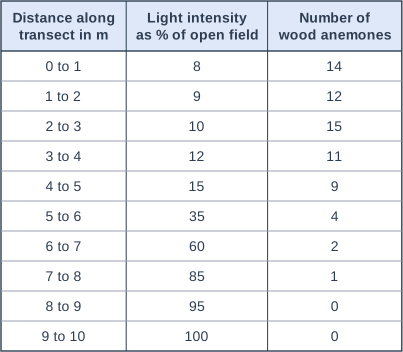
A student set up a belt transect 10 m long from the shaded edge of a wood into an open field. She placed ten 1 m × 1 m quadrats side by side along it and counted the wood anemone plants in each. She also measured the light intensity in each quadrat.

The table shows her results.

The student concluded: 'Wood anemones grow better in low light intensity than in high light intensity.'

Evaluate the student's conclusion.

Table with columns "Distance along transect in m", "Light intensity as % of open field", "Number of wood anemones". Distance along transect in m: 0 to 1; Light intensity as % of open field: 8; Number of wood anemones: 14 | Distance along transect in m: 1 to 2; Light intensity as % of open field: 9; Number of wood anemones: 12 | Distance along transect in m: 2 to 3; Light intensity as % of open field: 10; Number of wood anemones: 15 | Distance along transect in m: 3 to 4; Light intensity as % of open field: 12; Number of wood anemones: 11 | Distance along transect in m: 4 to 5; Light intensity as % of open field: 15; Number of wood anemones: 9 | Distance along transect in m: 5 to 6; Light intensity as % of open field: 35; Number of wood anemones: 4 | Distance along transect in m: 6 to 7; Light intensity as % of open field: 60; Number of wood anemones: 2 | Distance along transect in m: 7 to 8; Light intensity as % of open field: 85; Number of wood anemones: 1 | Distance along transect in m: 8 to 9; Light intensity as % of open field: 95; Number of wood anemones: 0 | Distance along transect in m: 9 to 10; Light intensity as % of open field: 100; Number of wood anemones: 0.

Model answer

The data support the conclusion to some extent: there were 9 to 15 wood anemones in each quadrat where the light intensity was 8 to 15 % of the open field, but only 0 to 2 where it was 60 to 100 %. However, this is only a correlation. Other factors also change from the edge of the wood into the field, such as soil moisture, temperature and competition from grasses, and any of these could explain the pattern. The student also counted the plants rather than measuring how well they grew, and she used only one transect, so the conclusion is not fully supported.

Explanation

To evaluate a conclusion, say what in the data supports it and then what limits it. Here the numbers fall as light intensity rises, but a transect shows only a correlation, other factors change along the same gradient, and counting plants does not measure how well they grow. Saying only that the results are not reliable, without a reason, does not score.

Mark scheme
  1. 1 mark

    (supports) the most wood anemones were in the quadrats with the lowest light intensity (9 to 15 at 8 to 15 %) and few or none in the brightest quadrats (0 to 2 at 60 to 100 %) (1)

    Any three from the five points; max 3. Max 2 if the answer gives no evidence from the table that supports the conclusion (point 1). Accept as light intensity increases the number of wood anemones decreases, with correct data.

  2. 1 mark

    but this is only a correlation, so it does not show that the low light intensity causes the difference (1)

    accept correlation does not prove cause

  3. 1 mark

    other factors also change along the transect, e.g. soil moisture / soil pH / soil nutrients / temperature / competition from grasses / grazing / trampling (1)

    a named factor is needed; ignore other variables with none named

  4. 1 mark

    only one transect was used / the transect was not repeated, so the results may not be typical of the edge of the wood (1)

    do not accept the results are not reliable with no reason

  5. 1 mark

    the student counted the plants but did not measure how well they grew (e.g. their size, mass or number of flowers), so 'grow better' was not tested (1)

    accept the number of plants is not the same as how well they grow

Question 4

5 marks

Ground beetles live among dead leaves on the floor of woodlands.

An ecologist used pitfall traps to estimate the population of one species of ground beetle in a small wood. On the first night she caught 36 beetles. She marked each beetle with a small dot of non-toxic paint on the underside of its body and released them where they were caught. Two nights later she trapped 45 beetles, of which 9 were marked.

The ecologist used this equation to estimate the size of the population:

estimated population = (number marked in first sample × number caught in second sample) ÷ number of marked beetles in second sample

Calculate the estimated population of ground beetles in the wood.

The ecologist put the paint on the underside of each beetle so that birds would not see it. Explain how the estimate would be affected if the paint made the marked beetles easier for birds to see.

Model answer

Estimated population = 36 × 45 ÷ 9 = 180 beetles

If the paint made the marked beetles easier to see, more of them would be eaten by birds than unmarked beetles. Then fewer marked beetles would be caught in the second sample, so the number of marked beetles in the second sample would be lower. Because this number is the divisor in the equation, the estimated population would be too high.

Explanation

Mark-release-recapture assumes that marked animals mix back into the population and survive as well as unmarked ones. If marking makes animals more likely to be eaten, fewer are recaptured, the divisor gets smaller and the population is overestimated. Common errors are multiplying or dividing the wrong numbers, and saying only that the estimate is 'inaccurate' without saying whether it is too high or too low.

Mark scheme
  1. 1 mark

    36 × 45 ÷ 9 (1)

    Calculation 2 marks + explanation 3 marks. An answer of 180 beetles with no working scores marking points 1 and 2.

  2. 1 mark

    180 (beetles) (1)

    Do not accept 7.2 (36 × 9 ÷ 45) or 11.25 (45 × 9 ÷ 36) - these are wrong methods.

  3. 1 mark

    (more of) the marked beetles would be eaten by birds / marked beetles would be less likely to survive than unmarked ones (1)

    An explanation linking the three points.

  4. 1 mark

    so fewer marked beetles would be caught in the second sample / the proportion of marked beetles in the second sample would be lower (1)

    Accept 'fewer recaptured beetles'.

  5. 1 mark

    so the estimate of the population would be too high / an overestimate (1)

    Accept 'the number dividing in the equation would be smaller, so the answer would be bigger'. Do not accept 'the estimate would be too low' or 'the estimate would be inaccurate' with no direction.

Ready to try the rest? Every answer you write is marked against the mark scheme, so you can see exactly where the marks are.

Study Helper Hints first, answers after you try

Stuck on this one? Ask for a hint and I’ll point you in the right direction, without giving the answer away. Once you’ve checked your answer, I’ll show you how the marks are awarded.