Level:
Correct: 0
Incorrect: 0
Marks: 0/0
Exam Practice
Course:
Topics:
Edexcel GCSE Combined Science (Biology Paper 2) Smart practice A mixed round aimed at your weak spots
Avg
score:
–
Topics
done:
0/30

Effect of pH on enzymes, rates and catalysis

Practise 13 exam-style questions on Effect of pH on enzymes, rates and catalysis for Edexcel GCSE Combined Science (Biology Paper 2). Write your answer as you would in the exam and get it marked in seconds against the mark scheme, point by point, with the Study Helper on hand if you get stuck.

  • 13 questions
  • 1–6 marks each
  • Instant marking
  • No sign-up needed
13 questions, marked as you go

Sample questions with model answers

Here are 4 of the questions in this topic, each with a model answer, an explanation of why it earns the marks and the mark scheme an examiner would use.

Question 1

1 mark

A student measured the mass of glucose produced by an enzyme-controlled reaction in a measured time.

Which unit could be used for the mean rate of this reaction?

Choose your answer.

  • A g/s
  • B g
  • C s
  • D s/g

Model answer

A - g/s.

Explanation

Mean rate = amount of product made (or substrate used) ÷ time, so its unit is the unit of the amount divided by the unit of time, here grams per second (g/s, also written g s⁻¹). Writing the units the wrong way round (s/g) is a common error.

Mark scheme
  1. 1 mark

    A / g/s (1)

    The only correct answer is A: mean rate = mass of product ÷ time, so the unit is g ÷ s = g/s. B is not correct because g is the unit of the mass produced, not of the rate; C is not correct because s is the unit of time; D is not correct because s/g is time divided by mass, the inverse of a rate. Accept the letter or the option. If more than one option is given, do not award the mark.
Question 2

2 marks

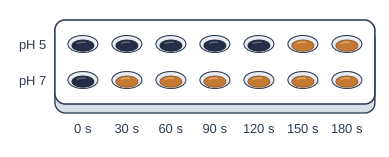
Jasmine mixed amylase with starch at pH 5 and at pH 7. For each mixture, she put one drop into iodine solution on a spotting tile straight after mixing (0 s), then one more drop every 30 s.

The diagram shows her spotting tile. A blue-black well means that starch was still present.

Explain why Jasmine cannot find how long the amylase took to break down the starch at pH 7.

Suggest one change to the method so that this time can be found.

Diagram of a spotting tile with drops of iodine solution. A white spotting tile with 2 rows of 7 small hollows (wells), seen from slightly above. Each hollow is empty or holds a drop of iodine solution coloured orange-brown or blue-black; from left to right, row 1 (labelled "pH 5"): blue-black, blue-black, blue-black, blue-black, blue-black, orange-brown, orange-brown; row 2 (labelled "pH 7"): blue-black, orange-brown, orange-brown, orange-brown, orange-brown, orange-brown, orange-brown. The columns are labelled, from left to right: "0 s", "30 s", "60 s", "90 s", "120 s", "150 s" and "180 s".

Model answer

At pH 7 the iodine was already orange-brown in the 30 s sample, so all the starch had been broken down at some time between 0 s and 30 s. The student only knows that the time was less than 30 s, so it cannot be measured. The student should take samples more often, for example every 5 seconds, so that the end point can be seen.

Explanation

The time taken is the time of the first sample with no starch, so the reaction must still be going on when sampling starts and the interval must be short compared with the reaction time. At pH 7, near the optimum, the reaction finished before the first 30 s sample. Sampling more often, or slowing the reaction by using less amylase or more starch, lets the end point be found.

Mark scheme
  1. 1 mark

    at pH 7 all the starch had been broken down by the first sample after mixing / by 30 s, so the time is only known to be less than 30 s (1)

    1 mark for the explanation (point 1) and 1 mark for one change (point 2 or point 3); max 2. accept the iodine was already orange-brown at 30 s, so the end point was missed / happened between 0 s and 30 s

  2. 1 mark

    take samples more often, e.g. every 5 or 10 seconds (1)

    accept any stated interval shorter than 30 s; ignore 'take more samples' unless it is clear they are more frequent

  3. 1 mark

    use a lower concentration of amylase / a higher concentration of starch, so that the reaction takes longer (1)

    accept use less amylase / more starch (so the reaction is slower); ignore 'use a different pH'

Question 3

3 marks

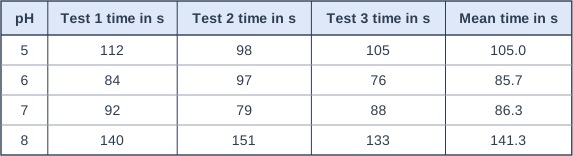
A student timed how long amylase took to break down starch at four pH values. Each test was done three times.

The table shows the results.

The student concluded that the optimum pH of this amylase is pH 6.

Comment on the student's conclusion.

Table with columns "pH", "Test 1 time in s", "Test 2 time in s", "Test 3 time in s", "Mean time in s". pH: 5; Test 1 time in s: 112; Test 2 time in s: 98; Test 3 time in s: 105; Mean time in s: 105.0 | pH: 6; Test 1 time in s: 84; Test 2 time in s: 97; Test 3 time in s: 76; Mean time in s: 85.7 | pH: 7; Test 1 time in s: 92; Test 2 time in s: 79; Test 3 time in s: 88; Mean time in s: 86.3 | pH: 8; Test 1 time in s: 140; Test 2 time in s: 151; Test 3 time in s: 133; Mean time in s: 141.3.

Model answer

pH 6 has the shortest mean time (85.7 s), so the data do support the conclusion to some extent. However, the mean time at pH 7 (86.3 s) is only 0.6 s longer, and the repeat results at pH 6 (76 to 97 s) and pH 7 (79 to 92 s) overlap, so the difference between the means could be caused by random error. The optimum pH could be anywhere between pH 6 and pH 7, so the student should test pH values between 6 and 7, such as 6.2, 6.4, 6.6 and 6.8, with more repeats, before deciding the optimum.

Explanation

To judge a conclusion, compare the size of a difference with the spread of the repeat results: if the ranges overlap, the difference may not be real. Here pH 6 and pH 7 are almost the same, and only whole-number pH values were tested, so the optimum may lie between them. A common error is to accept a conclusion just because one mean is the smallest.

Mark scheme
  1. 1 mark

    pH 6 has the shortest mean time (85.7 s), which supports the conclusion (1)

    Any three from the four points; max 3. accept pH 6 has the fastest (mean) rate

  2. 1 mark

    but the mean time at pH 7 (86.3 s) is almost the same / is only 0.6 s longer (1)

    accept the means at pH 6 and pH 7 are very similar; accept a difference of 0.6 s or 0.7 s

  3. 1 mark

    the ranges of the repeats at pH 6 (76 to 97 s) and pH 7 (79 to 92 s) overlap / the repeats vary by much more than the difference between the means, so the difference may be due to (random) error (1)

    accept the results at pH 6 are spread out / not repeatable (range 21 s), so the difference is not significant

  4. 1 mark

    so the optimum could be anywhere between pH 6 and pH 7 / the student should test pH values between 6 and 7 (e.g. 6.2, 6.4, 6.6, 6.8) (1)

    accept only whole-number pH values were tested, so the optimum could be between them; accept do more repeats at pH 6 and pH 7

Question 4

4 marks

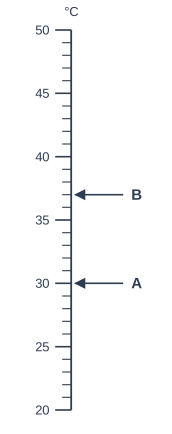
Ravi is investigating the effect of pH on amylase. His test tube of starch, buffer and amylase stands in a beaker of water heated by a Bunsen burner. He wants to keep the water at 30 °C.

The diagram shows the scale of the thermometer in the beaker of water. Arrow A shows the reading at the start of his test at pH 6 and arrow B shows the reading at the end of the test.

Give the change in temperature during the test.

Explain how this change could affect Ravi's result at pH 6, and suggest how he could stop the change happening.

A vertical scale from 20 to 50 °C, divided into 6 equal parts by long marks, each split into 5 small divisions by short marks. Every long mark is numbered (20, 25, 30, 35, 40, 45 and 50). An arrow labelled A points to a mark on the scale. An arrow labelled B points to a mark on the scale.

Model answer

The temperature rose from 30 °C to 37 °C, an increase of 7 °C.

At the higher temperature the amylase and starch molecules have more kinetic energy, so they collide more often and more enzyme-substrate complexes form each second. The starch is broken down faster, so the time Ravi records at pH 6 would be shorter than it should be, and it could not be compared fairly with his results at the other pH values, because temperature as well as pH has changed.

Ravi should watch the thermometer and move the Bunsen burner away when the temperature rises above 30 °C, heating the water gently again if it falls below 30 °C.

Explanation

Temperature is a control variable in the pH core practical because it affects enzyme activity; the Bunsen burner and beaker of water are used to hold it constant. If the water warms up during a test, the enzyme works faster and the time for that pH is too short, so the pH comparison is no longer valid. Vague answers such as 'control the temperature' need a practical method to gain the last mark.

Mark scheme
  1. 1 mark

    (an increase of) 7 (°C) (1)

    accept +7 / 7 degrees; accept readings of 30 °C and 37 °C with the change given as 7

  2. 1 mark

    the higher temperature gives the (enzyme and starch) molecules more kinetic energy, so there are more collisions / more enzyme-substrate complexes form, so the starch is broken down faster (1)

    ignore 'the enzyme works better' without a reason; do not accept the amylase is denatured (37 °C is not a high enough temperature to denature it)

  3. 1 mark

    so the time recorded at pH 6 would be shorter than it should be / the result could not be compared fairly with the results at other pH values (1)

    accept the result is not valid because pH is not the only variable that changed / temperature was not controlled

  4. 1 mark

    watch the thermometer and move the Bunsen burner away / turn it down when the temperature rises above 30 °C, and heat again when it falls below 30 °C (1)

    accept add cold water to bring the temperature back to 30 °C; accept use a thermostatically controlled (electric) water bath; ignore 'control the temperature' / 'keep it at 30 °C' with no method

Ready to try the rest? Every answer you write is marked against the mark scheme, so you can see exactly where the marks are.

Study Helper Hints first, answers after you try

Stuck on this one? Ask for a hint and I’ll point you in the right direction, without giving the answer away. Once you’ve checked your answer, I’ll show you how the marks are awarded.