
Level:
Correct: 0
Incorrect: 0
Marks: 0/0
Exam Practice
Course:
Topics:
Edexcel GCSE Combined Science (Biology Paper 2) Smart practice A mixed round aimed at your weak spots
Avg
score:
–
Topics
done:
0/30

Nitrates and the nitrogen cycle

Practise 12 exam-style questions on Nitrates and the nitrogen cycle for Edexcel GCSE Combined Science (Biology Paper 2). Write your answer as you would in the exam and get it marked in seconds against the mark scheme, point by point, with the Study Helper on hand if you get stuck.

  • 12 questions
  • 1–6 marks each
  • Instant marking
  • No sign-up needed
12 questions, marked as you go

Sample questions with model answers

Here are 4 of the questions in this topic, each with a model answer, an explanation of why it earns the marks and the mark scheme an examiner would use.

Question 1

1 mark

Bacteria in the soil are important in the nitrogen cycle.

Which conversion is carried out by nitrifying bacteria?

Choose your answer.

  • A nitrates → nitrogen gas
  • B nitrogen gas → ammonia
  • C proteins → ammonia
  • D ammonia → nitrates

Model answer

D - ammonia → nitrates.

Explanation

Nitrifying bacteria convert ammonia (ammonium compounds) into nitrites and then into nitrates, which plants can absorb. They need oxygen, so they work best in well-aerated soil. The other conversions are done by denitrifying bacteria, nitrogen-fixing bacteria and decomposers.

Mark scheme
  1. 1 mark

    D / ammonia → nitrates (1)

    The only correct answer is D. A is not correct because converting nitrates into nitrogen gas is done by denitrifying bacteria; B is not correct because converting nitrogen gas into ammonia is nitrogen fixation, done by nitrogen-fixing bacteria; C is not correct because breaking down proteins (in dead organisms and waste) into ammonia is done by decomposers. Accept the letter or the option. If more than one option is given, do not award the mark.
Question 2

2 marks

A farmer's crop is short of nitrates and needs them quickly.

Explain why the farmer should use an artificial fertiliser containing nitrates rather than spreading manure.

Model answer

The artificial fertiliser already contains nitrates, which dissolve in the soil water and can be absorbed by the roots straight away. The nitrogen in manure is in proteins and urea; these must first be broken down to ammonia by decomposers and then converted into nitrates by nitrifying bacteria, which takes time, so manure releases nitrates too slowly.

Explanation

Both are fertilisers, but they make nitrates available in different ways: artificial fertilisers supply nitrates (or ammonium compounds) directly, while manure supplies organic nitrogen that bacteria must convert to nitrates first. The question asks about speed, so the answer must link the bacterial steps to the time taken.

Mark scheme
  1. 1 mark

    the nitrates in the artificial fertiliser dissolve in the soil water and can be absorbed by the roots straight away (1)

    An explanation linking the two points. Accept the fertiliser already contains nitrates, which plants can take up immediately.

  2. 1 mark

    the nitrogen in manure is in proteins / urea, which must first be broken down by decomposers (to ammonia) and converted to nitrates by nitrifying bacteria, which takes time (1)

    Accept manure must be decomposed and nitrified before plants can use it, so it releases nitrates slowly. Ignore 'manure smells' / references to cost.

Question 3

3 marks

Ammonium nitrate is a fertiliser. It contains 35 % nitrogen by mass.

A farmer wants to add 140 kg of nitrogen to each hectare of a field. The field has an area of 6.0 hectares.

Calculate the mass of ammonium nitrate the farmer needs for the whole field.

Model answer

Nitrogen needed for the field = 140 kg × 6.0 = 840 kg
35 % of the mass of ammonium nitrate is nitrogen, so mass of ammonium nitrate = 840 ÷ 0.35 = 2400 kg

Explanation

First find the total mass of nitrogen needed, then work backwards from the percentage: if 35 % of the fertiliser is nitrogen, the mass of fertiliser is the mass of nitrogen divided by 0.35. A common error is to multiply by 0.35 (giving 294 kg), which would supply only about a third of the nitrogen needed.

Mark scheme
  1. 1 mark

    (nitrogen needed =) 140 × 6.0 = 840 (kg) (1)

    An answer of 2400 (kg) with no working scores 3 marks. Alternative order: (fertiliser per hectare =) 140 ÷ 0.35 = 400 (kg) (1), then 400 × 6.0 (1) = 2400 (kg) (1).

  2. 1 mark

    (mass of ammonium nitrate =) 840 ÷ 0.35 / 840 × 100 ÷ 35 (1)

    ecf from an incorrect mass of nitrogen. Multiplying by 0.35 (840 × 0.35 = 294) is a wrong method and scores 0 for this point and the next.

  3. 1 mark

    2400 (kg) (1)

    Accept 2.4 tonnes / 2.4 × 10³ kg.

Question 4

4 marks

A farmer uses a four-year crop rotation:

- year 1 wheat
- year 2 barley
- year 3 clover (at the end of year 3 the clover is ploughed into the soil)
- year 4 potatoes.

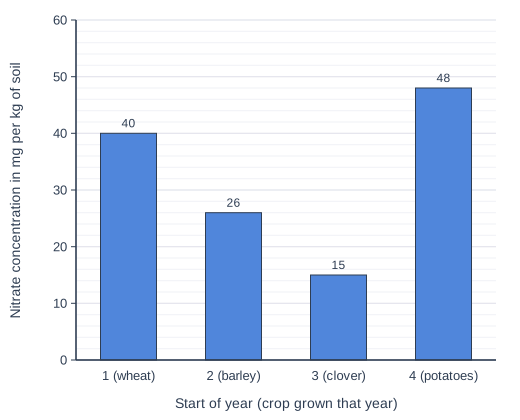
The farmer measured the concentration of nitrates in the soil at the start of each year, before the crop was planted. No fertiliser was used.

The bar chart shows the results.

Explain the changes in the concentration of nitrates in the soil.

Bar chart of nitrate concentration in mg per kg of soil for each start of year (crop grown that year): 1 (wheat) 40, 2 (barley) 26, 3 (clover) 15, 4 (potatoes) 48.

Model answer

From the start of year 1 to the start of year 3 the nitrate concentration falls from 40 to 15 mg per kg, because the wheat and barley absorb nitrates to make proteins and the crops are harvested and removed, and these crops add no nitrogen. Clover is a legume: its root nodules contain nitrogen-fixing bacteria, which convert nitrogen gas from the air into ammonium compounds. When the clover is ploughed in at the end of year 3, decomposers break down its proteins into ammonia, and nitrifying bacteria convert the ammonia into nitrates. So the nitrate concentration rises to 48 mg per kg at the start of year 4, ready for the potatoes, without any fertiliser.

Explanation

The data show the purpose of crop rotation: cereal crops remove nitrates, and a legume crop restores them. A full explanation needs the nitrogen-fixing bacteria in the clover's root nodules and the decomposers and nitrifying bacteria that turn the ploughed-in clover into nitrates. Many students wrongly say that the clover plant itself fixes nitrogen, or that rotation works by 'resting' the soil.

Mark scheme
  1. 1 mark

    the nitrate concentration falls from the start of year 1 to the start of year 3 (40 to 15 mg per kg) (1)

    An explanation linking four from the six points; max 4. Max 1 for descriptions of the data without explanation.

  2. 1 mark

    because the wheat and barley absorb nitrates (to make proteins) and (the nitrogen in) the crop is removed at harvest (1)

    Accept wheat and barley use up the nitrates and do not add any. Accept nitrates are leached from the soil.

  3. 1 mark

    clover is a legume with nitrogen-fixing bacteria in its root nodules (1)

    Do not accept 'clover fixes nitrogen itself' without the bacteria. Do not accept 'nitrifying bacteria in the root nodules'.

  4. 1 mark

    which convert nitrogen gas (from the air) into ammonium compounds / nitrogen compounds (1)

    Accept fix nitrogen from the air. Ignore 'produce nitrates' for this point.

  5. 1 mark

    when the clover is ploughed in, decomposers break down its proteins into ammonia (1)

    Accept the clover decays / rots in the soil.

  6. 1 mark

    nitrifying bacteria convert the ammonia into nitrates, so the nitrate concentration is highest at the start of year 4 (48 mg per kg) (1)

    Accept the nitrate concentration more than triples from year 3 to year 4.

Ready to try the rest? Every answer you write is marked against the mark scheme, so you can see exactly where the marks are.

Study Helper Hints first, answers after you try

Stuck on this one? Ask for a hint and I’ll point you in the right direction, without giving the answer away. Once you’ve checked your answer, I’ll show you how the marks are awarded.