
Level:
Correct: 0
Incorrect: 0
Marks: 0/0
Exam Practice
Course:
Topics:
Edexcel GCSE Combined Science (Biology Paper 2) Smart practice A mixed round aimed at your weak spots
Avg
score:
–
Topics
done:
0/30

Homeostasis and control of blood glucose

Practise 16 exam-style questions on Homeostasis and control of blood glucose for Edexcel GCSE Combined Science (Biology Paper 2). Write your answer as you would in the exam and get it marked in seconds against the mark scheme, point by point, with the Study Helper on hand if you get stuck.

  • 16 questions
  • 1–6 marks each
  • Instant marking
  • No sign-up needed
16 questions, marked as you go

Sample questions with model answers

Here are 4 of the questions in this topic, each with a model answer, an explanation of why it earns the marks and the mark scheme an examiner would use.

Question 1

1 mark

When blood glucose concentration falls, the pancreas releases glucagon.

Which substance does glucagon cause liver cells to convert into glucose?

Choose your answer.

  • A starch
  • B insulin
  • C amylase
  • D glycogen

Model answer

D - glycogen.

Explanation

Glycogen is the storage carbohydrate made from glucose in the liver and muscles. Glucagon causes liver cells to convert glycogen back into glucose, which is released into the blood. Examiners report that students mix up glucose, glycogen and glucagon, so spell them carefully.

Mark scheme
  1. 1 mark

    D / glycogen (1)

    The only correct answer is D. A is not correct because starch is the storage carbohydrate of plants; it is not stored in the liver. B is not correct because insulin is a hormone that lowers blood glucose; it is not converted into glucose. C is not correct because amylase is an enzyme that digests starch in the gut; it is not a store of glucose. Accept the letter or the option. If more than one option is given, do not award the mark.
Question 2

2 marks

Insulin and glucagon are both hormones involved in controlling blood glucose concentration.

Give one similarity and one difference between insulin and glucagon.

Model answer

Similarity: both insulin and glucagon are released by the pancreas.
Difference: insulin lowers blood glucose concentration by causing liver cells to convert glucose into glycogen, whereas glucagon raises it by causing liver cells to convert glycogen into glucose.

Explanation

Insulin and glucagon are both pancreatic hormones that act mainly on the liver, but they have opposite (antagonistic) effects. A difference needs both hormones in the statement, for example 'insulin lowers it but glucagon raises it'. Reversing the conversions is a common error.

Mark scheme
  1. 1 mark

    similarity: both are released by the pancreas (1)

    Points 1 to 3 are similarities: award a maximum of 1 mark from points 1 to 3. Points 4 to 6 are differences: award a maximum of 1 mark from points 4 to 6. Max 2 for the question. Do not accept 'both lower blood glucose' or 'both are enzymes'.

  2. 1 mark

    similarity: both act on the liver (1)

    Max 1 from points 1 to 3.

  3. 1 mark

    similarity: both are carried (to the liver) in the blood / plasma (1)

    Max 1 from points 1 to 3. Do not accept 'both are hormones' or 'both control blood glucose' on their own, as these repeat the question.

  4. 1 mark

    difference: insulin lowers blood glucose concentration whereas glucagon raises it (1)

    Max 1 from points 4 to 6. A difference must refer to both hormones. Do not accept a reversed statement.

  5. 1 mark

    difference: insulin is released when blood glucose is high whereas glucagon is released when it is low (1)

    Max 1 from points 4 to 6.

  6. 1 mark

    difference: insulin causes (liver) cells to convert glucose into glycogen whereas glucagon causes the liver to convert glycogen into glucose (1)

    Max 1 from points 4 to 6. The liver need not be named. Do not accept glucagon for glycogen, or a reversed statement.

Question 3

3 marks

Sam ate his evening meal at 19:00 and did not eat again until 08:00 the next morning. His blood glucose concentration at 07:30 was 4.5 mmol/L, which is within the normal range.

Explain how the hormone glucagon stopped Sam's blood glucose concentration from falling too low during the night.

Model answer

During the night Sam's cells kept using glucose for respiration, so his blood glucose concentration started to fall. The pancreas detected the fall and released glucagon into the blood. Glucagon causes liver cells to convert stored glycogen into glucose. This glucose is released into the blood, which raised Sam's blood glucose concentration and kept it within the normal range.

Explanation

Glucagon is the hormone that raises blood glucose: it is released by the pancreas when glucose is low and causes the liver to break down its glycogen store into glucose. The common errors are saying glucagon itself turns into glucose, or reversing the conversion (glucose to glycogen is caused by insulin).

Mark scheme
  1. 1 mark

    the pancreas detects that blood glucose concentration is falling / low (1)

    An explanation linking any three from the four points; max 3.

  2. 1 mark

    the pancreas releases glucagon (into the blood) (1)

    Do not accept 'the liver releases glucagon'.

  3. 1 mark

    glucagon causes the liver to convert glycogen into glucose (1)

    Accept 'glucagon causes glycogen to be converted / broken down into glucose' (the liver need not be named). Do not accept 'glucagon is converted into glucose' or 'glucose is converted into glycogen'. The spelling of glycogen must be clear.

  4. 1 mark

    the glucose is released into the blood, so blood glucose concentration rises / is kept up (1)

    Accept 'this replaces the glucose used by cells for respiration'.

Question 4

4 marks

A company says that its sports drink 'keeps your blood glucose high throughout exercise'.

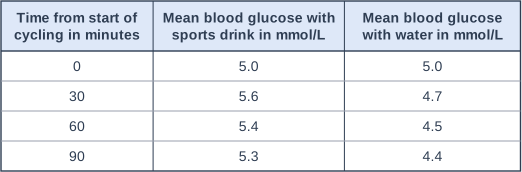
Scientists working for the company tested the drink. Eight cyclists drank the sports drink and a different eight cyclists drank the same volume of water, just before cycling for 90 minutes. The table shows the mean blood glucose concentrations of each group.

Evaluate the company's claim.

Table with columns "Time from start of cycling in minutes", "Mean blood glucose with sports drink in mmol/L", "Mean blood glucose with water in mmol/L". Time from start of cycling in minutes: 0; Mean blood glucose with sports drink in mmol/L: 5.0; Mean blood glucose with water in mmol/L: 5.0 | Time from start of cycling in minutes: 30; Mean blood glucose with sports drink in mmol/L: 5.6; Mean blood glucose with water in mmol/L: 4.7 | Time from start of cycling in minutes: 60; Mean blood glucose with sports drink in mmol/L: 5.4; Mean blood glucose with water in mmol/L: 4.5 | Time from start of cycling in minutes: 90; Mean blood glucose with sports drink in mmol/L: 5.3; Mean blood glucose with water in mmol/L: 4.4.

Model answer

The data partly support the claim. At every time after the start, the sports drink group had a higher mean blood glucose than the water group, for example 5.3 mmol/L compared with 4.4 mmol/L at 90 minutes. However, the drink did not keep glucose 'high': it rose to 5.6 mmol/L at 30 minutes and then fell, and all the values stayed within the normal range. This is because insulin is released when glucose rises, bringing it back down. The water group's glucose only fell from 5.0 to 4.4 mmol/L, because glucagon causes the liver to convert glycogen into glucose. Also, there were only eight cyclists in each group and only means are given, so the results may not be reliable. Overall, the drink keeps blood glucose slightly higher than water, but the claim that it keeps glucose 'high' throughout exercise is not supported.

Explanation

Evaluate means using the data to judge how far they support the claim, and reaching a conclusion. The drink does give a slightly higher glucose than water, but homeostasis (insulin and glucagon) keeps both groups within narrow limits, and the small sample limits confidence. Answers that only describe the numbers, or ignore the water group, cannot reach full marks.

Mark scheme
  1. 1 mark

    the sports drink group had higher blood glucose than the water group at every time after the start (e.g. 5.3 compared with 4.4 mmol/L at 90 minutes) (1)

    An answer including any four from the six points; max 4. Max 3 if there is no judgement about the claim (e.g. 'the data only partly support the claim'). Data are needed for this mark.

  2. 1 mark

    but blood glucose in the drink group did not stay high: it rose to 5.6 mmol/L at 30 minutes and then fell / it stayed within the normal range (1)

    Accept 'the drink group's glucose fell from 5.6 to 5.3 mmol/L'.

  3. 1 mark

    the water group's blood glucose fell only a little (5.0 to 4.4 mmol/L), because glucagon causes the liver to convert glycogen into glucose (1)

    The link to glucagon / the liver is needed for this mark.

  4. 1 mark

    insulin is released when blood glucose rises after the drink, so the body brings the concentration back down / it cannot be kept 'high' (1)

    Accept 'homeostasis keeps blood glucose within narrow limits whatever is drunk'.

  5. 1 mark

    only eight cyclists in each group / small sample / only means given (no range) / different people in each group (1)

    Accept other valid limitations (e.g. what the cyclists ate beforehand was not stated; only one type and length of exercise tested; the results may not apply to longer exercise).

  6. 1 mark

    the scientists worked for the company, so the results may be biased / should be checked by independent scientists (1)

    Accept 'the study should be repeated by scientists who do not work for the company'. 'It might be biased' with no reason does not score.

Ready to try the rest? Every answer you write is marked against the mark scheme, so you can see exactly where the marks are.

Study Helper Hints first, answers after you try

Stuck on this one? Ask for a hint and I’ll point you in the right direction, without giving the answer away. Once you’ve checked your answer, I’ll show you how the marks are awarded.