
Level:
Correct: 0
Incorrect: 0
Marks: 0/0
Exam Practice
Course:
Topics:
Edexcel GCSE Combined Science (Biology Paper 2) Smart practice A mixed round aimed at your weak spots
Avg
score:
–
Topics
done:
0/30

The menstrual cycle

Practise 16 exam-style questions on The menstrual cycle for Edexcel GCSE Combined Science (Biology Paper 2). Write your answer as you would in the exam and get it marked in seconds against the mark scheme, point by point, with the Study Helper on hand if you get stuck.

  • 16 questions
  • 1–6 marks each
  • Instant marking
  • No sign-up needed
16 questions, marked as you go

Sample questions with model answers

Here are 4 of the questions in this topic, each with a model answer, an explanation of why it earns the marks and the mark scheme an examiner would use.

Question 1

1 mark

After ovulation, the concentration of progesterone in the blood rises.

Which of these is an effect of a high concentration of progesterone in the blood?

Choose your answer.

  • A stimulates release of LH
  • B inhibits release of FSH and LH
  • C causes an egg to mature
  • D causes the lining to break down

Model answer

B - inhibits release of FSH and LH.

Explanation

Progesterone, released by the corpus luteum after ovulation, maintains the uterus lining and inhibits the release of FSH and LH from the pituitary gland, so no new egg matures or is released in the second half of the cycle. Option D describes what happens when progesterone falls, which is why it is a tempting wrong answer.

Mark scheme
  1. 1 mark

    B / inhibits release of FSH and LH (1)

    The only correct answer is B. A is not correct because it is a high concentration of oestrogen, not progesterone, that stimulates the release of LH from the pituitary gland. C is not correct because FSH causes an egg to mature. D is not correct because high progesterone maintains the uterus lining; it is a fall in progesterone that causes the lining to break down. Accept the letter or the option. If more than one option is given, do not award the mark.
Question 2

2 marks

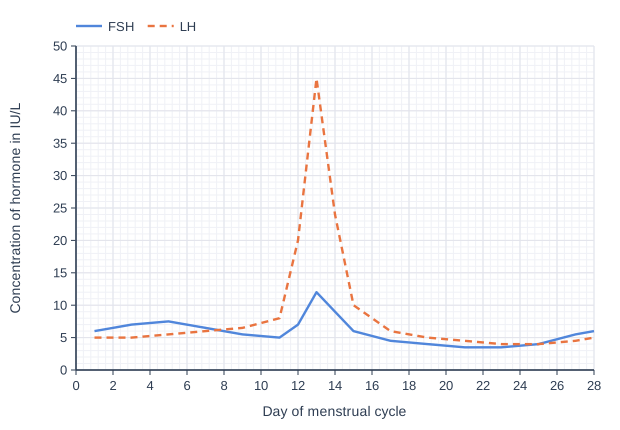
The graph shows the concentrations of FSH and LH in the blood of a woman during one menstrual cycle. Day 1 is the first day of menstruation.

Give the day on which ovulation most likely happened.

Give a reason for your answer.

Line graph of Concentration of hormone in IU/L (y-axis, 0 to 50) against day of menstrual cycle (x-axis, 0 to 28). "FSH" joins the points (1, 6), (3, 7), (5, 7.5), (7, 6.5), (9, 5.5), (11, 5), (12, 7), (13, 12), (14, 9), (15, 6), (17, 4.5), (19, 4), (21, 3.5), (23, 3.5), (25, 4), (27, 5.5), (28, 6). "LH" (dashed) joins the points (1, 5), (3, 5), (5, 5.5), (7, 6), (9, 6.5), (11, 8), (12, 20), (13, 45), (14, 24), (15, 10), (17, 6), (19, 5), (21, 4.5), (23, 4), (25, 4), (27, 4.5), (28, 5).

Model answer

Day 13 (or day 14). The concentration of LH rises sharply and peaks on day 13 at 45 IU/L, and this surge of LH causes ovulation.

Explanation

Ovulation is triggered by the LH surge, so it happens at or just after the LH peak (day 13 here). FSH also has a small peak at the same time, but FSH causes eggs to mature rather than to be released, so a reason based on FSH does not score.

Mark scheme
  1. 1 mark

    day 13 / day 14 (1)

    Accept day 13 or day 14 or 'between day 13 and day 14'. Do not accept days outside this range.

  2. 1 mark

    (because) LH concentration is at its highest / peaks / there is a surge of LH (on day 13) (and LH causes ovulation) (1)

    Accept 'LH rises sharply from 8 to 45 IU/L'. Do not accept a reason based on FSH alone (e.g. 'FSH is highest on day 13'), as FSH does not cause ovulation. Allow this mark even if the day given is outside the accepted range, provided the reason refers to the LH peak.

Question 3

3 marks

After the menopause, a woman's ovaries no longer contain follicles that can mature, so they release very little oestrogen and progesterone.

Blood tests show that the concentration of FSH in women after the menopause is much higher than in women who still have menstrual cycles.

Explain why.

Model answer

In a woman who still has menstrual cycles, oestrogen and progesterone from the ovaries inhibit the release of FSH from the pituitary gland. After the menopause the ovaries release very little oestrogen or progesterone, so this inhibition is removed. The pituitary gland therefore keeps releasing FSH, and its concentration in the blood rises to a high level.

Explanation

This applies the interactions of the cycle to a new situation. Oestrogen and progesterone normally keep FSH in check, so when the ovaries stop releasing them, the pituitary gland is no longer inhibited and FSH rises. The common error is to say the ovaries make FSH or to reverse the effect (FSH inhibiting oestrogen).

Mark scheme
  1. 1 mark

    oestrogen / progesterone (normally) inhibits the release of FSH (1)

    An explanation linking three points. Accept 'oestrogen and progesterone stop FSH being made'. Do not accept 'FSH inhibits oestrogen'.

  2. 1 mark

    with little oestrogen / progesterone, FSH is no longer inhibited / the inhibition is removed (1)

    Accept 'there is no negative feedback from the ovaries'.

  3. 1 mark

    so the pituitary gland releases more FSH (1)

    The pituitary gland must be named or clearly meant. Accept 'FSH is still released and is not switched off, and no follicle responds to it'. Do not accept 'the ovaries release more FSH'.

Question 4

4 marks

Lucy is a long-distance runner who trains for many hours each week. Her periods have stopped.

Blood tests show that the concentrations of FSH and LH in Lucy's blood are much lower than normal.

Explain why low concentrations of FSH and LH could stop Lucy ovulating and stop her having periods.

Model answer

FSH normally causes an egg to mature in a follicle, so with low FSH no follicle matures. FSH also stimulates the ovaries to release oestrogen, so Lucy's oestrogen concentration will be low. Oestrogen is needed to repair and build up the uterus lining, so the lining does not build up and there is no thick lining to break down, so she has no periods. A surge of LH is needed to cause ovulation, so with low LH no egg is released. Without ovulation no corpus luteum forms, so little progesterone is released either.

Explanation

Work through the chain of hormones: FSH (egg maturation and oestrogen) then oestrogen (lining repair and the LH surge) then LH (ovulation and the corpus luteum) then progesterone. Each mark needs the hormone linked to its effect. Low FSH and LH in athletes who use much more energy than they take in is a known cause of periods stopping; the common error is to say FSH or LH 'make' eggs.

Mark scheme
  1. 1 mark

    (with low FSH) eggs / follicles do not mature (1)

    An explanation linking any four from the five points; max 4. Accept 'no follicle develops'. Do not accept 'no eggs are produced / made'.

  2. 1 mark

    (with low FSH) the ovaries release little oestrogen (1)

    Accept 'FSH stimulates oestrogen production, so oestrogen is low'.

  3. 1 mark

    (with little oestrogen) the uterus lining is not repaired / does not build up, so there is no lining to break down / no period (1)

    Accept womb for uterus. The link between oestrogen and the lining is needed.

  4. 1 mark

    (with low LH) there is no LH surge, so no egg is released / no ovulation (1)

    Accept 'LH causes ovulation, so without enough LH ovulation does not happen'. 'No ovulation' with no link to LH does not score.

  5. 1 mark

    (without ovulation) no corpus luteum forms, so little progesterone is released (1)

    Accept 'LH is needed to form the corpus luteum, which makes progesterone'.

Ready to try the rest? Every answer you write is marked against the mark scheme, so you can see exactly where the marks are.

Study Helper Hints first, answers after you try

Stuck on this one? Ask for a hint and I’ll point you in the right direction, without giving the answer away. Once you’ve checked your answer, I’ll show you how the marks are awarded.