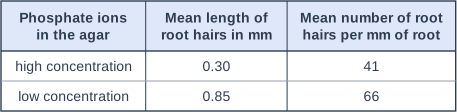
A scientist grew seedlings of thale cress on agar containing a high concentration or a low concentration of phosphate ions. After 15 days she measured the root hairs of the seedlings.
The table shows the results.
Calculate the percentage increase in the mean length of the root hairs in the low-phosphate agar compared with the high-phosphate agar.
Explain how the changes shown in the table help the seedlings to take up phosphate ions.
Model answer
Increase in length = 0.85 − 0.30 = 0.55 mm
Percentage increase = 0.55 ÷ 0.30 × 100 = 183 %
In low-phosphate agar the root hairs are longer and there are more of them per mm of root (66 compared with 41), so the roots have a much larger surface area. More phosphate ions can therefore be absorbed by active transport, and the longer root hairs reach phosphate ions in a larger volume of soil around the root.
Explanation
Percentage change = change ÷ original value × 100, and the original value is the high-phosphate length (0.30 mm); dividing by 0.85 gives 64.7 %, which is wrong. The seedlings respond to a shortage of phosphate by growing more and longer root hairs, which increases the surface area for absorbing mineral ions. A full answer links the change in the root hairs to surface area and to the uptake of the ions.