
Level:
Correct: 0
Incorrect: 0
Marks: 0/0
Exam Practice
Course:
Topics:
Edexcel GCSE Combined Science (Biology Paper 2) Smart practice A mixed round aimed at your weak spots
Avg
score:
–
Topics
done:
0/30

The carbon and water cycles

Practise 15 exam-style questions on The carbon and water cycles for Edexcel GCSE Combined Science (Biology Paper 2). Write your answer as you would in the exam and get it marked in seconds against the mark scheme, point by point, with the Study Helper on hand if you get stuck.

  • 15 questions
  • 1–6 marks each
  • Instant marking
  • No sign-up needed
15 questions, marked as you go

Sample questions with model answers

Here are 4 of the questions in this topic, each with a model answer, an explanation of why it earns the marks and the mark scheme an examiner would use.

Question 1

1 mark

Most of the water vapour in the air comes from the sea, but the rain that falls on land is fresh water.

Which process in the water cycle separates water from the salts in sea water?

Choose your answer.

  • A evaporation
  • B condensation
  • C precipitation
  • D run-off

Model answer

A - evaporation.

Explanation

Energy from the Sun evaporates water from the sea; the dissolved salts cannot evaporate, so the water vapour, and the rain that later falls from it, is fresh water. This natural process is the same idea used in desalination by distillation.

Mark scheme
  1. 1 mark

    A / evaporation (1)

    The only correct answer is A. When sea water evaporates, only water molecules escape into the air as water vapour and the salts are left behind. B is not correct because condensation turns water vapour into liquid droplets (clouds) - the salts were already left behind; C is not correct because precipitation is water falling as rain or snow; D is not correct because run-off carries water (and dissolved substances) from the land back to the sea. Accept the letter or the option. If more than one option is given, do not award the mark.
Question 2

2 marks

Some carbon is stored in rocks such as limestone, which is made of calcium carbonate. Limestone forms from the shells and skeletons of marine organisms.

Describe two ways the carbon in limestone can be returned to the atmosphere.

Model answer

Limestone is slowly weathered and eroded by acidic rain water, which releases carbon dioxide into the atmosphere. Limestone carried deep into the Earth is heated, and the carbon dioxide released escapes from volcanoes.

Explanation

Rocks, the oceans and the atmosphere are abiotic stores of carbon. Carbon locked in carbonate rocks is returned to the air as carbon dioxide very slowly, by weathering and by volcanic activity, or quickly when humans heat limestone to make lime or cement. Each way must say that carbon dioxide is released.

Mark scheme
  1. 1 mark

    weathering / erosion of limestone (e.g. by acid rain) releases carbon dioxide (1)

    Any two from the three points; max 2. Accept limestone dissolving in acidic rain water releases carbon dioxide. Ignore 'erosion' on its own without the release of carbon dioxide.

  2. 1 mark

    volcanic activity / heating of rocks deep in the Earth releases carbon dioxide (1)

    Accept volcanoes release carbon dioxide (from carbonate rocks).

  3. 1 mark

    humans heating limestone (to make lime / cement) releases carbon dioxide (1)

    Accept thermal decomposition of calcium carbonate (in industry) releases carbon dioxide. Do not accept 'burning fossil fuels' (not carbon from limestone).

Question 3

3 marks

Desalination plants release brine back into the sea. The brine has about twice the concentration of salt of normal sea water. It is denser than sea water, so it sinks to the seabed.

Explain why releasing brine can harm organisms living on the seabed near the outlet.

Model answer

The brine is much more concentrated than normal sea water, so it has a lower water concentration than the cytoplasm of the organisms' cells. Water moves out of their cells by osmosis, across the partially permeable cell membranes, so the cells lose water and shrink. Because the brine sinks and stays on the seabed, organisms there may be unable to carry out their normal cell processes and may die, reducing biodiversity near the outlet.

Explanation

This applies osmosis to an unfamiliar context: a solution that is more concentrated than the cell contents draws water out of cells. A common error is to say that salt moves by osmosis - osmosis is the movement of water. Because the brine is denser than sea water it collects on the seabed, which is why organisms there are most at risk.

Mark scheme
  1. 1 mark

    the brine has a lower (concentration of) water than the cells of the organisms / than normal sea water (1)

    An explanation linking three from the four points; max 3. Accept the brine is more concentrated (hypertonic) than the cell contents. Accept water concentration outside the cells is lower.

  2. 1 mark

    water moves out of their cells by osmosis (1)

    Accept across the partially permeable cell membrane. Do not accept 'salt moves into the cells by osmosis'.

  3. 1 mark

    the cells lose water / shrink / become dehydrated (1)

    Accept plant / algal cells become plasmolysed / flaccid.

  4. 1 mark

    so the organisms may die / cannot carry out normal (cell) processes, reducing biodiversity near the outlet (1)

    Accept because the brine sinks, the high salt concentration stays around organisms on the seabed. Ignore 'the brine poisons them'.

Question 4

4 marks

A small island in a dry region needs a new supply of potable water. Engineers compared two methods of desalination.

Drinking water with less than about 600 mg of dissolved salts per dm³ is generally considered to taste good.

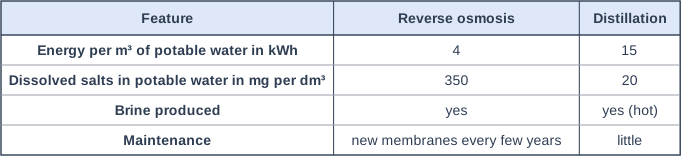
The table shows some information about the two methods.

Evaluate the use of reverse osmosis rather than distillation for this island.

Table with columns "Feature", "Reverse osmosis", "Distillation". Feature: Energy per m³ of potable water in kWh; Reverse osmosis: 4; Distillation: 15 | Feature: Dissolved salts in potable water in mg per dm³; Reverse osmosis: 350; Distillation: 20 | Feature: Brine produced; Reverse osmosis: yes; Distillation: yes (hot) | Feature: Maintenance; Reverse osmosis: new membranes every few years; Distillation: little.

Model answer

Reverse osmosis needs much less energy than distillation (4 kWh compared with 15 kWh for each m³ of water), so it would be cheaper to run and would release less carbon dioxide if the electricity comes from fossil fuels. Distillation produces purer water (20 mg of salt per dm³ compared with 350 mg per dm³), but the water from reverse osmosis is still well below 600 mg per dm³, so it is good to drink. Reverse osmosis has the extra cost of replacing its membranes every few years, and both methods produce brine that must be disposed of, although the brine from distillation is also hot. Overall, reverse osmosis is the better choice for the island, because the large saving in energy outweighs the cost of replacing the membranes and the water it produces is still potable.

Explanation

An evaluation uses the data to give points for and against, then makes a judgement supported by evidence. The key comparisons are energy (and so cost and carbon dioxide emissions) and whether the water is good enough to drink - purer is not needed once the water is potable. Answers that only list information from the table without comparing it, or give no judgement, cannot gain full marks.

Mark scheme
  1. 1 mark

    reverse osmosis needs much less energy than distillation (4 kWh compared with 15 kWh per m³) (1)

    An answer including four from the eight points; max 4. Max 3 if there is no judgement (the last point). Accept distillation needs almost four times as much energy.

  2. 1 mark

    so reverse osmosis is cheaper to run (1)

    Accept lower energy / fuel costs. Must be linked to the energy needed.

  3. 1 mark

    so less fuel is burned / less carbon dioxide is released (if the energy comes from fossil fuels) (1)

    Accept a smaller carbon footprint. Must be linked to the energy needed.

  4. 1 mark

    the water from reverse osmosis contains more dissolved salts (350 compared with 20 mg per dm³) / distillation produces purer water (1)

    Accept distillation gives water with less salt.

  5. 1 mark

    but the water from reverse osmosis is still below 600 mg per dm³, so it is still good to drink / potable (1)

    Accept both methods produce water that is safe / good to drink.

  6. 1 mark

    reverse osmosis has extra costs because its membranes must be replaced every few years (1)

    Accept reverse osmosis needs more maintenance.

  7. 1 mark

    both methods produce brine that must be disposed of (and distillation's brine is also hot) (1)

    Accept both may harm marine organisms when the brine is released. Accept hot brine from distillation can harm sea life.

  8. 1 mark

    a justified judgement, e.g. reverse osmosis is the better choice because it uses much less energy and still produces water good to drink (1)

    The judgement must be supported by at least one piece of evidence from the table. Accept a justified judgement in favour of distillation, e.g. if the island has a cheap source of heat (waste heat) or needs very pure water.

Ready to try the rest? Every answer you write is marked against the mark scheme, so you can see exactly where the marks are.

Study Helper Hints first, answers after you try

Stuck on this one? Ask for a hint and I’ll point you in the right direction, without giving the answer away. Once you’ve checked your answer, I’ll show you how the marks are awarded.