
Level:
Correct: 0
Incorrect: 0
Marks: 0/0
Exam Practice
Course:
Topics:
Edexcel GCSE Combined Science (Biology Paper 2) Smart practice A mixed round aimed at your weak spots
Avg
score:
–
Topics
done:
0/30

Core practical: osmosis in potatoes

Practise 12 exam-style questions on Core practical: osmosis in potatoes for Edexcel GCSE Combined Science (Biology Paper 2). Write your answer as you would in the exam and get it marked in seconds against the mark scheme, point by point, with the Study Helper on hand if you get stuck.

  • 12 questions
  • 1–6 marks each
  • Instant marking
  • No sign-up needed
12 questions, marked as you go

Sample questions with model answers

Here are 4 of the questions in this topic, each with a model answer, an explanation of why it earns the marks and the mark scheme an examiner would use.

Question 1

1 mark

In an osmosis investigation, Tariq uses a digital balance with a resolution of 0.01 g.

Which of these masses has Tariq recorded correctly?

Choose your answer.

  • A 2.4 g
  • B 2.41 g
  • C 2.413 g
  • D 2 g

Model answer

B - 2.41 g.

Explanation

Measurements should be recorded to the resolution of the instrument: here the smallest division is 0.01 g, so every mass has two decimal places (including a final zero, such as 2.40 g). Recording more decimal places than the balance shows invents precision that the measurement does not have.

Mark scheme
  1. 1 mark

    B / 2.41 g (1)

    The only correct answer is B: a balance that reads to 0.01 g gives masses to two decimal places. A is not correct because it has only one decimal place - a mass read as 2.4 on this balance should be recorded as 2.40 g; C is not correct because it has three decimal places, which is more precise than this balance can measure; D is not correct because it is rounded to the nearest gram, which throws away most of the information from the balance. Accept the letter or the option. If more than one option is given, do not award the mark.
Question 2

2 marks

In the osmosis core practical, any skin is removed from the potato cylinders before they are weighed.

Explain why the skin is removed.

Model answer

Potato skin is waterproof - it is much less permeable to water than the cells inside the potato. If some cylinders had skin and others did not, water would move into or out of them by osmosis at different rates, so their changes in mass would depend on the amount of skin as well as on the concentration of the sucrose solution.

Explanation

The skin protects the potato from drying out, so it is a barrier to water. Removing it means water can move by osmosis through the whole surface of every cylinder, and only the concentration of the solution affects the change in mass. Answers need to say why skin matters (it stops water moving), not just 'to make it fair'.

Mark scheme
  1. 1 mark

    the skin is waterproof / much less permeable to water than the rest of the potato (1)

    An explanation linking two points. accept the skin is corky / waxy so water cannot pass through it easily

  2. 1 mark

    so cylinders with different amounts of skin would gain or lose different amounts of water (by osmosis), so the change in mass would not depend only on the concentration of the solution (1)

    accept skin would slow down / reduce the movement of water into or out of the cylinder; accept so that it is a fair test, only if linked to the movement of water

Question 3

3 marks

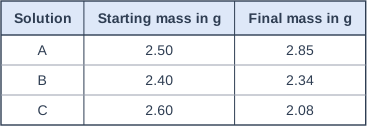
A technician made three sucrose solutions with concentrations of 0.0, 0.4 and 1.0 mol/dm³, but forgot to label them. A student labelled the solutions A, B and C. She placed one potato cylinder in each solution for 24 hours.

The table shows her results.

Deduce which solution, A, B or C, has each concentration. Explain your answer.

Table with columns "Solution", "Starting mass in g", "Final mass in g". Solution: A; Starting mass in g: 2.50; Final mass in g: 2.85 | Solution: B; Starting mass in g: 2.40; Final mass in g: 2.34 | Solution: C; Starting mass in g: 2.60; Final mass in g: 2.08.

Model answer

A is 0.0 mol/dm³, B is 0.4 mol/dm³ and C is 1.0 mol/dm³.
Percentage changes: A = (2.85 − 2.50) ÷ 2.50 × 100 = +14 %; B = (2.34 − 2.40) ÷ 2.40 × 100 = −2.5 %; C = (2.08 − 2.60) ÷ 2.60 × 100 = −20 %.
A gained mass, so it had a higher water concentration than the potato cells and water moved into the cells by osmosis: it must be the distilled water. The more concentrated a solution, the lower its water concentration, so more water moves out of the cells by osmosis and the loss in mass is greater. C lost the most mass, so it is 1.0 mol/dm³, and B lost a little mass, so it is 0.4 mol/dm³.

Explanation

Water moves by osmosis from the higher to the lower water concentration, so a gain in mass means the solution was more dilute than the cell contents and a larger loss means a more concentrated solution. Percentage changes make the comparison fair because the cylinders had different starting masses. A common error is to explain the results by sucrose moving.

Mark scheme
  1. 1 mark

    A is 0.0 mol/dm³ / distilled water (1)

    accept A is the most dilute / the water

  2. 1 mark

    B is 0.4 mol/dm³ and C is 1.0 mol/dm³ (1)

    both are needed for this point

  3. 1 mark

    the greater the (percentage) loss in mass, the more concentrated the solution / the lower its water concentration, because more water moves out of the cells by osmosis (1)

    accept a correct explanation of A or C, e.g. A gained mass because it had a higher water concentration than the cells, so water moved into the cells by osmosis / C lost the most mass because it had the lowest water concentration; accept the percentage changes: A +14 %, B −2.5 %, C −20 %; do not accept sucrose moved into / out of the cylinders as the explanation

Question 4

4 marks

Ella wrote this method for an osmosis investigation.

1 Cut five chips from a potato with a kitchen knife, making them roughly the same size.
2 Weigh each chip.
3 Put each chip into a beaker containing some sucrose solution: 0.0, 0.25, 0.50, 0.75 or 1.00 mol/dm³.
4 After 20 minutes, take each chip out and weigh it again.

Suggest two improvements to Ella's method. Explain how each improvement would make her results more valid or more repeatable.

Model answer

First, Ella should use a cork borer, ruler and scalpel to cut cylinders that all have the same diameter and length. Then all the chips would be the same size, so only the concentration of the solution would affect the change in mass, which makes the results more valid.

Second, she should set up three chips at each concentration and repeat the measurements. Then she could identify any anomalous results and calculate a mean for each concentration, which makes the results more repeatable.

Explanation

Each improvement needs a reason that says what it does to the results: controlling the size of the chips, the volume of solution and the drying improves validity; repeats and means improve repeatability; a longer time gives bigger, more measurable changes. An improvement with no reason scores only 1 mark, and the reason must match the improvement it follows.

Mark scheme
  1. 1 mark

    use a cork borer and a ruler / scalpel to cut cylinders of the same diameter and length (1)

    Two improvements, each with a linked explanation: 1 mark for each improvement and 1 mark for its explanation, which is dependent on that improvement; max 4 (credit at most two improvements). Accept other valid improvement and reason pairs, e.g. measure the same volume of each solution with a measuring cylinder (1) so every chip is covered / the volume is controlled (1); calculate the percentage change in mass (1) because the chips have different starting masses (1); remove the skin (1) because it is less permeable to water (1)

  2. 1 mark

    so that all the chips are the same size, so only the concentration of the solution affects the change in mass (1)

    accept so the surface area / starting size is controlled

  3. 1 mark

    blot each chip dry (with a paper towel) before weighing it again (1)

    accept dry the chips in the same way before each weighing

  4. 1 mark

    to remove solution on the surface, which would add to the mass but has not entered the cells by osmosis (1)

    accept so the mass measured is only the mass of the chip

  5. 1 mark

    leave the chips in the solutions for longer, e.g. 24 hours (1)

    accept any stated time of several hours or more

  6. 1 mark

    so that more water moves by osmosis / the changes in mass are large enough to measure precisely / the chips reach a constant mass (1)

    ignore 'so the experiment works' on its own

  7. 1 mark

    use three chips at each concentration / repeat the investigation (1)

    accept repeat at least three times

  8. 1 mark

    so that anomalous results can be identified and a mean calculated (1)

    accept to check that the results are repeatable

Ready to try the rest? Every answer you write is marked against the mark scheme, so you can see exactly where the marks are.

Study Helper Hints first, answers after you try

Stuck on this one? Ask for a hint and I’ll point you in the right direction, without giving the answer away. Once you’ve checked your answer, I’ll show you how the marks are awarded.