Level:
Correct: 0
Incorrect: 0
Marks: 0/0
Exam Practice
Course:
Topics:
AQA GCSE Economics (Paper 2) Smart practice A mixed round aimed at your weak spots
Unit 1
Introduction to the national economy
Interest rates, saving, borrowing, spending and investment
Government income and expenditure
Unit 2
Government objectives
Economic objectives of the government
Economic growth
Economic growth
Employment and unemployment
Inflation and price stability
Balance of payments
Balance of payments
Unit 3
How the government manages the economy
Fiscal policy
Fiscal policy
Monetary policy
Monetary policy
Supply-side policies
Policies to correct positive and negative externalities
Policies to correct externalities
Unit 4
International trade and the global economy
Why countries trade and the importance of international trade to the UK
Why countries trade
Exchange rates
Exchange rates
Free-trade agreements including the European Union
Free-trade agreements including the EU
Globalisation: benefits and drawbacks
Unit 5
The role of money and financial markets
The role of money
The role of money
The role and importance of the financial sector for the economy
The role and importance of the financial sector
Avg
score:
–
Topics
done:
0/18

Why countries trade

Practise 15 exam-style questions on Why countries trade for AQA GCSE Economics (Paper 2). Write your answer as you would in the exam and get it marked in seconds against the mark scheme, point by point, with the Study Helper on hand if you get stuck.

  • 15 questions
  • 1–15 marks each
  • Instant marking
  • No sign-up needed
15 questions, marked as you go

Sample questions with model answers

Here are 4 of the questions in this topic, each with a model answer, an explanation of why it earns the marks and the mark scheme an examiner would use.

Question 1

1 mark

Country A can produce wheat at a lower cost than Country B. Country B can produce cloth at a lower cost than Country A.

Which of the following is most likely to benefit both countries?

Choose your answer.

  • A Each country produces both wheat and cloth for itself and does not trade
  • B Country A specialises in wheat, Country B specialises in cloth, and they trade
  • C Country A specialises in cloth, Country B specialises in wheat, and they trade
  • D Both countries put tariffs on all imports from the other

Model answer

B Country A specialises in wheat, Country B specialises in cloth, and they trade

Explanation

Countries trade because they can specialise in what they produce most efficiently and swap for the rest. When resources are used where they are most productive, total output rises and both countries can have more. Specialising in the wrong good, or blocking trade with tariffs, loses these gains.

Mark scheme
  1. 1 mark

    B / Country A specialises in wheat, Country B specialises in cloth, and they trade

    Accept the letter or the option text. 0 marks if more than one option is chosen. If each country specialises in the good it produces at lower cost and they trade, more of both goods can be produced with the same resources, so both can consume more. A gives up the gains from specialisation; C makes each country produce the good it is worse at; D reduces trade and the gains from it.

Question 2

2 marks

Explain what is meant by global interdependence.

Model answer

Global interdependence means that the world's economies depend on each other through trade, investment and finance, so that an event in one country, such as a recession in the USA, affects output and jobs in other countries such as the UK.

Explanation

The first mark is for the idea that economies depend on, or are linked to, each other. The second mark is for showing the consequence: what happens in one economy affects others. An example such as the UK importing gas only helps if it shows this dependence.

Mark scheme
  1. 1 mark

    Countries / economies depend on each other / are linked to each other (e.g. through trade, investment or finance)

    2 marks for a complete explanation, e.g. 'economies around the world rely on each other through trade, so a change in one economy, such as a recession, affects the others'. 1 mark for a partial explanation, e.g. 'countries rely on each other' or 'countries trade with each other a lot'. Examples can be used to support an answer but, alone, do not constitute understanding: 'the UK buys oil from Norway' on its own scores 0. 0 marks for answers that only repeat the words, e.g. 'countries being interdependent'.

  2. 1 mark

    so that events or changes in one country (e.g. a recession, rising prices or a shortage) affect other countries

    Awarded only with the first mark: together they make a complete definition (2 marks).

Question 3

2 marks

In 2025, UK exports of goods and services were worth about £913 billion. Of this, exports of services were worth about £523 billion.

Calculate the percentage of the value of UK exports that came from services in 2025. Give your answer to one decimal place.

Model answer

523 ÷ 913 × 100 = 57.28...%
= 57.3% (to one decimal place)

Explanation

Divide the part (services) by the whole (all exports) and multiply by 100: more than half of UK exports are services. Common errors are dividing by the value of goods instead of by total exports, or turning the fraction upside down. Always round at the end, to the number of decimal places asked for.

Mark scheme
  1. 1 mark

    Correct method, e.g. 523 ÷ 913 × 100; or a correct final answer of 57.3% with no working

    An answer of 57.3% with no working scores 2 marks. Answer not to one decimal place but otherwise correct (e.g. 57% or 57.28%): 1 mark. For correct working but an incorrect answer: 1 mark. 42.7% (the share of goods, 390 ÷ 913) or 174.6% (913 ÷ 523 × 100) with no correct working: 0 marks.

  2. 1 mark

    57.3%

    Accept 57.3 with or without the % sign.

Question 4

9 marks

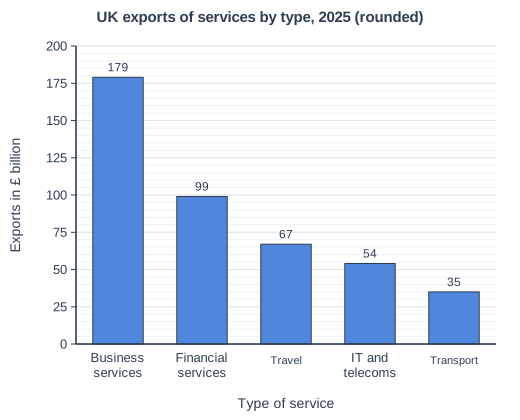
Figure 1 - UK exports of services

The UK is one of the world's largest exporters of services. In 2025 UK exports of services were worth about £523 billion, compared with about £390 billion of exports of goods. The bar chart shows the largest types of service the UK exported in 2025 (business services include consultancy, legal, accounting and advertising services).

Many jobs in finance, law and consultancy are highly paid, but they are concentrated in London and the South East of England. Over several decades the share of UK jobs in manufacturing has fallen, and some towns that relied on factories have suffered high unemployment. Trade in services can also face barriers other than tariffs, such as rules on which firms are allowed to sell financial services in another country.

Using Figure 1, assess whether it is good for the UK economy that so much of its export income comes from services.

UK exports of services by type, 2025 (rounded). Bar chart of exports in £ billion for each type of service: Business services 179, Financial services 99, Travel 67, IT and telecoms 54, Transport 35.

Model answer

Figure 1 shows that services are the UK's most important exports: about £523 billion in 2025, compared with about £390 billion of goods, so services are about 57% of UK exports. This is good for the UK because it reflects what the UK produces most efficiently. The UK has a highly skilled workforce, a long-established financial centre in London and the advantage that English law and language are widely used in business. By specialising in services such as business services (about £179 billion) and financial services (about £99 billion), the UK uses its resources where they are most productive, earning foreign currency to pay for the goods it imports. These are high-value activities, so they create well-paid jobs and large tax revenues that fund public services.

However, there are drawbacks. The information says many of these jobs are concentrated in London and the South East, so the benefits are unevenly spread and regional inequality may rise. As the UK has shifted towards services, manufacturing jobs have fallen, and workers in former factory towns may not have the skills for finance or consultancy jobs, causing structural unemployment. Relying heavily on financial services also makes the economy more exposed to financial crises, as in 2008, when problems in banks reduced lending and output across the economy. Services also face barriers such as licensing rules, so exports can be harder to expand than goods exports.

Overall, I think it is mostly good for the UK economy, because these services are where the UK has its strongest advantages, and the chart shows that export income is spread across several types of service, including travel (about £67 billion) and IT and telecoms services (about £54 billion), not just finance. However, how good it is depends on whether the government reduces regional inequality, for example through training and investment outside London, and on how well the financial sector is regulated to reduce the risk of another crisis.

Explanation

To reach Level 3, use the figures (services about £523 billion against goods about £390 billion; business and financial services the largest) to support arguments on both sides, then give a justified judgement that says what it depends on. Benefits include specialisation, high-value jobs and tax revenue; drawbacks include regional inequality, structural unemployment and exposure to financial crises. One-sided answers are capped at 6 marks.

Mark scheme
  1. 9 marks

    Levels of response (9 marks).
    Level 3 (7-9 marks): A fully justified conclusion with sustained evaluation, which is coherent and relevant, with judgements supported by evidence. A full analysis of the economic evidence, a well-developed and logical chain of reasoning. Comprehensive application of knowledge and understanding of pertinent concepts/issues relevant to the context; specialist language used throughout.
    Level 2 (4-6 marks): A partially justified conclusion with an evaluation, which is mostly coherent and relevant; judgements may not be fully supported by evidence. An incomplete analysis of the economic evidence; starts to develop a chain of reasoning. Good application of knowledge and understanding of concepts/issues mostly relevant to the context; specialist language used mostly appropriately.
    Level 1 (1-3 marks): A basic conclusion or assertion may be present based on evaluative judgements supported by little or no evidence. Analysis of discrete points of the economic evidence with no chain of reasoning attempted. Basic application of knowledge and understanding of concepts/issues with limited relevance to the context; may use non-specialist language.
    0 marks: Nothing written worthy of credit.

    Max 6 if the answer considers only one side or gives no judgement. Max 6 if the answer makes no use of the data in Figure 1. Indicative content (not exhaustive; credit other valid points):
    Good for the UK: the UK specialises in what it does well (skilled workforce, London's financial centre, the English language and law), so resources are used efficiently; services such as business and financial services are high value, so they create highly paid jobs and large tax revenues; world demand for services is growing; services exports earn foreign currency to pay for imports of goods; services are less affected by transport costs and can be sold online.
    Bad for the UK / risks: jobs and income are concentrated in London and the South East, increasing regional inequality; the decline of manufacturing caused structural unemployment in some towns; reliance on financial services exposes the economy to financial crises; trade in services faces non-tariff barriers (rules, licences), which can limit exports; services cannot replace some goods the UK must import.
    Use of data: services about £523 billion against goods about £390 billion (about 57% of exports); business services about £179 billion and financial services about £99 billion are the largest types, so finance and business services together are over half of services exports; travel about £67 billion, IT and telecoms about £54 billion, transport about £35 billion show a spread of service exports.
    Overall: e.g. it is mostly good because it reflects the UK's comparative strengths and brings high-value jobs, but it depends on whether the government can spread the benefits across regions, on how safely the financial sector is regulated, and on whether the UK keeps access to foreign markets for services.

Ready to try the rest? Every answer you write is marked against the mark scheme, so you can see exactly where the marks are.

Study Helper Hints first, answers after you try

Stuck on this one? Ask for a hint and I’ll point you in the right direction, without giving the answer away. Once you’ve checked your answer, I’ll show you how the marks are awarded.