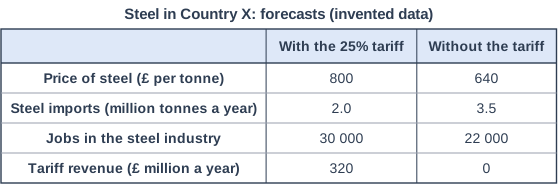
Figure 1 - Steel in Country X
Country X (an invented country) charges a tariff of 25% on imported steel to protect its steel industry. Most of its steelworks are in two northern towns, where they are the largest employers. The government plans to remove the tariff as part of a free-trade agreement with several other countries.
Country X's car and construction industries use large amounts of steel and employ about 600 000 workers. Some car makers say high steel prices make their cars less competitive abroad. The table shows forecasts for the steel market (invented data).
Using Figure 1, assess whether Country X should remove its tariff on imported steel.
Model answer
Removing the tariff would cut the price of steel from £800 to £640 per tonne, a fall of 20%. This would lower costs for Country X's car and construction industries, which employ about 600 000 workers. Car makers could cut their prices, making their cars more competitive abroad, so exports and output would rise and they might take on more workers. Lower construction costs would also make new homes and buildings cheaper. Free trade also gives domestic steel makers an incentive to become more efficient to survive.
However, the steel industry would be badly hit. Imports are forecast to rise from 2.0 to 3.5 million tonnes, and steel jobs to fall from 30 000 to 22 000, a loss of 8 000 jobs. Because the steelworks are concentrated in two towns, this would cause structural unemployment there: the workers' skills may not suit other jobs, and lower incomes would mean less spending in local shops, causing further job losses through the multiplier effect. The government would also lose £320 million a year of tariff revenue and might spend more on benefits. Some argue that a country needs its own steel industry for security reasons.
Overall, I think Country X should remove the tariff, because the gains are spread across far more people: 600 000 workers in steel-using industries, plus consumers, against 8 000 steel jobs lost. However, this depends on the government using some of the gains to help the two steel towns, for example with retraining and investment, and on car makers passing on lower costs. If steel is judged essential for national security, the government might prefer to support the industry in a different way, such as a subsidy, rather than keep the tariff.
Explanation
A Level 3 answer uses the table on both sides: the 20% fall in price and the 600 000 workers in steel-using industries against the 8 000 lost steel jobs and £320 million of lost tariff revenue. It then makes a judgement that weighs these and says what it depends on, such as support for the affected towns. One-sided answers, or answers that ignore the data, are capped at 6 marks.