Level:
Correct: 0
Incorrect: 0
Marks: 0/0
Exam Practice
Course:
Topics:
AQA GCSE Economics (Paper 2) Smart practice A mixed round aimed at your weak spots
Unit 1
Introduction to the national economy
Interest rates, saving, borrowing, spending and investment
Government income and expenditure
Unit 2
Government objectives
Economic objectives of the government
Economic growth
Economic growth
Employment and unemployment
Inflation and price stability
Balance of payments
Balance of payments
Unit 3
How the government manages the economy
Fiscal policy
Fiscal policy
Monetary policy
Monetary policy
Supply-side policies
Policies to correct positive and negative externalities
Policies to correct externalities
Unit 4
International trade and the global economy
Why countries trade and the importance of international trade to the UK
Why countries trade
Exchange rates
Exchange rates
Free-trade agreements including the European Union
Free-trade agreements including the EU
Globalisation: benefits and drawbacks
Unit 5
The role of money and financial markets
The role of money
The role of money
The role and importance of the financial sector for the economy
The role and importance of the financial sector
Avg
score:
–
Topics
done:
0/18

Balance of payments

Practise 18 exam-style questions on Balance of payments for AQA GCSE Economics (Paper 2). Write your answer as you would in the exam and get it marked in seconds against the mark scheme, point by point, with the Study Helper on hand if you get stuck.

  • 18 questions
  • 1–15 marks each
  • Instant marking
  • No sign-up needed
18 questions, marked as you go

Sample questions with model answers

Here are 4 of the questions in this topic, each with a model answer, an explanation of why it earns the marks and the mark scheme an examiner would use.

Question 1

1 mark

Which of the following would be recorded as an export of services in the UK's balance of payments?

Choose your answer.

  • A A UK insurance company sells insurance to a business in Japan
  • B A family from the UK stays in a hotel in Spain
  • C A car factory in the UK sells cars to a dealer in Germany
  • D A UK resident receives dividends on shares in a US company

Model answer

A A UK insurance company sells insurance to a business in Japan

Explanation

An export is anything that brings money into the UK from abroad in return for UK output. Insurance is a service, so selling it to a Japanese business is an export of services. A UK family's spending in a Spanish hotel is an import of services, because money leaves the UK. Cars are goods, so selling them to Germany is an export of goods, and dividends from shares abroad are primary income, not trade.

Mark scheme
  1. 1 mark

    A / A UK insurance company sells insurance to a business in Japan

    Accept the letter or the option text. If more than one option is given, 0 marks.

Question 2

2 marks

Explain one reason why a country may have a deficit on the current account of its balance of payments.

Model answer

If a country's firms have low productivity, their costs and prices are higher than those of foreign rivals. Overseas customers buy fewer of its exports, and its own consumers buy cheaper imports instead, so the value of imports is greater than the value of exports and the current account is in deficit.

Explanation

A current account deficit means more money flows out of the country than flows in, mostly because imports are greater than exports. Identify a reason, such as uncompetitive exports, a strong currency or booming consumer spending, then explain how it reduces exports or raises imports. Any valid reason scores if it is explained.

Mark scheme
  1. 1 mark

    Identifies a valid reason, e.g. its exports are uncompetitive (high costs, low productivity, high inflation or poor quality) / a high (strong) exchange rate / fast growth in consumers' incomes and spending / few natural resources, so it must import raw materials or energy / a recession in its main export markets / large income payments abroad, e.g. profits sent home by foreign-owned firms

    2 = explained, 1 = identified, 0 = nothing worthy of credit. Possible answers; this indicative content is not exhaustive: credit other valid reasons.

  2. 1 mark

    Explains it: develops the reason to show why money flowing out is greater than money flowing in, e.g. so foreign buyers buy fewer of its exports while it buys more imports / so consumers spend more on imported goods / so the value of imports is greater than the value of exports

    Example of a 2-mark answer: 'The country's firms have low productivity, so their costs and prices are higher than those of foreign rivals (1). This means it exports less and its consumers buy more imports, so the value of imports exceeds the value of exports (1).'

Question 3

2 marks

Explain one reason why a deficit on the current account of the balance of payments may not be a problem for an economy.

Model answer

If most of the imports are machinery and equipment for new factories, the deficit is helping to increase the economy's productive capacity. The extra capacity allows the country to produce and export more in future, which should reduce the deficit, so it need not be a problem.

Explanation

Whether a deficit matters depends on its size, how long it lasts, what is being imported and how it is paid for. A deficit caused by importing capital goods that will raise future output and exports is very different from one caused by a consumer spending boom paid for by borrowing. This kind of judgement is what 9 and 15-mark questions on the balance of payments reward.

Mark scheme
  1. 1 mark

    Identifies a valid reason, e.g. the deficit is small or temporary / imports are mainly capital goods or raw materials / the deficit is financed by long-term investment from abroad (foreign direct investment) / consumers gain from a wider choice of cheaper imports / a floating exchange rate may fall and correct it

    2 = explained, 1 = identified, 0 = nothing worthy of credit. Possible answers; this indicative content is not exhaustive: credit other valid reasons.

  2. 1 mark

    Explains it, e.g. imported machinery increases the economy's productive capacity, so it can produce and export more in future / foreign firms building factories create jobs and future exports, rather than the country building up short-term debts / consumers enjoy a higher standard of living / a fall in the currency makes exports cheaper and imports dearer, so the deficit narrows

    Example of a 2-mark answer: 'If the imports are machinery for new factories (1), they increase the country's ability to produce goods, so it can export more in future and the deficit may disappear (1).'

Question 4

6 marks

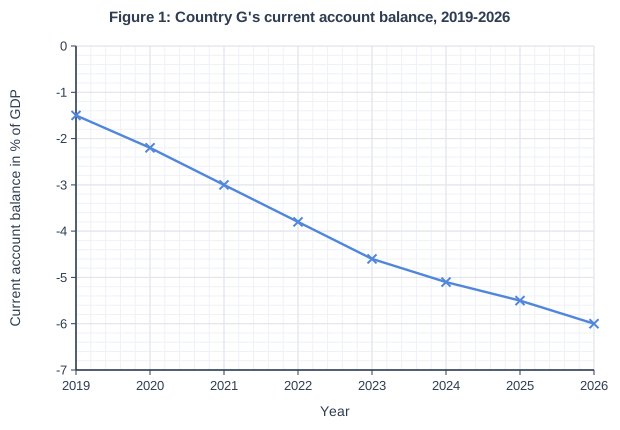
Country G (an invented country) has a growing deficit on the current account of its balance of payments. Its consumers have spent more and more on imported goods, while its manufacturing exporters have struggled to compete with foreign firms. The deficit has been paid for by borrowing from abroad and by selling some of Country G's businesses to foreign buyers. Figure 1 shows Country G's current account balance as a percentage of its GDP.

Using Figure 1, analyse the possible consequences for Country G's economy of the widening deficit on its current account.

Figure 1: Country G's current account balance, 2019-2026. Line graph of Current account balance in % of GDP (y-axis, -7 to 0) against year (x-axis, 2019 to 2026). The line joins the points (2019, -1.5), (2020, -2.2), (2021, -3), (2022, -3.8), (2023, -4.6), (2024, -5.1), (2025, -5.5), (2026, -6).

Model answer

Figure 1 shows that Country G's current account deficit has widened every year, from 1.5% of GDP in 2019 to 6.0% in 2026, so it is now four times as large.

One consequence is lost jobs and slower growth. The deficit has grown because consumers buy more imports and manufacturers struggle to export. This means more of Country G's spending goes to foreign firms instead of domestic ones, so firms in export and import-competing industries sell less, cut their output and make workers redundant. Unemployment rises, and because net exports are negative and getting larger, total demand and economic growth are lower than they would otherwise be.

A second consequence comes from how the deficit is paid for. Borrowing from abroad increases Country G's foreign debt, and the interest on this debt must be paid to foreign lenders in future. Selling businesses to foreign buyers means that their future profits flow abroad. Both of these increase the outflow of primary income, so the current account deficit can get even larger in future years, adding to the debt.

Finally, a deficit of 6% of GDP may lead lenders and investors to lose confidence. The value of Country G's currency could fall, making imports more expensive and raising inflation, and lenders may demand higher interest rates. However, a lower currency would also make exports cheaper, which could start to reduce the deficit.

Explanation

A top answer explains chains of cause and effect: from the deficit to lower demand for domestic output, lost jobs and slower growth; from the financing of the deficit to debts and future income outflows; and from a large deficit to pressure on the currency and inflation. It uses the graph accurately, for example the rise from 1.5% to 6.0% of GDP. Listing consequences without explaining how they happen stays in Level 1.

Mark scheme
  1. 6 marks

    Levels of response (6 marks).
    Level 3 (5-6 marks): A full analysis of the economic evidence, a well-developed and logical chain of reasoning.
    Level 2 (3-4 marks): An incomplete analysis of the economic evidence, starts to develop a chain of reasoning. Good application of knowledge and understanding of concepts/issues mostly relevant to the context.
    Level 1 (1-2 marks): Analysis of discrete points of the economic evidence with no chain of reasoning attempted. Basic application of knowledge and understanding of concepts/issues with limited relevance to the context.
    0 marks: Nothing written worthy of credit.

    Max 4 if the answer makes no use of the evidence or context given. Levels are a ladder, as AQA instructs: an answer reaches Level 3 only if it also applies knowledge to the context, as Level 2 requires. Indicative content (not exhaustive; credit other valid points): the deficit widened from 1.5% of GDP in 2019 to 6.0% in 2026, four times as large, and it grew every year; more spending on imports and fewer exports mean less demand for goods made in Country G, so firms in export and import-competing industries cut output and jobs, raising unemployment (possibly structural, if manufacturing declines for good); lower net exports reduce total demand and economic growth; the deficit must be financed: borrowing from abroad increases foreign debt, and interest on it must be paid in future, which adds to the primary income deficit; selling businesses to foreign owners means their future profits flow abroad, also worsening primary income; a persistent deficit may cause the currency to fall in value, which makes imports dearer and can raise inflation, though it also makes exports cheaper and may help to reduce the deficit; lenders may lose confidence and charge higher interest rates; consumers gain in the short run from cheaper or more varied imports, so living standards may be higher for now. Level 3 answers develop logical chains from the widening deficit to its effects on jobs, growth, debt or the currency, and use the data accurately.

Ready to try the rest? Every answer you write is marked against the mark scheme, so you can see exactly where the marks are.

Study Helper Hints first, answers after you try

Stuck on this one? Ask for a hint and I’ll point you in the right direction, without giving the answer away. Once you’ve checked your answer, I’ll show you how the marks are awarded.