
Level:
Correct: 0
Incorrect: 0
Marks: 0/0
Exam Practice
Course:
Topics:
AQA GCSE Economics (Paper 2) Smart practice A mixed round aimed at your weak spots
Unit 1
Introduction to the national economy
Interest rates, saving, borrowing, spending and investment
Government income and expenditure
Unit 2
Government objectives
Economic objectives of the government
Economic growth
Economic growth
Employment and unemployment
Inflation and price stability
Balance of payments
Balance of payments
Unit 3
How the government manages the economy
Fiscal policy
Fiscal policy
Monetary policy
Monetary policy
Supply-side policies
Policies to correct positive and negative externalities
Policies to correct externalities
Unit 4
International trade and the global economy
Why countries trade and the importance of international trade to the UK
Why countries trade
Exchange rates
Exchange rates
Free-trade agreements including the European Union
Free-trade agreements including the EU
Globalisation: benefits and drawbacks
Unit 5
The role of money and financial markets
The role of money
The role of money
The role and importance of the financial sector for the economy
The role and importance of the financial sector
Avg
score:
–
Topics
done:
0/18

The role and importance of the financial sector

Practise 15 exam-style questions on The role and importance of the financial sector for AQA GCSE Economics (Paper 2). Write your answer as you would in the exam and get it marked in seconds against the mark scheme, point by point, with the Study Helper on hand if you get stuck.

  • 15 questions
  • 1–15 marks each
  • Instant marking
  • No sign-up needed
15 questions, marked as you go

Sample questions with model answers

Here are 4 of the questions in this topic, each with a model answer, an explanation of why it earns the marks and the mark scheme an examiner would use.

Question 1

1 mark

Which of the following is the main difference between a building society and a commercial bank?

Choose your answer.

  • A A building society is owned by its members (its savers and borrowers), while a commercial bank is owned by shareholders
  • B A building society cannot lend money to its customers
  • C A building society is owned and run by the government
  • D A commercial bank does not accept deposits from savers

Model answer

A A building society is owned by its members (its savers and borrowers), while a commercial bank is owned by shareholders

Explanation

Both building societies and commercial banks accept deposits and make loans. The key difference is ownership: a building society is a mutual owned by its members, so profits can be used to offer better interest rates, while a bank aims to make profits for its shareholders. Building societies mainly provide savings accounts and mortgages.

Mark scheme
  1. 1 mark

    A / A building society is owned by its members (its savers and borrowers), while a commercial bank is owned by shareholders

    Accept the letter or the option text. 0 marks if more than one option is chosen. Building societies are mutual organisations owned by their members, so they do not have to pay dividends to outside shareholders; commercial banks are companies owned by shareholders. B is wrong: building societies lend, mainly as mortgages; C is wrong: they are private, not government-owned; D is wrong: banks accept deposits.
Question 2

2 marks

State two services that high street banks provide for their customers.

Model answer

1 Savings accounts.
2 Mortgages.

Explanation

High street banks serve both savers (current and savings accounts, payments) and borrowers (loans, overdrafts, mortgages, credit cards). Two different services are needed, so a debit card and contactless payments count only once. Setting Bank Rate and issuing banknotes are roles of the Bank of England.

Mark scheme
  1. 2 marks

    Any two different services, e.g. current accounts / making payments (debit cards, transfers, direct debits) / savings accounts / loans / overdrafts / mortgages / credit cards / currency exchange / financial advice / insurance / safe storage of money

    1 mark for each different correct example, max 2. Do not credit two versions of the same service (e.g. 'debit card' and 'contactless payments': 1 mark; 'loan' and 'personal loan': 1 mark). Accept a clear description, e.g. 'somewhere safe to keep your money' for a savings or current account. Do not accept 'printing money' or 'setting interest rates'.

Question 3

2 marks

A high street bank receives £500 million of deposits from its customers. It keeps 8% of its deposits as reserves and lends out the rest.

Calculate how much the bank lends.

Model answer

Reserves = 500 × 0.08 = £40 million
Amount lent = 500 - 40 = £460 million

Explanation

The bank keeps 8% of deposits as reserves so that it can meet customers' withdrawals, and lends the other 92%: 500 × 0.92 = £460 million. Lending deposits to households and firms is how banks link savers with borrowers and help to fund investment. Giving the reserves (£40 million) instead of the amount lent is the common error.

Mark scheme
  1. 1 mark

    Correct method: 500 × 0.92 / 500 - (500 × 0.08) / 500 - 40; or a correct final answer of £460 million with no working

    An answer of £460 million with no working scores 2 marks. For correct working but an incorrect answer: 1 mark. £40 million (the reserves, not the amount lent) scores 1 mark only if it is clearly shown as a step towards the answer; on its own it scores 0. £540 million (adding 8%) scores 0.

  2. 1 mark

    £460 million

    Accept 460, £460m, £460 000 000 or £0.46 billion, with or without the £ sign.

Question 4

9 marks

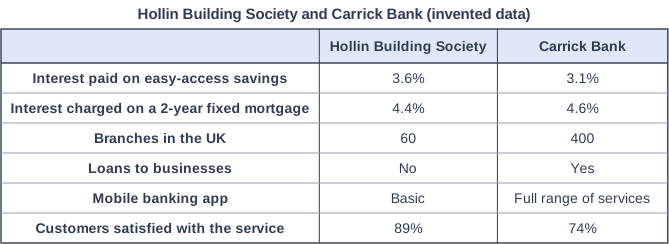
Figure 1 - Building society or bank?

Hollin Building Society and Carrick Bank (both invented) both have branches in the same town. Hollin Building Society is a mutual organisation owned by its members, and it does not pay dividends to shareholders. Carrick Bank is a public limited company owned by shareholders. The table compares some of the services they offer (invented data).

Using Figure 1, assess whether building societies provide a better service for savers and borrowers than commercial banks.

Hollin Building Society and Carrick Bank (invented data). Table with columns (row headings), "Hollin Building Society", "Carrick Bank". Interest paid on easy-access savings; Hollin Building Society: 3.6%; Carrick Bank: 3.1% | Interest charged on a 2-year fixed mortgage; Hollin Building Society: 4.4%; Carrick Bank: 4.6% | Branches in the UK; Hollin Building Society: 60; Carrick Bank: 400 | Loans to businesses; Hollin Building Society: No; Carrick Bank: Yes | Mobile banking app; Hollin Building Society: Basic; Carrick Bank: Full range of services | Customers satisfied with the service; Hollin Building Society: 89%; Carrick Bank: 74%.

Model answer

Figure 1 suggests that Hollin Building Society gives savers and home buyers better value than Carrick Bank. It pays 3.6% on easy-access savings compared with 3.1%, so a saver with £10 000 would earn about £50 more interest a year. It charges 4.4% on a 2-year fixed mortgage compared with 4.6%, which would save a borrower with a £200 000 mortgage about £400 a year in interest. This is because a building society is a mutual owned by its members: it does not have to pay dividends to shareholders, so it can use its profits to offer better rates. With less pressure to raise profits for shareholders, building societies may also take fewer risks, and Hollin has much higher customer satisfaction (89% compared with 74%).

However, Carrick Bank offers a wider and more convenient service. It has 400 branches compared with Hollin's 60, so it is easier for many customers to visit, and its mobile app offers a full range of services. It also lends to businesses, which Hollin does not, so a business owner who wants a loan to invest could not use the building society at all. For customers who value convenience and a wide range of services, the bank may be the better choice.

Overall, I think building societies provide a better service for ordinary savers and people buying a home, because their mutual ownership allows them to offer better interest rates, as the table shows. However, banks provide a better service for business borrowers and for customers who want many branches and a full range of digital services. The judgement also depends on whether this one comparison is typical: rates change often, and some banks offer better deals than some building societies.

Explanation

A Level 3 answer uses the data on both sides, for example the better savings and mortgage rates and higher satisfaction at the building society against the bank's 400 branches, full app and loans to businesses, and links the rates to mutual ownership. The judgement should say who each type of institution suits best and note that one example may not be typical. One-sided answers are capped at 6 marks.

Mark scheme
  1. 9 marks

    Levels of response (9 marks).
    Level 3 (7-9 marks): A fully justified conclusion with sustained evaluation, which is coherent and relevant, with judgements supported by evidence. A full analysis of the economic evidence, a well-developed and logical chain of reasoning. Comprehensive application of knowledge and understanding of pertinent concepts/issues relevant to the context; specialist language used throughout.
    Level 2 (4-6 marks): A partially justified conclusion with an evaluation, which is mostly coherent and relevant; judgements may not be fully supported by evidence. An incomplete analysis of the economic evidence; starts to develop a chain of reasoning. Good application of knowledge and understanding of concepts/issues mostly relevant to the context; specialist language used mostly appropriately.
    Level 1 (1-3 marks): A basic conclusion or assertion may be present based on evaluative judgements supported by little or no evidence. Analysis of discrete points of the economic evidence with no chain of reasoning attempted. Basic application of knowledge and understanding of concepts/issues with limited relevance to the context; may use non-specialist language.
    0 marks: Nothing written worthy of credit.

    Max 6 if the answer considers only one side or gives no judgement. Max 6 if the answer makes no use of the data in Figure 1. Indicative content (not exhaustive; credit other valid points):
    Building societies better: owned by members, so they do not pay dividends to shareholders and can use profits to give better rates: Hollin pays savers 3.6% against 3.1% and charges 4.4% on mortgages against 4.6%; on £10 000 of savings the 0.5 percentage point gap is £50 more interest a year, and on a £200 000 mortgage the 0.2 point gap is about £400 a year less interest; customer satisfaction higher (89% against 74%); less pressure to take risks to raise profits, so savings may be safer; focus on savers and home buyers.
    Banks better: Carrick has far more branches (400 against 60), so it is more convenient for many customers; a full mobile banking app; it offers a wider range of services, including loans to businesses, which Hollin does not offer, so business borrowers cannot use the building society; banks may offer better deals on some products or at other times.
    Use of data: rates 3.6% v 3.1% (savings) and 4.4% v 4.6% (mortgages); 60 v 400 branches; business loans no v yes; app basic v full; satisfaction 89% v 74%.
    Overall: e.g. for individual savers and home buyers the building society appears to offer better value because of its mutual ownership, but banks offer a wider range of services and more convenience, and serve business borrowers; it depends on the type of customer, what services they need, and whether the rates shown are typical of building societies and banks in general (this is only one example).

Ready to try the rest? Every answer you write is marked against the mark scheme, so you can see exactly where the marks are.

Study Helper Hints first, answers after you try

Stuck on this one? Ask for a hint and I’ll point you in the right direction, without giving the answer away. Once you’ve checked your answer, I’ll show you how the marks are awarded.