Practise 19 exam-style questions on Economic growth for AQA GCSE Economics (Paper 2). Write your answer as you would in the exam and get it marked in seconds against the mark scheme, point by point, with the Study Helper on hand if you get stuck.
19 questions
1–15 marks each
Instant marking
No sign-up needed
19 questions, marked as you go
Sample questions with model answers
Here are 4 of the questions in this topic, each with a model answer, an explanation of why it earns the marks and the mark scheme an examiner would use.
Question 1
1 mark
In one year, Country X's nominal GDP rose by 6.5% and the general price level rose by 4.0%.
Which of the following is the best estimate of Country X's rate of real economic growth in that year?
Choose your answer.
A 1.6%
B 2.5%
C 10.5%
D -2.5%
Model answer
B 2.5%
Explanation
Real growth removes the effect of inflation, so a good estimate is nominal growth minus inflation: 6.5% - 4.0% = 2.5%. (The exact figure, 1.065 ÷ 1.04, is about 2.4%, so 2.5% is the best estimate offered.) Adding the figures (10.5%) counts inflation as growth, dividing them (1.6%) has no meaning, and -2.5% subtracts the wrong way round.
Mark scheme
1 mark
B / 2.5%
accept the letter or the option text. If more than one option is given, 0 marks.
Question 2
2 marks
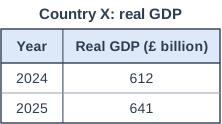
Figure 1 shows the real GDP of Country X in 2024 and 2025.
Using Figure 1, calculate the rate of economic growth for 2025. Give your answer to one decimal place.
Model answer
Increase in real GDP = £641 billion - £612 billion = £29 billion Rate of growth = 29 ÷ 612 × 100 = 4.7% (to 1 d.p.)
Explanation
The rate of economic growth is the percentage change in real GDP: (new - old) ÷ old × 100. Always divide by the earlier year's value (612). Dividing by 641 gives 4.5%, and giving only the £29 billion increase does not answer the question, which asks for a rate.
Mark scheme
1 mark
Correct method: (641 - 612) ÷ 612 × 100 = 29 ÷ 612 × 100; or a correct final answer of 4.7% with no working
An answer of 4.7% with no working scores 2 marks.
1 mark
4.7%
Accept 4.7 with or without the % sign. Answer not to one decimal place but otherwise correct (e.g. 5%, 4.74%): 1 mark. 4.5% (dividing by 641, the new value, instead of 612): 1 mark. 29 or £29 billion (the increase, not the rate): 1 mark. Correct working with an arithmetic slip: 1 mark.
Question 3
2 marks
State two possible causes of economic growth.
Model answer
1. Investment in new machinery and technology 2. Education and training that improve workers' skills
Explanation
Economic growth comes from increasing the quantity or quality of the factors of production - more workers, more and better capital, new technology, natural resources - or from higher spending that uses spare capacity. Each answer should be a specific cause; two versions of the same idea (more investment and more machinery) score only once.
Mark scheme
2 marks
Any two different causes, e.g. more investment in capital (machinery, factories, infrastructure) / new technology / education and training that improve workers' skills (productivity) / a rise in the size of the labour force (e.g. through immigration or more people choosing to work) / discovery of natural resources (e.g. oil or gas) / higher consumer spending / higher government spending / rising demand for exports / lower interest rates / lower taxes
1 mark for each different correct example, max 2. Answers may be about the supply side (more or better factors of production) or the demand side (more spending). Do not credit 'more money' or 'people get richer' (these describe effects or are vague). 'More investment' and 'more machinery' count as one cause.
Question 4
6 marks
Explain two government policies that could be used to increase economic growth.
Model answer
First, the government could invest in infrastructure, such as faster railways and better broadband. This reduces the time and cost of moving goods and people and of doing business, so firms become more productive and can produce more with the same resources. Better infrastructure also attracts investment from new businesses, which increases the economy's productive capacity, and the building work itself creates jobs and incomes in the short run.
Second, the government could spend more on education and training. Workers with better skills are more productive, so they can produce more output per hour and move into growing industries that need skilled staff. This increases the quality of the labour force, so the economy can grow faster in the long run without running into shortages of skilled workers.
Explanation
Name a specific policy and explain the chain from the policy to higher output - through more or better factors of production (supply side) or through higher spending (demand side). Strong answers use terms such as productivity, productive capacity and investment. The two policies must be different: building roads and building railways are both infrastructure investment.
Mark scheme
3 marks
First policy, e.g. investment in infrastructure (roads, railways, broadband): it lowers firms' costs and raises the productivity of workers and businesses, so the economy can produce more. 3 = a full and precise explanation applying economic concepts and issues; 2 = a partial explanation applying economic concepts and issues but lacking detail; 1 = fragmented points made; 0 = nothing worthy of credit.
Max 3 if both explanations make the same point. Possible answers include: investment in infrastructure (transport, broadband, energy) - lowers costs, raises productivity and productive capacity, and creates jobs while being built; investment in education and training - improves the skills of the workforce (human capital), raising productivity; lower taxes on business profits (corporation tax) or tax allowances for investment - firms keep more profit, so they invest more in capital; lower income tax - increases the incentive to work and raises disposable income and spending; higher government spending - raises total demand, so firms produce more and hire more workers; lower interest rates - cheaper borrowing increases consumer spending and business investment; supply-side policies such as deregulation or privatisation - increase competition and efficiency; grants for research and new technology. Each explanation must show how the policy increases output (productive capacity or spending). Note: this indicative content is not exhaustive; credit other creditworthy responses.
3 marks
Second, different policy, e.g. lower taxes on business profits: firms keep more of their profit, so they have more money and more incentive to invest in new machinery and technology, which increases the economy's productive capacity. 3 = a full and precise explanation applying economic concepts and issues; 2 = a partial explanation applying economic concepts and issues but lacking detail; 1 = fragmented points made; 0 = nothing worthy of credit.
Credit any valid policy that is different from the first. 2 marks: a valid policy with a partial explanation, e.g. 'spend more on education so workers have more skills'. 1 mark: fragmented points, e.g. 'cut taxes'. Two policies that are the same kind (e.g. building roads and building railways) count as one.
Ready to try the rest? Every answer you write is marked against the mark scheme, so you can see exactly where the marks are.
Ctrl + Enter to check
Study HelperHints first, answers after you try
Stuck on this one? Ask for a hint and I’ll point you in the right direction, without giving the answer away. Once you’ve checked your answer, I’ll show you how the marks are awarded.