Level:
Correct: 0
Incorrect: 0
Marks: 0/0
Exam Practice
Course:
Topics:
AQA GCSE Economics (Paper 2) Smart practice A mixed round aimed at your weak spots
Unit 1
Introduction to the national economy
Interest rates, saving, borrowing, spending and investment
Government income and expenditure
Unit 2
Government objectives
Economic objectives of the government
Economic growth
Economic growth
Employment and unemployment
Inflation and price stability
Balance of payments
Balance of payments
Unit 3
How the government manages the economy
Fiscal policy
Fiscal policy
Monetary policy
Monetary policy
Supply-side policies
Policies to correct positive and negative externalities
Policies to correct externalities
Unit 4
International trade and the global economy
Why countries trade and the importance of international trade to the UK
Why countries trade
Exchange rates
Exchange rates
Free-trade agreements including the European Union
Free-trade agreements including the EU
Globalisation: benefits and drawbacks
Unit 5
The role of money and financial markets
The role of money
The role of money
The role and importance of the financial sector for the economy
The role and importance of the financial sector
Avg
score:
–
Topics
done:
0/18

Globalisation: benefits and drawbacks

Practise 15 exam-style questions on Globalisation: benefits and drawbacks for AQA GCSE Economics (Paper 2). Write your answer as you would in the exam and get it marked in seconds against the mark scheme, point by point, with the Study Helper on hand if you get stuck.

  • 15 questions
  • 1–15 marks each
  • Instant marking
  • No sign-up needed
15 questions, marked as you go

Sample questions with model answers

Here are 4 of the questions in this topic, each with a model answer, an explanation of why it earns the marks and the mark scheme an examiner would use.

Question 1

1 mark

Which of the following is a multinational company?

Choose your answer.

  • A A UK bakery chain with 400 shops in England, Scotland and Wales
  • B A UK clothing firm that sells online to customers in 30 countries from one warehouse in the UK
  • C A firm with its head office in Japan and factories in the UK, Mexico and Thailand
  • D A French wine shop that imports wine from Chile

Model answer

C A firm with its head office in Japan and factories in the UK, Mexico and Thailand

Explanation

The key feature of a multinational company is that it operates in more than one country, not just that it trades with other countries. A firm that exports from one country, or imports into one country, is not a multinational. Having many branches within one country does not count either.

Mark scheme
  1. 1 mark

    C / A firm with its head office in Japan and factories in the UK, Mexico and Thailand

    Accept the letter or the option text. 0 marks if more than one option is chosen. A multinational company operates (has offices, factories or other operations) in more than one country; the Japanese firm has factories in three other countries. A operates only in the UK; B only exports from the UK, which does not make it a multinational; D only imports.

Question 2

2 marks

State two developments in technology that have helped globalisation to grow.

Model answer

1 The internet.
2 Container shipping.

Explanation

Technology has helped globalisation by cutting the cost of communication (the internet, mobile phones, video calls) and of transport (container ships, air freight). Lower tariffs and the growth of multinational companies have also helped, but they are not developments in technology.

Mark scheme
  1. 2 marks

    Any two different developments, e.g. the internet / email / online shopping (e-commerce) / mobile phones / video calls / container shipping / larger cargo ships / cheaper air travel or air freight / satellite and GPS tracking of goods / online or electronic payments / cloud computing / automation of ports

    1 mark for each different correct example, max 2. Accept any development in technology that makes trade, communication or travel between countries cheaper or easier. Do not credit two versions of the same development (e.g. 'the internet' and 'websites': 1 mark). Do not accept answers that are not technology, such as 'lower tariffs' or 'multinational companies'.

Question 3

2 marks

In one year a multinational company had sales revenue of 220 billion US dollars. In the same year Country X, a less developed country, had a GDP of 180 billion US dollars.

Calculate the multinational company's revenue as a percentage of Country X's GDP. Give your answer to one decimal place.

Model answer

220 ÷ 180 × 100 = 122.22...%
= 122.2% (to one decimal place)

Explanation

Divide the company's revenue by the country's GDP and multiply by 100: the answer is over 100% because the company's revenue is larger than the whole country's GDP. This shows how large and powerful some multinational companies are compared with less developed countries. The common error is to divide GDP by revenue.

Mark scheme
  1. 1 mark

    Correct method: 220 ÷ 180 × 100; or a correct final answer of 122.2% with no working

    An answer of 122.2% with no working scores 2 marks. Answer not to one decimal place but otherwise correct (e.g. 122% or 122.22%): 1 mark. For correct working but an incorrect answer: 1 mark. 81.8% (180 ÷ 220 × 100, the fraction upside down) scores 0.

  2. 1 mark

    122.2%

    Accept 122.2 with or without the % sign.

Question 4

9 marks

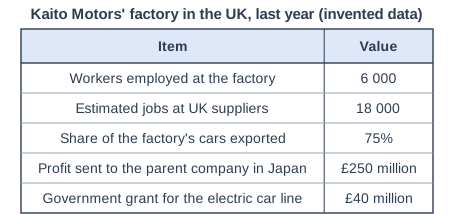
Figure 1 - A multinational car maker in the UK

Kaito Motors (an invented business) is a Japanese multinational company. It owns a large car factory in north-east England, which it opened more than 20 years ago. The UK government gave it a grant to help pay for a new production line for electric cars.

The factory buys parts from many UK suppliers, and most of the cars it makes are exported. Profits made by the factory are sent to the company's shareholders, many of whom live in Japan. The company has said that it could move production to another country if its costs in the UK rise. The table shows data for the factory (invented data).

Using Figure 1, assess whether multinational companies such as Kaito Motors benefit the UK economy.

Kaito Motors' factory in the UK, last year (invented data). Table with columns "Item", "Value". Item: Workers employed at the factory; Value: 6 000 | Item: Estimated jobs at UK suppliers; Value: 18 000 | Item: Share of the factory's cars exported; Value: 75% | Item: Profit sent to the parent company in Japan; Value: £250 million | Item: Government grant for the electric car line; Value: £40 million.

Model answer

Figure 1 suggests that Kaito Motors brings large benefits to the UK economy. It employs 6 000 workers directly and supports an estimated 18 000 more jobs at UK suppliers, so 24 000 jobs depend on it, in a region that may otherwise have high unemployment. These workers spend their wages in local shops and services, creating further jobs through the multiplier effect. As 75% of the factory's cars are exported, it adds to UK output and economic growth, and the government receives tax on wages and spending. Multinationals also bring new technology and methods, such as electric car production, which UK workers and suppliers learn from, raising productivity.

However, there are drawbacks. The factory sent £250 million of profit to the parent company in Japan last year, so not all the income it creates stays in the UK. The company has said it could move production abroad if its UK costs rise. Because multinationals can move between countries, the UK depends on decisions made elsewhere: if the factory closed, up to 24 000 jobs could be at risk in one region, causing structural unemployment that would be hard to solve. The government also paid a £40 million grant, which has an opportunity cost, as the money could have been spent on schools or hospitals.

Overall, I think multinationals like Kaito Motors do benefit the UK economy, because the jobs, exports, tax revenue and skills they create are much larger than the profits sent abroad or the cost of the grant. However, the size of the benefit depends on how long the company stays and how much it uses UK suppliers. The risk that it could leave means the UK should avoid relying too heavily on one firm in a region, and the grant is only good value if it keeps the factory in the UK for many years.

Explanation

A Level 3 answer uses the data on both sides: 6 000 direct and 18 000 supplier jobs and 75% of output exported against £250 million of profit sent abroad, the £40 million grant and the risk of the company leaving. The judgement should weigh these and say what the answer depends on, such as how long the company stays. One-sided answers are capped at 6 marks.

Mark scheme
  1. 9 marks

    Levels of response (9 marks).
    Level 3 (7-9 marks): A fully justified conclusion with sustained evaluation, which is coherent and relevant, with judgements supported by evidence. A full analysis of the economic evidence, a well-developed and logical chain of reasoning. Comprehensive application of knowledge and understanding of pertinent concepts/issues relevant to the context; specialist language used throughout.
    Level 2 (4-6 marks): A partially justified conclusion with an evaluation, which is mostly coherent and relevant; judgements may not be fully supported by evidence. An incomplete analysis of the economic evidence; starts to develop a chain of reasoning. Good application of knowledge and understanding of concepts/issues mostly relevant to the context; specialist language used mostly appropriately.
    Level 1 (1-3 marks): A basic conclusion or assertion may be present based on evaluative judgements supported by little or no evidence. Analysis of discrete points of the economic evidence with no chain of reasoning attempted. Basic application of knowledge and understanding of concepts/issues with limited relevance to the context; may use non-specialist language.
    0 marks: Nothing written worthy of credit.

    Max 6 if the answer considers only one side or gives no judgement. Max 6 if the answer makes no use of the data in Figure 1. Indicative content (not exhaustive; credit other valid points):
    Benefits: direct jobs (6 000) in an area that may have had high unemployment; more jobs at UK suppliers (about 18 000) and multiplier effects as workers spend their wages locally; exports (75% of output) earn foreign currency and add to UK output and economic growth; tax revenue from wages, profits and spending; transfer of technology, skills and production methods (e.g. electric cars) to UK workers and suppliers; competition encourages UK firms to become more efficient.
    Drawbacks: profits (£250 million) flow abroad to shareholders in Japan, so not all the income stays in the UK; the company is 'footloose' and could move production abroad, causing sudden large-scale unemployment in one region (the 6 000 jobs plus supplier jobs); the government may need to pay grants (£40 million) to attract or keep it, which has an opportunity cost; decisions are made abroad; MNCs may use their size to avoid tax or put pressure on suppliers.
    Use of data: 6 000 direct jobs and about 18 000 jobs at suppliers (24 000 in total); 75% of output exported; £250 million profit sent abroad compared with the £40 million grant.
    Overall: e.g. MNCs such as Kaito Motors are likely to benefit the UK overall, as the jobs, exports and skills are large compared with the profits sent abroad and the grant, but it depends on how long the company stays, whether it keeps investing in the UK, how far it uses UK suppliers and whether the grant was needed to keep it.

Ready to try the rest? Every answer you write is marked against the mark scheme, so you can see exactly where the marks are.

Study Helper Hints first, answers after you try

Stuck on this one? Ask for a hint and I’ll point you in the right direction, without giving the answer away. Once you’ve checked your answer, I’ll show you how the marks are awarded.