Level:
Correct: 0
Incorrect: 0
Marks: 0/0
Exam Practice
Course:
Topics:
AQA GCSE Combined Science (Foundation Chemistry Paper 2) Smart practice A mixed round aimed at your weak spots
Unit 13
The rate and extent of chemical change
Unit 14
Organic chemistry
Unit 15
Chemical analysis
Purity, formulations and chromatography
Pure substances and formulations
Chromatography
Identification of common gases
Unit 16
Chemistry of the atmosphere
The composition and evolution of the Earth's atmosphere
Common atmospheric pollutants and their sources
Unit 17
Using resources
Life cycle assessment and recycling
Avg
score:
–
Topics
done:
0/16

Using the Earth's resources and sustainable development

Practise 18 exam-style questions on Using the Earth's resources and sustainable development for AQA GCSE Combined Science (Foundation Chemistry Paper 2). Write your answer as you would in the exam and get it marked in seconds against the mark scheme, point by point, with the Study Helper on hand if you get stuck.

  • 18 questions
  • 1–6 marks each
  • Instant marking
  • No sign-up needed
18 questions, marked as you go

Sample questions with model answers

Here are 4 of the questions in this topic, each with a model answer, an explanation of why it earns the marks and the mark scheme an examiner would use.

Question 1

1 mark

Clothing and building materials are made from resources taken from the Earth or grown by farmers.

Which of these resources can be replaced as fast as it is used, so it is a renewable resource?

Choose your answer.

  • Cotton
  • Copper ore
  • Limestone
  • Natural gas

Model answer

Cotton

Explanation

Cotton is a renewable resource because new cotton plants can be grown every year, so it is replaced as fast as it is used. Ores, rocks such as limestone and fossil fuels such as natural gas form far too slowly to be replaced, so they are finite (limited) resources.

Mark scheme
  1. 1 mark

    Cotton

    If more than one option is given, 0 marks. Copper ore and limestone are rocks that formed over millions of years, so they are finite. Natural gas is a fossil fuel that formed over millions of years, so it is also finite.

Question 2

2 marks

Humans use the Earth's resources to provide warmth, shelter, food and transport.

Match each use of a resource, A, B, C and D, to the human need it mainly provides. Write each letter with warmth, shelter, food or transport.

A Bricks made from clay are used to build houses.
B Diesel oil is burned in the engines of lorries.
C Natural gas is burned in a central heating boiler.
D Wheat is grown on farms and made into bread.

Model answer

A shelter
B transport
C warmth
D food

Explanation

Bricks are used to build homes, which give shelter. Diesel oil is a fuel for vehicles, so it provides transport. Natural gas burned in a boiler heats a home, giving warmth, and wheat from farms provides food. Read each use carefully: the same resource can meet different needs depending on how it is used.

Mark scheme
  1. 2 marks

    A shelter; B transport; C warmth; D food

    4 correct = 2 marks; 2 or 3 correct = 1 mark; 0 or 1 correct = 0 marks. A letter given with more than one need is wrong. allow heating / heat for warmth; allow housing / homes for shelter.

Question 3

3 marks

Some resources are finite and some are renewable.

Read the information about three resources, A, B and C.

A Cork is the bark of the cork oak tree. Once a tree is about 25 years old, its bark can be stripped off about every 9 years. The tree is not killed and the bark grows back.
B Helium is a gas found trapped underground with natural gas. It formed over millions of years. When helium is released into the air, it escapes into space.
C Bamboo is a fast-growing plant. When the stems are cut, new stems grow up from the parts of the plant under the ground and can be cut again within about 5 years.

Is each resource finite or renewable? Write each letter with finite or renewable.

Model answer

A renewable
B finite
C renewable

Explanation

A renewable resource is replaced, by natural growth or by people, as fast as it is used: cork bark grows back and bamboo regrows new stems from under the ground. Helium took millions of years to form underground and is lost to space once released, so it cannot be replaced and is finite. Use the information about how quickly each resource is replaced.

Mark scheme
  1. 1 mark

    A renewable

    a letter given with both finite and renewable scores 0 for that letter

  2. 1 mark

    B finite

    allow non-renewable / limited

  3. 1 mark

    C renewable

Question 4

4 marks

Copper and zinc are obtained from metal ores. Metal ores are finite resources.

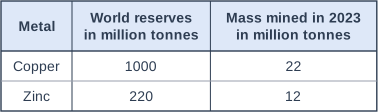
The table shows the world reserves of copper and zinc and the mass of each metal mined in 2023 (data from the US Geological Survey).

Use the equation:

number of years the reserves will last = reserves ÷ mass mined each year

Calculate the number of years the reserves of each metal will last if the same mass is mined each year.

Give one reason why the reserves may last for a different number of years.

Table with columns "Metal", "World reserves in million tonnes", "Mass mined in 2023 in million tonnes". Metal: Copper; World reserves in million tonnes: 1000; Mass mined in 2023 in million tonnes: 22 | Metal: Zinc; World reserves in million tonnes: 220; Mass mined in 2023 in million tonnes: 12.

Model answer

Copper: 1000 ÷ 22 = 45 years
Zinc: 220 ÷ 12 = 18 years
The reserves may last a different number of years because the mass mined each year may increase as demand grows, or new reserves may be discovered.

Explanation

Both reserves and production are in million tonnes, so the units cancel and the answer is in years. Divide the reserves by the mass mined each year for each metal. The estimate assumes nothing changes, but in reality demand, recycling and new discoveries all change how long a finite resource lasts.

Mark scheme
  1. 1 mark

    1000 ÷ 22 or 220 ÷ 12

    either correct division earns this mark; a correct answer with no working scores full marks for the calculations; full marks are not awarded for a correct final answer from incorrect working

  2. 1 mark

    copper: 45 (years)

    allow 45.5 / 45.45; do not accept 46 (incorrect rounding); do not accept 1000 ÷ 12 = 83 (values from different metals)

  3. 1 mark

    zinc: 18 (years)

    allow 18.3 / 18.33; do not accept 19 (incorrect rounding); do not accept 220 ÷ 22 = 10 (values from different metals); if the two answers are given the wrong way round (copper 18, zinc 45), award 1 mark of these two

  4. 1 mark

    any one from: new reserves may be found / new methods may make it possible to extract metal from lower-grade ores / the mass mined each year may increase (as demand increases) / more of the metal may be recycled / substitutes may be used instead

    allow demand may change; ignore 'the data may be wrong'

Ready to try the rest? Every answer you write is marked against the mark scheme, so you can see exactly where the marks are.

Revision notes

Using the Earth's resources and sustainable development

The big idea

Everything we use comes from the Earth: from the crust, the oceans, the atmosphere or from living things. Some of these resources will run out, so chemists look for ways to meet people's needs today while leaving enough for the future: sustainable development. You need to sort resources into finite and renewable, give examples of natural and synthetic products, and judge data about resources.

What we use the Earth's resources for

Humans use the Earth's resources to provide warmth, shelter, food and transport.

NeedExamples of resources used
WarmthFuels such as natural gas, coal, oil and wood
ShelterTimber; limestone (for cement and concrete), clay (for bricks), sand (for glass), iron ore (for steel)
FoodSoil, water, crops, farm animals and fertilisers
TransportCrude oil (for petrol, diesel and kerosene); metal ores (for vehicles)

Natural resources, supplemented by agriculture, provide food, timber, clothing and fuels. Farming adds to what nature supplies: crops and farmed animals add to wild food, plantations add to natural forests, and crops such as sugar cane and rapeseed are grown to make biofuels (ethanol and biodiesel).

Finite resources from the Earth, oceans and atmosphere are processed to provide energy and materials: for example metal ores, crude oil and limestone from the crust, salt (sodium chloride) from the oceans, and nitrogen from the air, used to make ammonia.

Natural and synthetic products

A natural product is made by living things or found in nature. A synthetic product is made by people using chemical reactions, often from crude oil. Synthetic products supplement (add to) or replace natural ones because natural supplies cannot meet the demand of a growing population, because they can be made cheaply in large amounts, or because they have more useful properties.

Natural productProduct that supplements or replaces it
Wool, cotton, silkSynthetic fibres: polyester, nylon, acrylic
Natural rubber (from rubber trees)Synthetic rubber
Wood (e.g. window frames)Plastics such as PVC
LeatherSynthetic leather
ManureSynthetic fertilisers
Medicines from plants (willow bark)Synthetic medicines (aspirin)

Finite and renewable resources

  • A finite resource will run out because it is not replaced at the rate it is used. Fossil fuels (coal, oil, natural gas), metal ores and uranium (nuclear fuel) took millions of years to form.
  • A renewable resource can be replaced at the rate it is used, usually within a few years or decades: timber, cotton, wool, and crops grown for biofuels.

When a question gives you information about a resource, compare how fast it is replaced with how fast it is used. A resource that is normally renewable behaves like a finite one if it is used faster than it is replaced, for example fish caught faster than they can breed.

Sustainable development

Sustainable development is development that meets the needs of current generations without compromising the ability of future generations to meet their own needs.

Chemistry helps by improving agricultural and industrial processes and making new products:

  • fertilisers increase crop yields, so more food grows on the same land;
  • catalysts let reactions run at lower temperatures, saving energy;
  • recycling metals, glass and plastics means fewer finite resources are extracted;
  • products are made from renewable raw materials instead of crude oil.

Most solutions have costs too: making fertilisers uses natural gas (a finite resource) and a lot of energy. A good answer gives a benefit and a limitation.

Using data about resources

Resource data come as charts, graphs and tables. Two skills come up often.

  • How long will a reserve last? Divide the reserves by the amount used each year. This assumes nothing changes: new discoveries and more recycling make reserves last longer; rising demand makes them run out sooner.
  • Orders of magnitude. Each order of magnitude is a factor of 10, so \(10^7\) is two orders of magnitude bigger than \(10^5\). Comparing them shows quickly whether a number is significant: a supply a hundred times smaller than the demand makes little difference.

Is this water supply renewable?

A town pumps water from porous rock underground. Rain soaking into the rock raises the water level by about 0.5 cm each year. Pumping lowers the water level by about 60 cm each year. Use orders of magnitude to decide whether the water is being used as a renewable resource.

Compare the two rates: \(60 \div 0.5 = 120\), which is about \(10^2\)

The water is used about 100 times (two orders of magnitude) faster than it is replaced. Rain water is normally renewable, but here it is not replaced at the rate it is used, so it behaves like a finite resource. This is not sustainable: the supply will fail, and future generations will not be able to meet their needs from it.

Common mistakes

  • Giving only half the definition of sustainable development. You need both the needs of current generations and not compromising future generations.
  • Forgetting that nuclear power uses a finite resource. Uranium is mined from the Earth's crust and is not replaced.
  • Saying a renewable resource "can be reused". Renewable means it is replaced (it regrows or re-forms) as fast as it is used.
  • Assuming the resource with the largest reserves lasts the longest. What matters is the reserves divided by the rate of use.

Exam tip

For "evaluate" questions with a table of data, compare the options factor by factor, quoting the numbers ("uses less than half as much energy"), then finish with a judgement and a reason. When the question mentions sustainability, link your answer to future generations, not just to people today.

Study Helper Hints first, answers after you try

Stuck on this one? Ask for a hint and I’ll point you in the right direction, without giving the answer away. Once you’ve checked your answer, I’ll show you how the marks are awarded.