
Level:
Correct: 0
Incorrect: 0
Marks: 0/0
Exam Practice
Course:
Topics:
AQA GCSE Combined Science (Foundation Chemistry Paper 2) Smart practice A mixed round aimed at your weak spots
Unit 13
The rate and extent of chemical change
Unit 14
Organic chemistry
Unit 15
Chemical analysis
Purity, formulations and chromatography
Pure substances and formulations
Chromatography
Identification of common gases
Unit 16
Chemistry of the atmosphere
The composition and evolution of the Earth's atmosphere
Common atmospheric pollutants and their sources
Unit 17
Using resources
Life cycle assessment and recycling
Avg
score:
–
Topics
done:
0/16

Calculating rates of reactions and factors which affect them

Practise 24 exam-style questions on Calculating rates of reactions and factors which affect them for AQA GCSE Combined Science (Foundation Chemistry Paper 2). Write your answer as you would in the exam and get it marked in seconds against the mark scheme, point by point, with the Study Helper on hand if you get stuck.

  • 24 questions
  • 1–6 marks each
  • Instant marking
  • No sign-up needed
20 questions, marked as you go

Sample questions with model answers

Here are 4 of the questions in this topic, each with a model answer, an explanation of why it earns the marks and the mark scheme an examiner would use.

Question 1

1 mark

Lucy added a metal to dilute acid and measured the volume of gas produced. She plotted her results on a graph of volume of gas against time. After 3 minutes the line on her graph became horizontal.

Why did the line become horizontal?

Choose your answer.

  • The catalyst had been used up
  • One of the reactants had been used up
  • The acid had become more concentrated
  • The rate of reaction had increased

Model answer

One of the reactants had been used up

Explanation

The slope of a graph of volume of gas against time shows the rate. A horizontal line has no slope, so no more gas is being made: the reaction has finished because all of one of the reactants has been used up. A common mistake is to say a catalyst has run out - catalysts are not used up in a reaction.

Mark scheme
  1. 1 mark

    One of the reactants had been used up

    If more than one option is given, 0 marks. A horizontal line means no more gas is being produced, so the reaction has stopped because all of one reactant (the metal or the acid) has been used up. Catalysts are not used up in reactions. The acid becomes less concentrated as it reacts, not more. If the rate had increased, the line would be steeper, not horizontal.
Question 2

2 marks

In a factory, two gases react together to make a product.

Give two changes to the conditions that would increase the rate of this reaction.

Model answer

Increase the pressure of the gases.
Increase the temperature.

Explanation

The rate of a reaction between gases is increased by a higher pressure, a higher temperature or a catalyst; any two score both marks. Surface area applies to solid reactants, and concentration of solutions applies to reactions in solution, so they are not the best answers for two gases. Each answer must say which way to change the condition - 'change the pressure' does not score.

Mark scheme
  1. 1 mark

    increase the pressure (of the gases)

    any two from the three points: max 2. allow 'increase the concentration of the gases' for this point.

  2. 1 mark

    increase the temperature

    allow 'heat the gases'.

  3. 1 mark

    use / add a catalyst

    The answer must give the direction of a change: 'change the pressure' or 'change the temperature' scores 0. Apply the list rule: each wrong answer (e.g. 'lower the temperature', 'reduce the pressure') cancels a correct one. Ignore 'increase the surface area', 'stir' and 'use more gas'. Max 2.

Question 3

3 marks

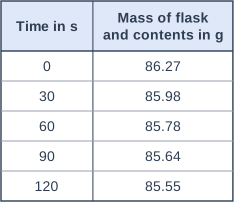
A student put some magnesium carbonate powder and dilute hydrochloric acid in a conical flask standing on a balance. A cotton wool plug was put in the neck of the flask. The mass decreased because carbon dioxide escaped from the flask.

The table shows the student's results.

Calculate the mean rate of reaction in the first 60 s.

Use the equation:
mean rate of reaction = mass of carbon dioxide lost ÷ time taken

Give your answer in g/s to 2 significant figures.

Table with columns "Time in s", "Mass of flask and contents in g". Time in s: 0; Mass of flask and contents in g: 86.27 | Time in s: 30; Mass of flask and contents in g: 85.98 | Time in s: 60; Mass of flask and contents in g: 85.78 | Time in s: 90; Mass of flask and contents in g: 85.64 | Time in s: 120; Mass of flask and contents in g: 85.55.

Model answer

Mass of carbon dioxide lost = 86.27 - 85.78 = 0.49 g
Mean rate = 0.49 ÷ 60 = 0.00817 g/s
= 0.0082 g/s (2 significant figures)

Explanation

The mass lost in the first 60 s is the starting mass minus the mass at 60 s, 0.49 g; dividing by 60 s gives 0.008166... g/s, which is 0.0082 g/s to 2 significant figures. The zeros after the decimal point are not significant figures, so 0.0082 has two. Common errors are dividing the balance reading itself by the time, cutting the answer off at 0.0081 instead of rounding, and giving 0.008 (1 significant figure).

Mark scheme
  1. 1 mark

    (mass lost =) 86.27 - 85.78 = 0.49 (g)

    A correct answer with no working scores full marks. Full marks are not awarded for a correct final answer from incorrect working.

  2. 1 mark

    (mean rate =) 0.49 ÷ 60 = 0.00817 (g/s)

    allow ecf from an incorrect mass lost, e.g. 0.29 ÷ 60 = 0.00483 (the mass lost in the first 30 s). allow 0.0081666... / 0.0082 / 0.008167. Dividing a balance reading by the time (e.g. 85.78 ÷ 60 = 1.43) scores 0 for this mark.

  3. 1 mark

    0.0082 (g/s)

    allow 8.2 × 10⁻³. Do not accept 0.0081 (the value has been cut off, not rounded) or 0.008 (1 significant figure). allow an answer from an incorrect calculation correctly given to 2 significant figures, e.g. 0.0048 from 0.29 ÷ 60.

Question 4

4 marks

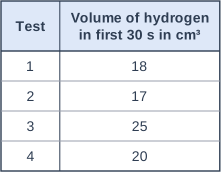
Leah added 3 cm of magnesium ribbon to dilute hydrochloric acid. She measured the volume of hydrogen collected in the first 30 s. She did the experiment four times.

The table shows her results.

Calculate the mean rate of reaction in the first 30 s. Do not include the anomalous result in your calculation. Give the unit.

Use the equation:
mean rate of reaction = quantity of product formed ÷ time taken

Table with columns "Test", "Volume of hydrogen in first 30 s in cm³". Test: 1; Volume of hydrogen in first 30 s in cm³: 18 | Test: 2; Volume of hydrogen in first 30 s in cm³: 17 | Test: 3; Volume of hydrogen in first 30 s in cm³: 25 | Test: 4; Volume of hydrogen in first 30 s in cm³: 20.

Model answer

Test 3 (25 cm³) is anomalous, so it is left out.
Mean volume = (18 + 17 + 20) ÷ 3 = 18.3 cm³
Mean rate = 18.3 ÷ 30
= 0.61 cm³/s

Explanation

An anomalous result does not fit the pattern of the others: 25 cm³ is much higher than 17-20 cm³, so it is left out of the mean. The mean volume, 18.3 cm³, divided by 30 s gives 0.61 cm³/s. Including the anomalous result is the most common mistake, and the unit must show a volume divided by a time.

Mark scheme
  1. 1 mark

    (mean volume =) (18 + 17 + 20) ÷ 3 = 18.3 (cm³)

    A correct answer with no working scores full marks. Full marks are not awarded for a correct final answer from incorrect working. Test 3 (25 cm³) is the anomalous result. Including it gives a mean of 20 (cm³): 0 for this mark, but allow ecf for the next two marks (20 ÷ 30 = 0.67).

  2. 1 mark

    (mean rate =) 18.3 ÷ 30

    allow ecf from an incorrect mean volume. Finding the rate for each test and then the mean of the three rates is also correct.

  3. 1 mark

    = 0.61 (cm³/s)

    allow 0.6 / 0.611.

  4. 1 mark

    cm³/s

    allow cm³ per second. allow cm³/min only if the number is correct for minutes (36.7 cm³/min). This mark can be awarded on its own.

Ready to try the rest? Every answer you write is marked against the mark scheme, so you can see exactly where the marks are.

Study Helper Hints first, answers after you try

Stuck on this one? Ask for a hint and I’ll point you in the right direction, without giving the answer away. Once you’ve checked your answer, I’ll show you how the marks are awarded.