
Level:
Correct: 0
Incorrect: 0
Marks: 0/0
Exam Practice
Course:
Topics:
AQA GCSE Combined Science (Foundation Chemistry Paper 2) Smart practice A mixed round aimed at your weak spots
Unit 13
The rate and extent of chemical change
Unit 14
Organic chemistry
Unit 15
Chemical analysis
Purity, formulations and chromatography
Pure substances and formulations
Chromatography
Identification of common gases
Unit 16
Chemistry of the atmosphere
The composition and evolution of the Earth's atmosphere
Common atmospheric pollutants and their sources
Unit 17
Using resources
Life cycle assessment and recycling
Avg
score:
–
Topics
done:
0/16

Global climate change and the carbon footprint

Practise 23 exam-style questions on Global climate change and the carbon footprint for AQA GCSE Combined Science (Foundation Chemistry Paper 2). Write your answer as you would in the exam and get it marked in seconds against the mark scheme, point by point, with the Study Helper on hand if you get stuck.

  • 23 questions
  • 1–6 marks each
  • Instant marking
  • No sign-up needed
20 questions, marked as you go

Sample questions with model answers

Here are 4 of the questions in this topic, each with a model answer, an explanation of why it earns the marks and the mark scheme an examiner would use.

Question 1

1 mark

The bar chart shows the greenhouse gas emissions from generating electricity in the UK in four different years (data from the Department for Energy Security and Net Zero, 2025, rounded).

Which change helps to explain the decrease in emissions from 2010 to 2023?

Choose your answer.

  • More coal was burned in power stations
  • More oil was burned in power stations
  • More electricity was used in the UK
  • More electricity was made by wind turbines
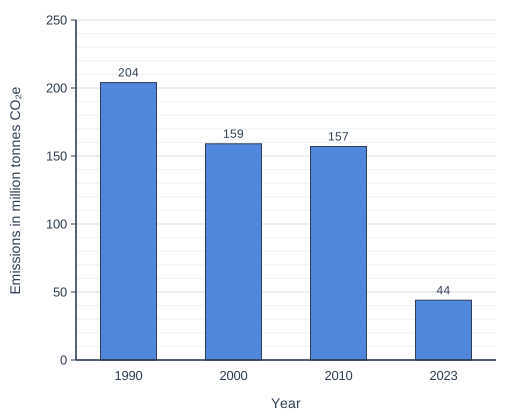
Bar chart of Emissions in million tonnes CO₂e for each year: 1990 204, 2000 159, 2010 157, 2023 44.

Model answer

More electricity was made by wind turbines

Explanation

Using alternative energy resources such as wind and solar instead of fossil fuels is one of the main ways to reduce carbon dioxide emissions. Between 2010 and 2023 many UK coal-fired power stations closed and much more electricity was generated by wind turbines.

Mark scheme
  1. 1 mark

    More electricity was made by wind turbines

    If more than one option is given, 0 marks. Burning more coal or more oil would increase carbon dioxide emissions, not decrease them. Using more electricity would mean more had to be generated, so it would not explain a decrease (UK electricity use actually fell). Wind turbines generate electricity without burning fuel, so replacing fossil-fuel power stations with wind turbines reduces emissions.

Question 2

2 marks

Which two are potential effects of global climate change?

Give two answers from this list: A, B, C, D, E

A More carbon monoxide in the air
B More frequent and more severe storms
C More sulfur dioxide in the air
D Changes in where some wildlife species live
E More particulates in the air

Model answer

B and D

Explanation

Potential effects of global climate change include more frequent and more severe storms and changes in the distribution of wildlife species, as well as sea level rise, changes in rainfall and changes in food production. A common mistake is to think climate change causes more air pollution: carbon monoxide, sulfur dioxide and particulates come from burning fuels.

Mark scheme
  1. 1 mark

    B (more frequent and more severe storms)

    The two answers can be given in either order. allow the words of the option instead of the letter. List rule: each wrong extra answer cancels a correct one, e.g. B, D, E scores 1 mark and B, D, A, C scores 0 marks.

  2. 1 mark

    D (changes in where some wildlife species live)

    A, C and E are wrong: carbon monoxide, sulfur dioxide and particulates are air pollutants produced when fuels burn. They are not effects of climate change.

Question 3

2 marks

Car travel and flying make up a large part of many people's carbon footprints.

Suggest two reasons why many people do not change how they travel.

Model answer

Many people do not want to change their lifestyle, because cars and flights are quicker and more convenient. Also, in many places there is no good public transport, or travelling by train costs more than driving.

Explanation

Actions to reduce emissions are often limited because people are reluctant to change their lifestyles, because the low-carbon choice can cost more or may not be available, and because some people lack information or doubt the evidence. Two different reasons are needed.

Mark scheme
  1. 1 mark

    first reason, e.g. cars or flights are more convenient / quicker / people do not want to change their lifestyle (e.g. holidays abroad)

    Any two from: people do not want to change their lifestyle / cars and flights are convenient or quicker; other ways of travelling cost more (e.g. train tickets, electric cars); there is no good public transport where they live (e.g. in the countryside); lack of information or education about carbon footprints; people think their own actions make little difference / doubt that climate change is caused by humans. List rule: each wrong extra reason cancels a correct one.

  2. 1 mark

    a second, different reason, e.g. alternatives cost more / no good public transport nearby / lack of information about carbon footprints

    the two reasons must be different. ignore 'people are lazy' alone.

Question 4

4 marks

Riverford is a town in England. It is built next to a large river, a long way from the sea.

Explain two ways that global climate change could affect the people who live in Riverford.

Model answer

Climate change could cause heavier rainfall, especially in winter. The river could then flood homes, roads and businesses in Riverford.

Climate change could also cause hotter, drier summers with more droughts and heatwaves. There could be water shortages in the town, and people, especially elderly people, could suffer from heat stress.

Explanation

Each way needs a potential effect of climate change (heavier rain, more severe storms, droughts, heatwaves) and what it would mean for the people of Riverford. 'It will get hotter' on its own is not enough, because that is the cause of climate change, not an effect. Sea level rise does not fit this town because it is far from the sea.

Mark scheme
  1. 1 mark

    a potential effect of climate change, e.g. heavier rainfall / more frequent and more severe storms / hotter, drier summers or droughts / more heatwaves

    Any two pairs from:
    - heavier or more frequent rainfall (1) so the river floods homes, roads or businesses (1)
    - more frequent and more severe storms (1) so buildings, trees or power lines are damaged / the town floods (1)
    - hotter, drier summers / droughts / less rain in summer (1) so there are water shortages / water use is restricted / local crops fail (1)
    - more heatwaves / higher summer temperatures (1) so people suffer heat stress / heat-related illness, especially elderly people (1)
    - changes in food production (1) so food becomes scarcer or more expensive (1)
    ignore 'it gets hotter' / 'the temperature rises' on its own: that is the cause of climate change and needs a specific effect and consequence, e.g. heatwaves causing heat stress.
    ignore sea level rise and coastal flooding: Riverford is a long way from the sea.
    do not accept acid rain, global dimming or damage to the ozone layer.

  2. 1 mark

    a consequence for the people of Riverford linked to that effect

    the consequence must follow from the effect given for the first mark (see the pairs listed in the first mark point).

  3. 1 mark

    a second, different potential effect of climate change

    must be different from the first effect (e.g. 'heavier rain' and 'more rain' count as the same effect).

  4. 1 mark

    a consequence for the people of Riverford linked to the second effect

    the consequence must follow from the second effect.

Ready to try the rest? Every answer you write is marked against the mark scheme, so you can see exactly where the marks are.

Study Helper Hints first, answers after you try

Stuck on this one? Ask for a hint and I’ll point you in the right direction, without giving the answer away. Once you’ve checked your answer, I’ll show you how the marks are awarded.