
Level:
Correct: 0
Incorrect: 0
Marks: 0/0
Exam Practice
Course:
Topics:
AQA GCSE Combined Science (Foundation Chemistry Paper 2) Smart practice A mixed round aimed at your weak spots
Unit 13
The rate and extent of chemical change
Unit 14
Organic chemistry
Unit 15
Chemical analysis
Purity, formulations and chromatography
Pure substances and formulations
Chromatography
Identification of common gases
Unit 16
Chemistry of the atmosphere
The composition and evolution of the Earth's atmosphere
Common atmospheric pollutants and their sources
Unit 17
Using resources
Life cycle assessment and recycling
Avg
score:
–
Topics
done:
0/16

Life cycle assessment and recycling

Practise 22 exam-style questions on Life cycle assessment and recycling for AQA GCSE Combined Science (Foundation Chemistry Paper 2). Write your answer as you would in the exam and get it marked in seconds against the mark scheme, point by point, with the Study Helper on hand if you get stuck.

  • 22 questions
  • 1–6 marks each
  • Instant marking
  • No sign-up needed
20 questions, marked as you go

Sample questions with model answers

Here are 4 of the questions in this topic, each with a model answer, an explanation of why it earns the marks and the mark scheme an examiner would use.

Question 1

1 mark

Which material is produced from limited raw materials?

Choose your answer.

  • Cotton
  • Glass
  • Paper
  • Wool

Model answer

Glass

Explanation

Glass is made from sand, limestone and sodium carbonate, which are obtained by quarrying and mining and are limited raw materials. Metals, building materials and most plastics are also made from limited raw materials. The other three come from plants or animals that can be grown again.

Mark scheme
  1. 1 mark

    Glass

    If more than one option is given, 0 marks. Cotton comes from plants, paper from trees and wool from sheep, so they come from renewable resources.
Question 2

2 marks

Glass milk bottles can be reused or recycled.

Explain why reusing a glass milk bottle uses less energy than recycling it.

Model answer

To recycle the bottle, the glass has to be crushed and melted at a high temperature to make new glass products, which needs a lot of energy. To reuse it, the bottle only has to be collected, washed and refilled, so no melting is needed and much less energy is used.

Explanation

Reuse keeps the product as it is, while recycling breaks it down and remakes it. Melting glass needs high temperatures, so recycling uses much more energy than washing a bottle. Make sure you do not mix up reuse and recycling.

Mark scheme
  1. 1 mark

    recycling: the glass is crushed and melted (at a high temperature) to make new glass products

    allow melting the glass needs a lot of energy

  2. 1 mark

    reusing: the bottle is only collected, washed (and sterilised) and refilled, so it does not need to be melted

    allow reusing needs only cleaning; ignore 'reusing is free'

Question 3

2 marks

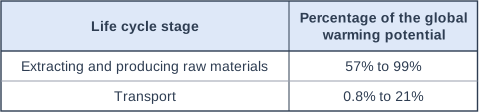
An Environment Agency LCA (2011) of seven types of carrier bag found how much of the global warming potential of each type of bag was caused by two of its life cycle stages. The table shows the smallest and largest percentages for the seven types of bag.

A supermarket plans to reduce the environmental impact of its carrier bags by buying them from a factory closer to its shops.

Evaluate the supermarket's plan. Use the data.

Table with columns "Life cycle stage", "Percentage of the global warming potential". Life cycle stage: Extracting and producing raw materials; Percentage of the global warming potential: 57% to 99% | Life cycle stage: Transport; Percentage of the global warming potential: 0.8% to 21%.

Model answer

Transport causes at most 21% of the global warming potential of a bag, and usually much less, so buying from a closer factory will only make a small difference. Raw materials cause 57% to 99% of the impact, so the supermarket would reduce the impact much more by using bags with less material or by encouraging customers to reuse their bags.

Explanation

Interpreting an LCA means finding which stage has the biggest impact. Here raw material extraction and production dominate, while transport is small. An evaluation needs a judgement about the plan, supported by the percentages given.

Mark scheme
  1. 1 mark

    transport causes only a small part (at most 21%) of the global warming potential, so the plan will make only a small difference

    allow the plan will help a little because transport is reduced; allow transport is (much) less than raw materials for every bag

  2. 1 mark

    a bigger reduction would come from using less raw material / bags with less material / encouraging customers to reuse bags, because raw materials cause 57% to 99% of the impact

    allow the plan is not the best way to reduce the impact; must refer to raw materials or reuse for this mark

Question 4

4 marks

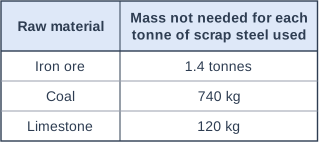
Using scrap steel to make new steel means that some raw materials are not needed. The table shows the mass of each raw material that is not needed for every tonne of scrap steel used (data from the World Steel Association).

A steelworks uses 3.0 × 10⁵ tonnes of scrap steel in one year.

Calculate the total mass of iron ore, coal and limestone that is not needed.

Give your answer in tonnes, in standard form.

1 tonne = 1000 kg

Table with columns "Raw material", "Mass not needed for each tonne of scrap steel used". Raw material: Iron ore; Mass not needed for each tonne of scrap steel used: 1.4 tonnes | Raw material: Coal; Mass not needed for each tonne of scrap steel used: 740 kg | Raw material: Limestone; Mass not needed for each tonne of scrap steel used: 120 kg.

Model answer

740 kg = 0.740 tonnes and 120 kg = 0.120 tonnes
Raw materials saved for each tonne of scrap = 1.4 + 0.740 + 0.120 = 2.26 tonnes
Total saved = 2.26 × 3.0 × 10⁵ = 678 000 tonnes
Total saved = 6.78 × 10⁵ tonnes

Explanation

Convert the masses in kg to tonnes first, so that all three are in the same unit, then add them and multiply by the mass of scrap. Forgetting to convert kg to tonnes (giving a huge answer) is the most likely error. Recycling scrap steel reduces the amount of iron that has to be extracted from iron ore, and saves the coal and limestone used in the blast furnace.

Mark scheme
  1. 1 mark

    (740 kg =) 0.740 (tonnes) and (120 kg =) 0.120 (tonnes)

    a correct answer with no working scores full marks; full marks are not awarded for a correct final answer from incorrect working

  2. 1 mark

    (1.4 + 0.740 + 0.120 =) 2.26 (tonnes per tonne of scrap)

    allow ecf from their conversions; allow separate masses for this mark: iron ore 4.2 × 10⁵ t, coal 2.22 × 10⁵ t, limestone 3.6 × 10⁴ t

  3. 1 mark

    (2.26 × 3.0 × 10⁵ =) 678 000 (tonnes)

    allow ecf from their mass per tonne of scrap

  4. 1 mark

    6.78 × 10⁵ (tonnes)

    allow their answer correctly written in standard form; allow 6.8 × 10⁵

Ready to try the rest? Every answer you write is marked against the mark scheme, so you can see exactly where the marks are.

Study Helper Hints first, answers after you try

Stuck on this one? Ask for a hint and I’ll point you in the right direction, without giving the answer away. Once you’ve checked your answer, I’ll show you how the marks are awarded.