
Level:
Correct: 0
Incorrect: 0
Marks: 0/0
Exam Practice
Course:
Topics:
AQA GCSE Combined Science (Foundation Chemistry Paper 2) Smart practice A mixed round aimed at your weak spots
Unit 13
The rate and extent of chemical change
Unit 14
Organic chemistry
Unit 15
Chemical analysis
Purity, formulations and chromatography
Pure substances and formulations
Chromatography
Identification of common gases
Unit 16
Chemistry of the atmosphere
The composition and evolution of the Earth's atmosphere
Common atmospheric pollutants and their sources
Unit 17
Using resources
Life cycle assessment and recycling
Avg
score:
–
Topics
done:
0/16

Greenhouse gases and human activities which increase them

Practise 21 exam-style questions on Greenhouse gases and human activities which increase them for AQA GCSE Combined Science (Foundation Chemistry Paper 2). Write your answer as you would in the exam and get it marked in seconds against the mark scheme, point by point, with the Study Helper on hand if you get stuck.

  • 21 questions
  • 1–6 marks each
  • Instant marking
  • No sign-up needed
20 questions, marked as you go

Sample questions with model answers

Here are 4 of the questions in this topic, each with a model answer, an explanation of why it earns the marks and the mark scheme an examiner would use.

Question 1

1 mark

Greenhouse gases in the atmosphere are important for life on Earth.

Which statement explains why?

Choose your answer.

  • They provide the oxygen that animals need
  • They stop all radiation escaping from the Earth
  • They keep the Earth warm enough for life
  • They absorb all the radiation from the Sun

Model answer

They keep the Earth warm enough for life

Explanation

Greenhouse gases maintain temperatures on Earth high enough to support life: without them the Earth's surface would be well below 0 °C. They do this by absorbing some of the long wavelength radiation emitted by the Earth, not all of it. The words 'all' in two of the options make those statements wrong.

Mark scheme
  1. 1 mark

    They keep the Earth warm enough for life

    If more than one option is given, 0 marks. Oxygen is not a greenhouse gas. Greenhouse gases absorb only some of the long wavelength radiation, so some radiation still escapes into space. Most radiation from the Sun passes through the atmosphere.
Question 2

2 marks

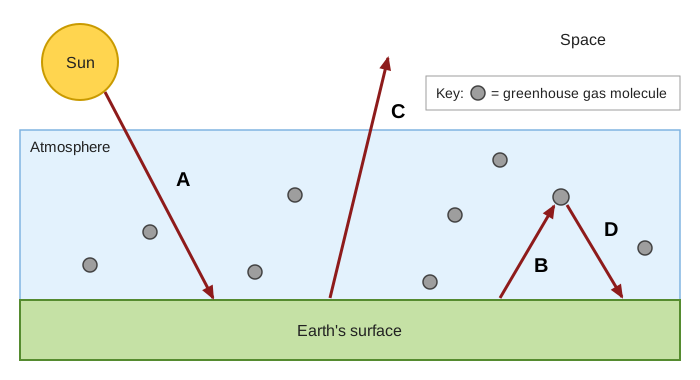
The diagram shows radiation travelling between the Sun, the Earth's atmosphere and the Earth's surface.

Which arrow, A, B, C or D, shows short wavelength radiation?

Explain why arrow D goes down towards the Earth's surface.

A diagram with the Sun at the top left, a shaded band labelled Atmosphere containing small grey circles, and a band labelled Earth's surface at the bottom. Above the atmosphere is space. A key at the top right shows that each grey circle is a greenhouse gas molecule. Arrow A goes from the Sun, down through the atmosphere, to the Earth's surface. Arrow C goes up from the Earth's surface, through the atmosphere and out into space. Arrow B goes up from the Earth's surface and ends at a greenhouse gas molecule in the atmosphere. Arrow D starts at the same greenhouse gas molecule and goes down to the Earth's surface. All four arrows are drawn in the same style.

Model answer

Arrow A. Greenhouse gas molecules absorb long wavelength radiation emitted by the Earth's surface (arrow B) and then emit radiation in all directions, so some of it goes back down towards the Earth's surface (arrow D).

Explanation

Radiation from the Sun is short wavelength radiation, and most of it passes through the atmosphere to the Earth's surface. The warm surface emits long wavelength radiation; some escapes into space (arrow C) and some is absorbed by greenhouse gases, which then emit it in all directions, including back to the surface. Saying that the gases 'reflect' the radiation is a common misconception.

Mark scheme
  1. 1 mark

    A

    do not accept more than one letter.

  2. 1 mark

    greenhouse gases absorb long wavelength radiation (emitted by the Earth's surface) and then emit it in all directions / some of it back towards the Earth's surface

    allow 'the greenhouse gas molecule absorbs the radiation from arrow B and gives it out again, some of it downwards'. do not accept 'the greenhouse gases reflect the radiation back to the Earth' or 'the radiation bounces off the gases'.

Question 3

2 marks

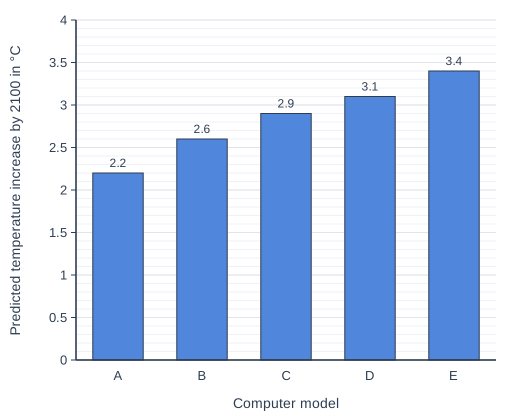
A report shows predictions from five computer models of the rise in the Earth's mean surface temperature by 2100, compared with 1850 to 1900. The bar chart shows these predictions, which are illustrative values.

Calculate the mean of the five predictions.

Bar chart of predicted temperature increase by 2100 in °C for each computer model: A 2.2, B 2.6, C 2.9, D 3.1, E 3.4.

Model answer

Total = 2.2 + 2.6 + 2.9 + 3.1 + 3.4 = 14.2
Mean = 14.2 ÷ 5 = 2.84 °C

Explanation

To find the mean, add the five values and divide by the number of values, 5. The middle value (2.9 °C) is the median, not the mean. Scientists often report a mean or a range of model predictions because each model is a simplified version of a very complex system.

Mark scheme
  1. 1 mark

    (2.2 + 2.6 + 2.9 + 3.1 + 3.4 =) 14.2

  2. 1 mark

    (14.2 ÷ 5 =) 2.84 (°C)

    allow 2.8. allow ecf from an incorrect total. A correct answer with no working scores full marks. Full marks are not awarded for a correct final answer from incorrect working. 2.9 (the middle value, the median) with no working scores 0.

Question 4

4 marks

Human activities have increased the amount of methane in the atmosphere.

Explain how two different human activities increase the amount of methane in the atmosphere.

Model answer

Cattle farming: more cattle are kept for meat and milk, and cattle produce methane in their digestive systems, which they release into the air.
Growing rice: rice is grown in flooded paddy fields, where plant material decays in the waterlogged soil and releases methane.

Explanation

For each activity, name it and then say how the methane is produced: digestion in cattle, decay in flooded rice fields, or the decomposition of rubbish in landfill sites. Burning fossil fuels and deforestation are carbon dioxide activities, so they do not score here.

Mark scheme
  1. 1 mark

    cattle farming / keeping more cattle (for meat or milk)

    allow 'farming cows'.

  2. 1 mark

    cattle produce methane in their digestive systems (and release it into the air)

    must be linked to cattle. allow 'cows burp out methane'.

  3. 1 mark

    growing rice (in flooded paddy fields)

  4. 1 mark

    plant material decays / decomposes in the flooded (waterlogged) soil, releasing methane

    must be linked to rice fields. allow 'microorganisms / bacteria in the flooded fields produce methane'.

  5. 1 mark

    putting rubbish in landfill sites

  6. 1 mark

    waste (e.g. food or paper) in landfill decomposes / is broken down by microorganisms, releasing methane

    must be linked to landfill. max 4: up to 2 marks for each of two activities (1 mark for the activity and 1 mark for how it releases methane). Credit two activities only. do not accept burning fossil fuels or deforestation (these increase carbon dioxide).

  7. 1 mark

    leaks of natural gas (from gas wells or pipes)

    allow 'extracting natural gas' if leaks or escaping gas are mentioned.

  8. 1 mark

    natural gas is (mainly) methane, so the leaked gas adds methane to the air

    must be linked to the leaks of natural gas.

Ready to try the rest? Every answer you write is marked against the mark scheme, so you can see exactly where the marks are.

Study Helper Hints first, answers after you try

Stuck on this one? Ask for a hint and I’ll point you in the right direction, without giving the answer away. Once you’ve checked your answer, I’ll show you how the marks are awarded.