Level:
Correct: 0
Incorrect: 0
Marks: 0/0
Exam Practice
Course:
Topics:
AQA GCSE Combined Science (Foundation Chemistry Paper 2) Smart practice A mixed round aimed at your weak spots
Unit 13
The rate and extent of chemical change
Unit 14
Organic chemistry
Unit 15
Chemical analysis
Purity, formulations and chromatography
Pure substances and formulations
Chromatography
Identification of common gases
Unit 16
Chemistry of the atmosphere
The composition and evolution of the Earth's atmosphere
Common atmospheric pollutants and their sources
Unit 17
Using resources
Life cycle assessment and recycling
Avg
score:
–
Topics
done:
0/16

Crude oil, hydrocarbons and alkanes

Practise 21 exam-style questions on Crude oil, hydrocarbons and alkanes for AQA GCSE Combined Science (Foundation Chemistry Paper 2). Write your answer as you would in the exam and get it marked in seconds against the mark scheme, point by point, with the Study Helper on hand if you get stuck.

  • 21 questions
  • 1–6 marks each
  • Instant marking
  • No sign-up needed
20 questions, marked as you go

Sample questions with model answers

Here are 4 of the questions in this topic, each with a model answer, an explanation of why it earns the marks and the mark scheme an examiner would use.

Question 1

1 mark

Which of these is the molecular formula of an alkane?

Choose your answer.

  • C₆H₁₂O₆
  • C₇H₁₄
  • C₄H₈
  • C₅H₁₂

Model answer

C₅H₁₂

Explanation

Alkanes have the general formula CₙH₂ₙ₊₂: the number of hydrogen atoms is twice the number of carbon atoms, plus 2. For C₅H₁₂, 2 × 5 + 2 = 12, so it fits. C₇H₁₄ and C₄H₈ have only twice as many hydrogen atoms as carbon atoms, and C₆H₁₂O₆ (glucose) contains oxygen, so it is not even a hydrocarbon.

Mark scheme
  1. 1 mark

    C₅H₁₂

    If more than one option is given, 0 marks. Allow C5H12 typed without subscripts. C₆H₁₂O₆ is wrong: it contains oxygen, so it is not a hydrocarbon. C₇H₁₄ is wrong: an alkane with 7 carbon atoms would have 2 × 7 + 2 = 16 hydrogen atoms (C₇H₁₆). C₄H₈ is wrong: an alkane with 4 carbon atoms would have 2 × 4 + 2 = 10 hydrogen atoms (C₄H₁₀).

Question 2

1 mark

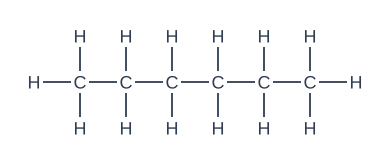
Petrol contains several different alkanes. Figure 1 shows one of them.

Write the molecular formula of this alkane.

Figure 1: the displayed formula of a molecule. A chain of six carbon atoms is joined by single bonds. Each of the two end carbon atoms is also joined to three hydrogen atoms, and each of the four middle carbon atoms is joined to two hydrogen atoms. Every bond is drawn as a single line.

Model answer

C₆H₁₄

Explanation

Count the atoms: 6 carbon atoms in the chain, and 3 + 3 hydrogen atoms on the end carbons plus 2 on each of the 4 middle carbons, which is 14 hydrogen atoms. Check with the general formula: 2 × 6 + 2 = 14. Write the formula with C first and the numbers after each symbol: C₆H₁₄.

Mark scheme
  1. 1 mark

    C₆H₁₄

    Allow C6H14 written without subscripts. Do not accept C₆H₁₂ or C₆H₁₆ (miscounted hydrogen atoms), CH₁₄ or 6C14H. The name hexane alone does not give the molecular formula, so it scores 0; ignore the name if the correct formula is also given.

Question 3

2 marks

C₅H₁₀ is a hydrocarbon.

Explain why C₅H₁₀ is a hydrocarbon but is not an alkane.

Model answer

C₅H₁₀ contains only carbon and hydrogen atoms, so it is a hydrocarbon. An alkane with 5 carbon atoms would have 2 × 5 + 2 = 12 hydrogen atoms (C₅H₁₂), so C₅H₁₀ does not fit the general formula CₙH₂ₙ₊₂ and is not an alkane.

Explanation

All alkanes are hydrocarbons, but not all hydrocarbons are alkanes. Test a formula in two steps: does it contain only carbon and hydrogen, and does the number of hydrogen atoms equal 2n + 2? C₅H₁₀ passes the first test but fails the second.

Mark scheme
  1. 1 mark

    it contains (atoms of) hydrogen and carbon only

    Do not accept 'it contains hydrogen and carbon' without the idea of only (this does not rule out other elements).

  2. 1 mark

    an alkane with 5 carbon atoms would have 12 hydrogen atoms / would be C₅H₁₂ / C₅H₁₀ does not fit the general formula CₙH₂ₙ₊₂

    Allow '2 × 5 + 2 = 12, not 10'. Allow 'it has too few hydrogen atoms to be an alkane'. Ignore 'it is an alkene' or 'it has a double bond' (these do not explain why the formula is not an alkane's).

Question 4

4 marks

Crude oil is a finite resource found in rocks.

Describe how crude oil was formed.

Explain why crude oil is described as a finite resource.

Model answer

Crude oil was formed from the remains of an ancient biomass, mainly plankton, which was buried in mud. Over millions of years, under heat and pressure, the remains slowly changed into crude oil, which is found in rocks.

Crude oil is finite because it takes millions of years to form, but we are using it up much faster than that. Once it has been used it cannot be replaced, so it will run out.

Explanation

Two marks are for formation (plankton or ancient biomass, buried in mud) and two for the explanation of finite (forms over millions of years, used much faster than it forms, so it will run out). Many students write 'non-renewable' without a reason, or think crude oil formed from trees or dinosaurs.

Mark scheme
  1. 1 mark

    (from the) remains of (ancient) plankton / ancient biomass

    Allow microscopic plants or animals / tiny sea organisms. Do not accept trees, dinosaurs or rocks. Ignore 'fossils' or 'dead things' alone.

  2. 1 mark

    (which were) buried in mud

    Allow buried under sediment / under layers of rock / under the sea bed. Do not award this mark for 'over millions of years' alone: that idea is credited in the third mark.

  3. 1 mark

    it takes millions of years to form / it forms very slowly

    Allow 'it is not being made now in useful amounts'.

  4. 1 mark

    it is being used up much faster than it is formed / it cannot be replaced once it is used / it will run out

    Ignore 'it is non-renewable' alone (this repeats 'finite'). Ignore 'it is limited' alone.

Ready to try the rest? Every answer you write is marked against the mark scheme, so you can see exactly where the marks are.

Revision notes

Crude oil, hydrocarbons and alkanes

The big idea

Crude oil is the starting point for most of the fuels and plastics we use. It is a mixture of a very large number of compounds, and most of them are hydrocarbons called alkanes. In the exam you need to say what crude oil is and how it formed, and to recognise an alkane from its name or its formula.

What crude oil is

  • Crude oil is found in rocks. It is the remains of an ancient biomass (living material) made mainly of plankton, tiny organisms that lived in the sea, which was buried in mud. Over millions of years, heat and pressure underground slowly changed it into oil.
  • It is a finite (non-renewable) resource. It took millions of years to form and is not being replaced at a useful rate, so we are using it up far faster than it forms and it will eventually run out.
  • It is a mixture: its compounds are not chemically bonded to each other, so they can be separated by physical methods (see also: Fractional distillation and petrochemicals).

Hydrocarbons

A hydrocarbon is a compound whose molecules are made of hydrogen and carbon atoms only. The word "only" matters. Ethanol (C₂H₅OH) contains carbon and hydrogen, but it also contains oxygen, so it is not a hydrocarbon. Most of the compounds in crude oil are hydrocarbons, and most of these hydrocarbons are alkanes.

The alkanes

The alkanes are a homologous series: a family of compounds that

  • have the same general formula;
  • differ from one member to the next by CH₂;
  • have similar chemical reactions (for example, all alkanes burn to give carbon dioxide and water);
  • show a gradual trend in physical properties, such as boiling point.

The general formula of the alkanes is CₙH₂ₙ₊₂: an alkane with \(n\) carbon atoms has \(2n + 2\) hydrogen atoms. You need to know the names of the first four.

NameCarbon atomsMolecular formulaStructural formula
methane1CH₄CH₄
ethane2C₂H₆CH₃CH₃
propane3C₃H₈CH₃CH₂CH₃
butane4C₄H₁₀CH₃CH₂CH₂CH₃
Displayed formula of methane (labelled "Methane") displayed formula of ethane (labelled "Ethane") displayed formula of propane (labelled "Propane") displayed formula of butane (labelled "Butane"). (Methane = methane; Ethane = ethane; Propane = propane; Butane = butane.)
Displayed formulae show every atom and every covalent bond: each carbon atom forms four bonds and each hydrogen atom forms one.

Alkanes are saturated: every carbon-carbon bond is a single bond, so each molecule holds the maximum possible number of hydrogen atoms.

Recognising an alkane

You may be given a molecular formula (C₂H₆) or a displayed formula. It is an alkane if:

  1. it contains only carbon and hydrogen;
  2. it has only single bonds;
  3. the number of hydrogen atoms is twice the number of carbon atoms plus two.

You do not need to name alkanes bigger than butane, but you must recognise them: C₁₁H₂₄ fits CₙH₂ₙ₊₂, so it is an alkane, while C₆H₁₂ has too few hydrogen atoms and C₃H₈O contains oxygen.

Finding an alkane from its hydrogen-to-carbon ratio

An alkane has 2.4 hydrogen atoms for every carbon atom. Find its molecular formula.

With \(n\) carbon atoms there are \(2n + 2\) hydrogen atoms, so \(2n + 2 = 2.4n\)

\(2 = 0.4n\), so \(n = 5\) and the alkane is C₅H₁₂.

Check: \(12 \div 5 = 2.4\)

Remember

  • Crude oil is a finite resource found in rocks: the remains of an ancient biomass, mainly plankton, buried in mud.
  • A hydrocarbon contains hydrogen and carbon atoms only.
  • Alkanes have the general formula CₙH₂ₙ₊₂ and only single bonds (they are saturated).
  • The first four alkanes are methane, ethane, propane and butane.

Common mistakes

  • Saying crude oil formed from dinosaurs. It formed mainly from plankton buried in mud.
  • Defining a hydrocarbon as "a mixture of hydrogen and carbon". It is a compound made of hydrogen and carbon atoms only.
  • Calling crude oil a compound. It is a mixture of many compounds.
  • Writing the alkane general formula as CₙH₂ₙ. That is the general formula of the alkenes.
  • Writing -ene for -ane: ethene and butene are alkenes, not alkanes.

Exam tip

When a question asks you to show that a compound is an alkane, write the check out in full: "\(n = 12\), so there are \((2 \times 12) + 2 = 26\) hydrogen atoms; C₁₂H₂₆ fits CₙH₂ₙ₊₂". For "explain why crude oil is finite", link both halves: it took millions of years to form, so it is being used up much faster than it is made.

Study Helper Hints first, answers after you try

Stuck on this one? Ask for a hint and I’ll point you in the right direction, without giving the answer away. Once you’ve checked your answer, I’ll show you how the marks are awarded.