
Level:
Correct: 0
Incorrect: 0
Marks: 0/0
Exam Practice
Course:
Topics:
AQA GCSE Combined Science (Foundation Chemistry Paper 2) Smart practice A mixed round aimed at your weak spots
Unit 13
The rate and extent of chemical change
Unit 14
Organic chemistry
Unit 15
Chemical analysis
Purity, formulations and chromatography
Pure substances and formulations
Chromatography
Identification of common gases
Unit 16
Chemistry of the atmosphere
The composition and evolution of the Earth's atmosphere
Common atmospheric pollutants and their sources
Unit 17
Using resources
Life cycle assessment and recycling
Avg
score:
–
Topics
done:
0/16

Collision theory, activation energy and catalysts

Practise 21 exam-style questions on Collision theory, activation energy and catalysts for AQA GCSE Combined Science (Foundation Chemistry Paper 2). Write your answer as you would in the exam and get it marked in seconds against the mark scheme, point by point, with the Study Helper on hand if you get stuck.

  • 21 questions
  • 1–6 marks each
  • Instant marking
  • No sign-up needed
20 questions, marked as you go

Sample questions with model answers

Here are 4 of the questions in this topic, each with a model answer, an explanation of why it earns the marks and the mark scheme an examiner would use.

Question 1

1 mark

A block of calcium carbonate is broken into small pieces. The total mass of calcium carbonate does not change.

What happens to the surface area to volume ratio of the calcium carbonate?

Choose your answer.

  • It decreases
  • It stays the same
  • It increases
  • It becomes zero

Model answer

It increases

Explanation

Smaller pieces have a larger surface area to volume ratio, so more of the particles are on the surface where acid particles can collide with them. This increases the frequency of collisions and the rate of reaction. A common error is to think the surface area stays the same because the mass is the same.

Mark scheme
  1. 1 mark

    It increases

    If more than one option is given, 0 marks. The total volume stays the same, but breaking the block exposes new surfaces, so the total surface area and the surface area to volume ratio increase. 'It stays the same' is wrong because the surface area changes even though the volume does not. The ratio cannot be zero while the pieces have surfaces.
Question 2

1 mark

In an investigation, the rate of reaction between a metal and an acid was directly proportional to the concentration of the acid.

With acid of concentration 20 g/dm³, the mean rate of reaction was 0.25 cm³/s.

Predict the mean rate of reaction with acid of concentration 60 g/dm³.

Model answer

60 ÷ 20 = 3, so the rate is 3 times greater.
0.25 × 3 = 0.75 cm³/s

Explanation

Directly proportional means that if the concentration is multiplied by a number, the rate is multiplied by the same number. 60 g/dm³ is three times 20 g/dm³, so the rate is three times 0.25 cm³/s. In collision theory terms, three times as many acid particles in the same volume give three times as many collisions per second.

Mark scheme
  1. 1 mark

    0.75 (cm³/s)

    A correct answer with no working scores full marks. The concentration is 3 times greater, so the rate is 3 times greater: 0.25 × 3. Do not accept 0.083 (0.25 ÷ 3) or 0.5 (doubling instead of multiplying by 3).

Question 3

2 marks

A catalytic converter in a car exhaust system speeds up reactions that change harmful gases into less harmful gases. It contains a honeycomb structure with very many narrow channels. The walls of the channels are coated with a thin layer of a metal catalyst.

Suggest two reasons why the catalyst is spread thinly over the honeycomb instead of being used as a solid lump.

Model answer

Spreading the catalyst thinly gives it a much larger surface area, so more of the gas particles collide with the catalyst and the reactions are faster. Also, much less of the expensive metal catalyst is needed.

Explanation

The reactions happen on the surface of the catalyst, so a thin coating over a honeycomb with many channels gives a very large surface area for a small mass of metal. More gas particles reach the catalyst surface, so the harmful gases react faster as they pass through. Using less of a rare, expensive metal is a second good reason.

Mark scheme
  1. 1 mark

    it gives the catalyst a larger surface area

    any two from the three points, max 2. allow 'more of the catalyst is exposed to the gases'.

  2. 1 mark

    so more gas particles collide with the catalyst (each second) / the reactions are faster / more of the harmful gases react as they pass through

    allow 'more frequent collisions with the catalyst'.

  3. 1 mark

    less catalyst is needed (so it costs less) / the metal catalyst is expensive or rare

    Ignore 'it is lighter' and 'the catalyst lasts longer'. Max 2.

Question 4

4 marks

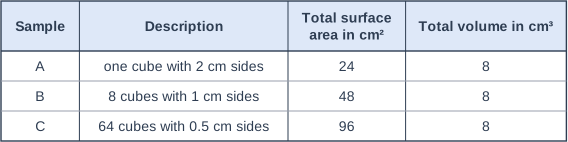
A student has three samples of calcium carbonate, A, B and C. Each sample has a total volume of 8 cm³.

The table shows information about the samples.

Calculate the surface area to volume ratio of sample A and of sample C.

Use your values to explain which sample would react fastest with dilute hydrochloric acid.

Table with columns "Sample", "Description", "Total surface area in cm²", "Total volume in cm³". Sample: A; Description: one cube with 2 cm sides; Total surface area in cm²: 24; Total volume in cm³: 8 | Sample: B; Description: 8 cubes with 1 cm sides; Total surface area in cm²: 48; Total volume in cm³: 8 | Sample: C; Description: 64 cubes with 0.5 cm sides; Total surface area in cm²: 96; Total volume in cm³: 8.

Model answer

Sample A: 24 ÷ 8 = 3, so the ratio is 3 : 1
Sample C: 96 ÷ 8 = 12, so the ratio is 12 : 1
Sample C would react fastest. It has the largest surface area to volume ratio (4 times that of A), so more of its particles are on the surface where acid particles can collide with them. Collisions are more frequent, so the rate is faster.

Explanation

The surface area to volume ratio is the surface area divided by the volume. All three samples have the same volume, but cutting into smaller cubes increases the surface area, so C's ratio is 4 times A's. A larger ratio exposes more particles to the acid and increases the frequency of collisions. Dividing the volume by the surface area gives the ratio the wrong way round.

Mark scheme
  1. 1 mark

    (sample A) 24 ÷ 8 = 3 (or 3 : 1)

    A correct answer with no working scores full marks for the ratios. Full marks are not awarded for a correct final answer from incorrect working. If both ratios are inverted (0.33 and 0.083), allow 1 mark for the two ratios.

  2. 1 mark

    (sample C) 96 ÷ 8 = 12 (or 12 : 1)

  3. 1 mark

    sample C (would react fastest)

    allow ecf: the sample with the larger ratio from the student's own values.

  4. 1 mark

    (because) it has the largest surface area to volume ratio, so more particles are exposed to the acid and collisions (with acid particles) are more frequent

    The answer must link the larger ratio to more frequent collisions (or more particles exposed to collide). Ignore 'more collisions' with no reference to time or exposure. Do not accept 'the particles are smaller'.

Ready to try the rest? Every answer you write is marked against the mark scheme, so you can see exactly where the marks are.

Study Helper Hints first, answers after you try

Stuck on this one? Ask for a hint and I’ll point you in the right direction, without giving the answer away. Once you’ve checked your answer, I’ll show you how the marks are awarded.