
Level:
Correct: 0
Incorrect: 0
Marks: 0/0
Exam Practice
Course:
Topics:
AQA GCSE Combined Science (Foundation Chemistry Paper 2) Smart practice A mixed round aimed at your weak spots
Unit 13
The rate and extent of chemical change
Unit 14
Organic chemistry
Unit 15
Chemical analysis
Purity, formulations and chromatography
Pure substances and formulations
Chromatography
Identification of common gases
Unit 16
Chemistry of the atmosphere
The composition and evolution of the Earth's atmosphere
Common atmospheric pollutants and their sources
Unit 17
Using resources
Life cycle assessment and recycling
Avg
score:
–
Topics
done:
0/16

Common atmospheric pollutants and their sources

Practise 21 exam-style questions on Common atmospheric pollutants and their sources for AQA GCSE Combined Science (Foundation Chemistry Paper 2). Write your answer as you would in the exam and get it marked in seconds against the mark scheme, point by point, with the Study Helper on hand if you get stuck.

  • 21 questions
  • 1–6 marks each
  • Instant marking
  • No sign-up needed
20 questions, marked as you go

Sample questions with model answers

Here are 4 of the questions in this topic, each with a model answer, an explanation of why it earns the marks and the mark scheme an examiner would use.

Question 1

1 mark

Some lorries have engines that burn hydrogen as the fuel instead of diesel. The hydrogen burns in air at a high temperature inside the engine.

Which pollutant could still be produced by the engine?

Choose your answer.

  • Carbon monoxide
  • Soot
  • Sulfur dioxide
  • Oxides of nitrogen

Model answer

Oxides of nitrogen

Explanation

Burning hydrogen produces water vapour, and no carbon or sulfur compounds. However, any engine that burns a fuel in air at a high temperature can produce oxides of nitrogen, because the nitrogen comes from the air, not from the fuel.

Mark scheme
  1. 1 mark

    Oxides of nitrogen

    If more than one option is given, 0 marks. Carbon monoxide and soot cannot form because hydrogen contains no carbon. Sulfur dioxide cannot form because hydrogen contains no sulfur. Oxides of nitrogen can still form because nitrogen and oxygen from the air react at the high temperature in the engine.
Question 2

2 marks

A student heats a beaker of water using a Bunsen burner.

When the air hole of the Bunsen burner is open, the flame is blue and the bottom of the beaker stays clean.

When the air hole is closed, the flame is yellow and a black solid forms on the bottom of the beaker.

Explain why the black solid forms when the air hole is closed.

Model answer

With the air hole closed, not enough oxygen mixes with the gas, so incomplete combustion happens. Some of the carbon in the gas is not oxidised and forms soot (carbon particles), which collects on the beaker.

Explanation

Soot is carbon from the fuel that has not been oxidised because there is not enough oxygen. A yellow, smoky flame is a sign of incomplete combustion. A common mistake is to think the black solid is carbon monoxide, which is a gas.

Mark scheme
  1. 1 mark

    less air / oxygen mixes with the gas, so there is incomplete combustion

    allow 'not enough oxygen to burn all the gas'. 'incomplete combustion' alone scores this mark. ignore 'the gas does not burn properly' alone.

  2. 1 mark

    (unburned) carbon / soot is produced (which collects on the beaker)

    allow 'carbon particles' / 'particulates'. do not accept 'carbon monoxide forms the black solid' (carbon monoxide is a colourless gas). do not accept 'the beaker burns'.

Question 3

3 marks

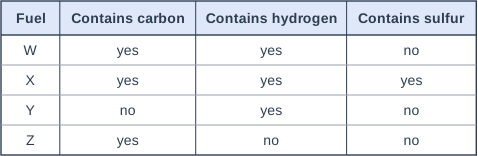
The table shows which elements are in four fuels, W, X, Y and Z.

Use the table to answer these three questions.
Which fuel will produce sulfur dioxide when it burns?
Which fuel will not produce any carbon dioxide when it burns?
Which fuel will not produce any water vapour when it burns?

Give one letter for each answer.

Table with columns "Fuel", "Contains carbon", "Contains hydrogen", "Contains sulfur". Fuel: W; Contains carbon: yes; Contains hydrogen: yes; Contains sulfur: no | Fuel: X; Contains carbon: yes; Contains hydrogen: yes; Contains sulfur: yes | Fuel: Y; Contains carbon: no; Contains hydrogen: yes; Contains sulfur: no | Fuel: Z; Contains carbon: yes; Contains hydrogen: no; Contains sulfur: no.

Model answer

Sulfur dioxide: X
No carbon dioxide: Y
No water vapour: Z

Explanation

The products of combustion can be predicted from the elements in the fuel: carbon forms carbon dioxide (or carbon monoxide and soot in limited oxygen), hydrogen forms water vapour and sulfur forms sulfur dioxide. Fuel Y could be hydrogen and fuel Z could be charcoal, which is almost pure carbon.

Mark scheme
  1. 1 mark

    (produces sulfur dioxide) X

    X is the only fuel that contains sulfur. If more than one letter is given for an answer, 0 marks for that answer.

  2. 1 mark

    (no carbon dioxide) Y

    Y contains no carbon, so no carbon dioxide (or carbon monoxide) can form.

  3. 1 mark

    (no water vapour) Z

    Z contains no hydrogen, so no water can form from the fuel.

Question 4

4 marks

A gas boiler burns natural gas to heat a house. Natural gas is mainly methane (CHâ‚„). The waste gases from the boiler leave the house through a pipe called a flue.

If the flue becomes blocked, the boiler can produce carbon monoxide, which can then get into the house.

Explain why a blocked flue can cause carbon monoxide to be produced, and why carbon monoxide is dangerous for the people in the house.

Model answer

When the flue is blocked, the waste gases cannot escape, so fresh air cannot reach the flame and there is not enough oxygen. The methane then undergoes incomplete combustion, which produces carbon monoxide.

Carbon monoxide is toxic. It is colourless and odourless, so people in the house cannot see or smell it and do not know it is there.

Explanation

Two marks are for how the carbon monoxide forms (not enough oxygen, so incomplete combustion) and two for why it is dangerous (toxic, and not easily detected because it is colourless and odourless). This is why gas appliances should be serviced regularly and why homes should have a carbon monoxide alarm. Saying carbon monoxide is 'clear' or just 'harmful' does not score.

Mark scheme
  1. 1 mark

    not enough oxygen / air reaches the flame (because the waste gases cannot escape, so fresh air cannot get to the flame)

    allow 'a limited supply of oxygen'. ignore 'the gas does not burn properly' alone.

  2. 1 mark

    (so there is) incomplete combustion (of the gas / methane)

    allow 'the gas does not burn completely'. 'incomplete combustion' alone scores this mark.

  3. 1 mark

    carbon monoxide is toxic / poisonous

    allow 'it can kill people'. ignore 'harmful' / 'bad for you' alone.

  4. 1 mark

    carbon monoxide is colourless and / or odourless, so people cannot detect it / do not know it is there

    allow 'cannot be seen or smelled'. either colourless or odourless with the idea that it is not easily detected scores the mark. ignore 'clear' alone.

Ready to try the rest? Every answer you write is marked against the mark scheme, so you can see exactly where the marks are.

Study Helper Hints first, answers after you try

Stuck on this one? Ask for a hint and I’ll point you in the right direction, without giving the answer away. Once you’ve checked your answer, I’ll show you how the marks are awarded.