
Level:
Correct: 0
Incorrect: 0
Marks: 0/0
Exam Practice
Course:
Topics:
AQA GCSE Combined Science (Foundation Chemistry Paper 2) Smart practice A mixed round aimed at your weak spots
Unit 13
The rate and extent of chemical change
Unit 14
Organic chemistry
Unit 15
Chemical analysis
Purity, formulations and chromatography
Pure substances and formulations
Chromatography
Identification of common gases
Unit 16
Chemistry of the atmosphere
The composition and evolution of the Earth's atmosphere
Common atmospheric pollutants and their sources
Unit 17
Using resources
Life cycle assessment and recycling
Avg
score:
–
Topics
done:
0/16

Potable water and waste water treatment

Practise 22 exam-style questions on Potable water and waste water treatment for AQA GCSE Combined Science (Foundation Chemistry Paper 2). Write your answer as you would in the exam and get it marked in seconds against the mark scheme, point by point, with the Study Helper on hand if you get stuck.

  • 22 questions
  • 1–6 marks each
  • Instant marking
  • No sign-up needed
20 questions, marked as you go

Sample questions with model answers

Here are 4 of the questions in this topic, each with a model answer, an explanation of why it earns the marks and the mark scheme an examiner would use.

Question 1

1 mark

Desalination removes dissolved salts from sea water.

Which process can be used for desalination?

Choose your answer.

  • Filtration
  • Sedimentation
  • Reverse osmosis
  • Sterilisation

Model answer

Reverse osmosis

Explanation

Desalination can be done by distillation or by processes that use membranes, such as reverse osmosis. Filtration is the most common wrong answer: a filter cannot remove salts that are dissolved in the water, because dissolved particles pass straight through it.

Mark scheme
  1. 1 mark

    Reverse osmosis

    If more than one option is given, 0 marks. Filtration and sedimentation only remove insoluble solids, not dissolved salts. Sterilisation kills microbes but does not remove salts.
Question 2

2 marks

A student says:

'Tap water is pure water because it is safe to drink.'

Explain why the student is wrong.

Model answer

Tap water is potable, which means it is safe to drink because it has low levels of dissolved salts and microbes. But it still contains dissolved substances such as salts, so it is a mixture and not pure water in the chemical sense.

Explanation

In chemistry, pure means a single substance, so pure water contains nothing but water. Potable water is safe to drink, but it contains small amounts of dissolved salts. The answer needs both ideas: what makes water potable, and why that is different from pure.

Mark scheme
  1. 1 mark

    tap water is potable: it is safe to drink because it has low levels of dissolved salts and microbes

    allow safe to drink does not mean pure; allow 'tap water is potable water'

  2. 1 mark

    but tap water contains dissolved substances (such as salts), so it is not a single substance / it is a mixture, so it is not pure (in the chemical sense)

    allow pure water contains only water (molecules); allow named dissolved substance, e.g. calcium compounds / chlorine; ignore microbes for this mark

Question 3

3 marks

A student wants to find the mass of dissolved solids in a sample of tap water by evaporating it. The tap water contains about 0.3 g of dissolved solids in each dm³. The student uses a balance that reads to 0.01 g.

Calculate the mass of solid that would be left by 10 cm³ and by 100 cm³ of the tap water.

Explain why the student should evaporate 100 cm³ of the tap water rather than 10 cm³.

Model answer

10 cm³: 0.3 × 10 ÷ 1000 = 0.003 g
100 cm³: 0.3 × 100 ÷ 1000 = 0.03 g
The balance reads to 0.01 g, so it could not measure 0.003 g (it would read 0.00 g). The 0.03 g of solid from 100 cm³ can be measured, with a much smaller percentage error.

Explanation

1 dm³ is 1000 cm³, so 10 cm³ is one hundredth of a dm³ and leaves only 0.003 g of solid, which is below the resolution of the balance. Ten times the volume gives ten times the mass, which can be measured. 'It is more reliable' does not explain the problem with the balance's resolution.

Mark scheme
  1. 1 mark

    (10 cm³: 0.3 × 10 ÷ 1000 =) 0.003 (g)

    a correct answer with no working scores the mark; full marks are not awarded for a correct final answer from incorrect working

  2. 1 mark

    (100 cm³: 0.3 × 100 ÷ 1000 =) 0.03 (g)

    allow ecf: 10 × their mass for 10 cm³

  3. 1 mark

    0.003 g is less than 0.01 g, so the balance could not measure it (it would read 0.00 g), but 0.03 g can be measured

    allow ecf from their masses; allow the larger mass gives a smaller percentage error / a more accurate measurement; ignore 'it is a fair test' / 'more reliable'

Question 4

4 marks

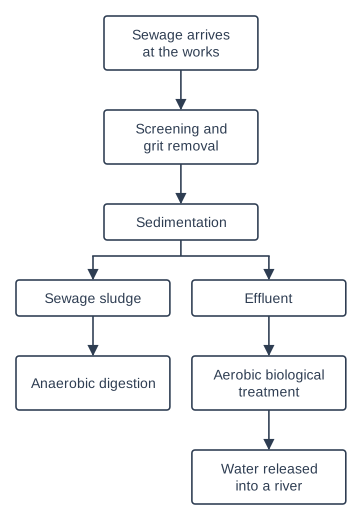
The flow chart shows the main stages in treating sewage.

Explain why each stage is needed so that the water can be safely released into a river.

Flow chart of 8 boxes joined by arrows, read from top to bottom. The first box is "Sewage arrives at the works", which leads to "Screening and grit removal", which leads to "Sedimentation". From "Sedimentation", 2 arrows branch out side by side: the left arrow leads to "Sewage sludge", which leads to "Anaerobic digestion"; the right arrow leads to "Effluent", which leads to "Aerobic biological treatment", which leads to "Water released into a river".

Model answer

Screening removes large objects such as rags, wipes and plastics, which would block the pipes and damage the pumps, and grit is removed because it would damage equipment and fill up the tanks. In sedimentation the sewage is left to settle, so the solid organic matter sinks to form sewage sludge and the liquid effluent can be separated from it. The sludge is digested anaerobically: bacteria break down the organic matter without oxygen, producing biogas that can be used as a fuel. The effluent has air bubbled through it so that aerobic bacteria break down the remaining organic matter. This removes most of the organic matter and harmful microbes, so the water will not use up the oxygen in the river or spread disease when it is released.

Explanation

Sewage treatment removes organic matter and harmful microbes. For the top level, each stage needs a reason linked to what it removes or does, not just its name. The key difference to remember is that sludge is digested anaerobically (without oxygen) and effluent is treated aerobically (with air).

Mark scheme
  1. 4 marks

    Levels of response (4 marks).
    Level 2 (3-4 marks): Relevant points (reasons / causes) are identified, given in detail and logically linked to form a clear account.
    Level 1 (1-2 marks): Points are identified and stated simply, but their relevance is not clear and there is no attempt at logical linking.
    No relevant content: 0 marks.

    Indicative content (not a checklist; credit other valid points):
    Screening and grit removal
    - screening removes large objects, e.g. rags, wipes, plastics, sticks
    - these would block pipes or damage pumps and other equipment
    - grit and sand are removed because they would damage equipment / settle in the tanks
    Sedimentation
    - the sewage is left to settle so that solids (organic matter) sink to the bottom
    - this separates sewage sludge (solid) from the liquid effluent
    Anaerobic digestion of sewage sludge
    - bacteria break down the organic matter in the sludge without oxygen
    - this produces biogas (methane), which can be used as a fuel
    - the digested sludge can be used as a fertiliser on farmland
    Aerobic biological treatment of effluent
    - air is bubbled through the effluent
    - bacteria use the oxygen to break down the remaining organic matter
    - harmful microbes are reduced
    Why it matters
    - organic matter released into a river would be broken down by microbes that use up oxygen, so fish and other organisms die
    - harmful microbes in the river could cause disease
    For Level 2, reasons must be linked to at least three of the stages, including the treatment of the sludge or the effluent.
    Common errors: saying the effluent is distilled or desalinated; saying chlorine is added at every stage; confusing aerobic and anaerobic.
    Use best fit; full marks only if no incorrect statement contradicts a correct response.

Ready to try the rest? Every answer you write is marked against the mark scheme, so you can see exactly where the marks are.

Study Helper Hints first, answers after you try

Stuck on this one? Ask for a hint and I’ll point you in the right direction, without giving the answer away. Once you’ve checked your answer, I’ll show you how the marks are awarded.