
Level:
Correct: 0
Incorrect: 0
Marks: 0/0
Exam Practice
Course:
Topics:
AQA GCSE Combined Science (Foundation Chemistry Paper 2) Smart practice A mixed round aimed at your weak spots
Unit 13
The rate and extent of chemical change
Unit 14
Organic chemistry
Unit 15
Chemical analysis
Purity, formulations and chromatography
Pure substances and formulations
Chromatography
Identification of common gases
Unit 16
Chemistry of the atmosphere
The composition and evolution of the Earth's atmosphere
Common atmospheric pollutants and their sources
Unit 17
Using resources
Life cycle assessment and recycling
Avg
score:
–
Topics
done:
0/16

Reversible reactions and dynamic equilibrium

Practise 18 exam-style questions on Reversible reactions and dynamic equilibrium for AQA GCSE Combined Science (Foundation Chemistry Paper 2). Write your answer as you would in the exam and get it marked in seconds against the mark scheme, point by point, with the Study Helper on hand if you get stuck.

  • 18 questions
  • 1–6 marks each
  • Instant marking
  • No sign-up needed
18 questions, marked as you go

Sample questions with model answers

Here are 4 of the questions in this topic, each with a model answer, an explanation of why it earns the marks and the mark scheme an examiner would use.

Question 1

1 mark

A reversible reaction is endothermic in the forward direction. When a sample reacts in the forward direction, 50 kJ of energy is taken in.

Which statement describes the reverse reaction for the same amount of substance?

Choose your answer.

  • Exothermic: 50 kJ is given out
  • Endothermic: 50 kJ is taken in
  • Exothermic: 25 kJ is given out
  • Endothermic: 100 kJ is taken in

Model answer

Exothermic: 50 kJ is given out

Explanation

The energy taken in by the forward reaction is given out again by the reverse reaction, so the reverse reaction is exothermic and transfers exactly the same amount of energy, 50 kJ. Students sometimes think the reverse reaction must also be endothermic, or that some energy is lost.

Mark scheme
  1. 1 mark

    Exothermic: 50 kJ is given out

    If more than one option is given, 0 marks. If a reversible reaction is endothermic in one direction it is exothermic in the other, and the same amount of energy is transferred in each case. 'Endothermic: 50 kJ' has the right amount but the wrong direction; 25 kJ and 100 kJ are the wrong amounts.
Question 2

1 mark

A student heated some blue hydrated copper sulfate crystals in a test tube. The crystals turned white, and droplets of a colourless liquid formed near the top of the tube.

Name the colourless liquid.

Model answer

Water

Explanation

Heating hydrated copper sulfate gives white anhydrous copper sulfate and water: hydrated copper sulfate ⇌ anhydrous copper sulfate + water. The water is given off as steam, which condenses into droplets in the cooler part of the tube.

Mark scheme
  1. 1 mark

    water

    allow H₂O. Ignore 'steam' on its own (the droplets are liquid). Do not accept copper sulfate solution.

Question 3

2 marks

Some glasses have photochromic glass lenses, which darken in bright sunlight. The lenses contain tiny crystals of silver chloride. In bright light, silver chloride breaks down into silver and chlorine, and the silver makes the lenses darker.

silver chloride ⇌ silver + chlorine

The lenses become clear again when the person goes indoors.

Explain why.

Model answer

Indoors there is much less bright light, so the silver and chlorine react together to form silver chloride again. This is the reverse reaction, and silver chloride does not darken the lenses.

Explanation

The direction of a reversible reaction can be changed by changing the conditions. In bright light the forward reaction makes silver, which darkens the lenses; in dim light the reverse reaction re-forms silver chloride, so the lenses clear. Many answers mention less light but do not say that the reverse reaction happens.

Mark scheme
  1. 1 mark

    there is less (bright / sun / ultraviolet) light indoors

    allow 'the conditions change (less light)'.

  2. 1 mark

    so the reverse reaction happens / silver and chlorine react to form silver chloride again

    allow 'the reaction goes backwards'. Ignore 'the silver disappears' with no reference to the reaction.

Question 4

4 marks

A student heated some blue hydrated copper sulfate in a boiling tube until it had all turned white.

hydrated copper sulfate ⇌ anhydrous copper sulfate + water

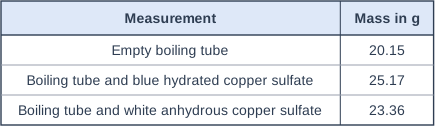
The table shows the student's results.

Calculate the percentage by mass of water in the hydrated copper sulfate. Give your answer to 3 significant figures.

Table with columns "Measurement", "Mass in g". Measurement: Empty boiling tube; Mass in g: 20.15 | Measurement: Boiling tube and blue hydrated copper sulfate; Mass in g: 25.17 | Measurement: Boiling tube and white anhydrous copper sulfate; Mass in g: 23.36.

Model answer

Mass of hydrated copper sulfate = 25.17 - 20.15 = 5.02 g
Mass of water = 25.17 - 23.36 = 1.81 g
Percentage of water = (1.81 ÷ 5.02) × 100 = 36.06%
= 36.1% (3 significant figures)

Explanation

The mass lost on heating is the water driven off, 1.81 g. The percentage is the mass of water divided by the mass of hydrated copper sulfate at the start (5.02 g, not including the tube), multiplied by 100. Common errors are dividing by the mass including the boiling tube or by the mass of anhydrous copper sulfate left.

Mark scheme
  1. 1 mark

    (mass of hydrated copper sulfate =) 25.17 - 20.15 = 5.02 (g)

    A correct answer with no working scores full marks. Full marks are not awarded for a correct final answer from incorrect working.

  2. 1 mark

    (mass of water =) 25.17 - 23.36 = 1.81 (g)

  3. 1 mark

    (1.81 ÷ 5.02) × 100 = 36.06 (%)

    allow ecf from incorrect masses. allow 36.0558... Dividing by 25.17 (7.19%) or by the mass of anhydrous copper sulfate, 3.21 g (56.4%), scores 0 for this mark.

  4. 1 mark

    36.1 (%)

    allow an answer from an incorrect calculation correctly given to 3 significant figures.

Ready to try the rest? Every answer you write is marked against the mark scheme, so you can see exactly where the marks are.

Study Helper Hints first, answers after you try

Stuck on this one? Ask for a hint and I’ll point you in the right direction, without giving the answer away. Once you’ve checked your answer, I’ll show you how the marks are awarded.