Practise 20 exam-style questions on Chromatography for AQA GCSE Combined Science (Foundation Chemistry Paper 2). Write your answer as you would in the exam and get it marked in seconds against the mark scheme, point by point, with the Study Helper on hand if you get stuck.
20 questions
1–6 marks each
Instant marking
No sign-up needed
20 questions, marked as you go
Sample questions with model answers
Here are 4 of the questions in this topic, each with a model answer, an explanation of why it earns the marks and the mark scheme an examiner would use.
Question 1
1 mark
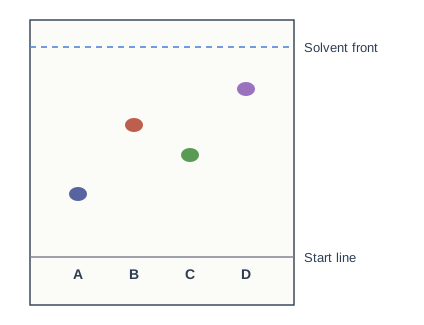
A student used paper chromatography to test four dyes, A, B, C and D. Each dye gave one spot.
The diagram shows the chromatogram.
Which dye is the most soluble in the solvent?
Choose your answer.
A
B
C
D
Model answer
D
Explanation
The more soluble a dye is in the solvent (the mobile phase), the more time it spends moving with the solvent, so the further it travels up the paper. Dye D moved furthest and has the highest Rf value. Choosing A, the lowest spot, is the common mistake.
Mark scheme
1 mark
D
If more than one option is given, 0 marks. D moved furthest up the paper (5.6 cm, highest Rf value). A moved the shortest distance (2.1 cm), so it is the least soluble in the solvent / most attracted to the paper.
Question 2
1 mark
In a chromatography experiment, a dye moved three-fifths of the distance moved by the solvent.
What is the Rf value of the dye?
Use the equation:
Rf = distance moved by substance ÷ distance moved by solvent
Model answer
0.6
Explanation
Rf = distance moved by substance ÷ distance moved by solvent. If the dye moved three-fifths of the solvent's distance, the ratio is 3/5 = 0.6. Rf values are written as decimals between 0 and 1, with no unit.
Mark scheme
1 mark
0.6
allow 3/5 / 0.60. do not accept 1.67 (5/3, the wrong way round). Rf has no unit: do not award the mark if a unit is given with the value (e.g. 0.6 cm).
Question 3
2 marks
A scientist has a table of Rf values for some dyes. All the Rf values in the table were measured with ethanol as the solvent.
A student found the Rf value of an unknown dye using water as the solvent.
Explain why the student cannot use the scientist's table to identify the dye.
Model answer
A compound has different Rf values in different solvents. So the student's Rf value in water cannot be compared with the Rf values measured in ethanol; she would need to run the dye in ethanol.
Explanation
Rf values are used to identify compounds, but only when they are compared in the same solvent, because how far a substance moves depends on how it is distributed between the paper and that solvent. 'Because it is a different solvent' does not explain why that matters.
Mark scheme
1 mark
the Rf value of a substance depends on the solvent / a compound has different Rf values in different solvents
allow the dye would move a different distance in ethanol. ignore 'it is a different solvent' (on its own).
1 mark
so the Rf value in water cannot be compared with values in ethanol / she must use the same solvent as the table (ethanol)
allow the Rf value might match the wrong dye in the table.
Question 4
4 marks
A food scientist used paper chromatography to test the dyes in an orange drink. The drink gave two spots.
The solvent moved 8.0 cm from the start line. Spot 1 moved 2.4 cm and spot 2 moved 5.2 cm from the start line.
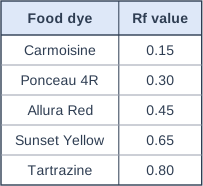
The table shows the Rf values that the scientist measured for some food dyes in the same solvent.
Identify the two dyes in the drink.
Use the equation:
Rf = distance moved by substance ÷ distance moved by solvent
Model answer
Spot 1: Rf = 2.4 ÷ 8.0 = 0.30, so spot 1 is Ponceau 4R. Spot 2: Rf = 5.2 ÷ 8.0 = 0.65, so spot 2 is Sunset Yellow.
Explanation
Different compounds have different Rf values in a solvent, so calculating an Rf value and matching it to known values in the same solvent helps to identify a substance. Both distances must be measured from the start line. A common slip is to divide 8.0 by the spot's distance, which gives a value bigger than 1.
Mark scheme
1 mark
(Rf of spot 1 =) 2.4 ÷ 8.0 = 0.3
allow 0.30. A correct answer with no working scores full marks. Full marks are not awarded for a correct final answer from incorrect working. Rf has no unit: do not award this mark if a unit is given with the value (e.g. 0.3 cm); the dye can still be credited by ecf.
1 mark
(spot 1 is) Ponceau 4R
allow ecf: the dye in the table that matches their Rf value for spot 1.
1 mark
(Rf of spot 2 =) 5.2 ÷ 8.0 = 0.65
allow 0.650. do not accept values from dividing the wrong way round (3.33 or 1.54). Rf has no unit: do not award this mark if a unit is given with the value (e.g. 0.65 cm).
1 mark
(spot 2 is) Sunset Yellow
allow ecf: the dye in the table that matches their Rf value for spot 2. allow phonetic spellings of the dye names.
Ready to try the rest? Every answer you write is marked against the mark scheme, so you can see exactly where the marks are.
Ctrl + Enter to check
Study HelperHints first, answers after you try
Stuck on this one? Ask for a hint and I’ll point you in the right direction, without giving the answer away. Once you’ve checked your answer, I’ll show you how the marks are awarded.