
Level:
Correct: 0
Incorrect: 0
Marks: 0/0
Exam Practice
Course:
Topics:
AQA GCSE Combined Science (Foundation Chemistry Paper 2) Smart practice A mixed round aimed at your weak spots
Unit 13
The rate and extent of chemical change
Unit 14
Organic chemistry
Unit 15
Chemical analysis
Purity, formulations and chromatography
Pure substances and formulations
Chromatography
Identification of common gases
Unit 16
Chemistry of the atmosphere
The composition and evolution of the Earth's atmosphere
Common atmospheric pollutants and their sources
Unit 17
Using resources
Life cycle assessment and recycling
Avg
score:
–
Topics
done:
0/16

Fractional distillation, petrochemicals and properties of hydrocarbons

Practise 22 exam-style questions on Fractional distillation, petrochemicals and properties of hydrocarbons for AQA GCSE Combined Science (Foundation Chemistry Paper 2). Write your answer as you would in the exam and get it marked in seconds against the mark scheme, point by point, with the Study Helper on hand if you get stuck.

  • 22 questions
  • 1–6 marks each
  • Instant marking
  • No sign-up needed
20 questions, marked as you go

Sample questions with model answers

Here are 4 of the questions in this topic, each with a model answer, an explanation of why it earns the marks and the mark scheme an examiner would use.

Question 1

1 mark

Hydrocarbons are used as fuels.

During combustion, what happens to the carbon and hydrogen in a hydrocarbon fuel?

Choose your answer.

  • They are cracked
  • They are distilled
  • They are oxidised
  • They are reduced

Model answer

They are oxidised

Explanation

When a hydrocarbon burns, its carbon and hydrogen combine with oxygen, so they are oxidised: in complete combustion the carbon becomes carbon dioxide and the hydrogen becomes water. Energy is released, which is why hydrocarbons are useful fuels.

Mark scheme
  1. 1 mark

    They are oxidised

    If more than one option is given, 0 marks. Cracked is wrong: cracking breaks large hydrocarbon molecules into smaller ones and does not need oxygen. Distilled is wrong: distillation separates substances by boiling and condensing them without reacting them. Reduced is wrong: during combustion the carbon and hydrogen gain oxygen, which is oxidation.
Question 2

2 marks

A hydrocarbon in petrol has the formula C₇H₁₆.

Write a balanced symbol equation for the complete combustion of C₇H₁₆.

Model answer

C₇H₁₆ + 11O₂ → 7CO₂ + 8H₂O
(7 carbon atoms give 7CO₂; 16 hydrogen atoms give 8H₂O; oxygen atoms on the right = 14 + 8 = 22, so 11O₂)

Explanation

Complete combustion of a hydrocarbon always gives carbon dioxide and water. Balance carbon first (7CO₂), then hydrogen (16 ÷ 2 = 8H₂O), then count the oxygen atoms in the products (22) and halve to get 11O₂. A common mistake is to write carbon monoxide, which is formed only when there is not enough oxygen.

Mark scheme
  1. 1 mark

    C₇H₁₆ + O₂ → CO₂ + H₂O (correct formulae of the reactants and products)

    Allow formulae written without subscripts (C7H16, O2, CO2, H2O). Do not accept products CO, C or H₂, or O instead of O₂.

  2. 1 mark

    C₇H₁₆ + 11O₂ → 7CO₂ + 8H₂O

    This mark depends on the correct formulae. Allow multiples, e.g. 2C₇H₁₆ + 22O₂ → 14CO₂ + 16H₂O. State symbols are not required. Allow = in place of →. An equation with CO or C as a product scores 0.

Question 3

2 marks

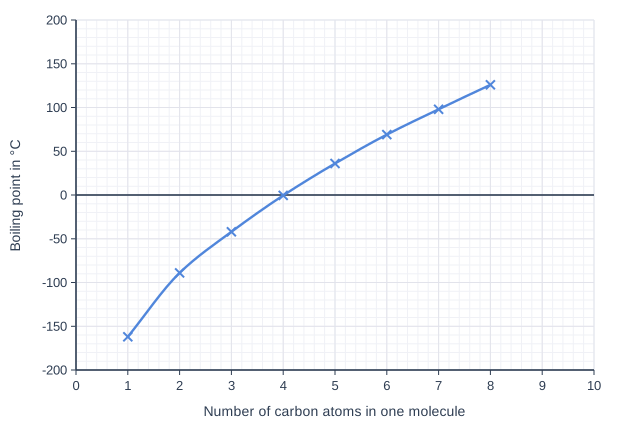
The graph shows the boiling points of the first eight alkanes (data-book values).

Describe the trend shown by the graph.

Use the graph to estimate the boiling point of the alkane with 10 carbon atoms.

Line graph of boiling point in °C (y-axis, -200 to 200) against number of carbon atoms in one molecule (x-axis, 0 to 10). The line is a smooth curve through (1, -162), (2, -89), (3, -42), (4, -0.5), (5, 36), (6, 69), (7, 98), (8, 126).

Model answer

As the number of carbon atoms in the alkane increases, the boiling point increases (the rise gets slightly smaller each time).
Extending the curve to 10 carbon atoms gives a boiling point of about 175 °C.

Explanation

Always name both variables when you describe a trend: 'it increases' does not say what increases. To estimate a value beyond the data, continue the curve with the same shape: the boiling point rises by about 28 °C from 7 to 8 carbon atoms and the rise is getting smaller, so 10 carbon atoms gives about 175 °C.

Mark scheme
  1. 1 mark

    as the number of carbon atoms increases, the boiling point increases

    Both variables must be named for the mark. Allow 'the bigger the molecule, the higher the boiling point'. Ignore 'the increase gets smaller'. Do not accept 'it increases' without saying what increases with what.

  2. 1 mark

    (an estimate in the range) 160 to 190 (°C)

    The value comes from extending the curve beyond 8 carbon atoms. The real value is 174 °C. Do not accept values outside this range, e.g. 126 (the 8-carbon value) or about 210 (a straight line through the first and eighth points, extended).

Question 4

3 marks

A teacher demonstrated the fractional distillation of a crude oil substitute (a mixture of hydrocarbons used in schools instead of crude oil).

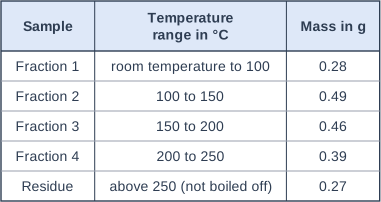
She heated 2.00 g of the crude oil substitute in a side-arm boiling tube and collected four fractions over different temperature ranges. She weighed each fraction and the black residue left in the boiling tube.

The table shows her results.

Calculate the mass of crude oil substitute that was lost (not collected as a fraction or left as residue).

Suggest one reason why some of the crude oil substitute was not collected.

Table with columns "Sample", "Temperature range in °C", "Mass in g". Sample: Fraction 1; Temperature range in °C: room temperature to 100; Mass in g: 0.28 | Sample: Fraction 2; Temperature range in °C: 100 to 150; Mass in g: 0.49 | Sample: Fraction 3; Temperature range in °C: 150 to 200; Mass in g: 0.46 | Sample: Fraction 4; Temperature range in °C: 200 to 250; Mass in g: 0.39 | Sample: Residue; Temperature range in °C: above 250 (not boiled off); Mass in g: 0.27.

Model answer

Total mass of fractions and residue = 0.28 + 0.49 + 0.46 + 0.39 + 0.27 = 1.89 g
Mass not collected = 2.00 - 1.89 = 0.11 g
Some of the vapour escaped from the apparatus without condensing, so it was not collected.

Explanation

Add all five masses, including the residue, then take the total away from the starting mass. Mass is not lost in a physical process, so the missing 0.11 g must have gone somewhere: hydrocarbons with low boiling points easily escape as vapour or evaporate from the collecting tubes. Forgetting to add the residue gives 0.38 g.

Mark scheme
  1. 1 mark

    total collected = 0.28 + 0.49 + 0.46 + 0.39 + 0.27 = 1.89 (g)

    A correct answer with no working scores full marks. Full marks are not awarded for a correct final answer from incorrect working. 1.62 (the residue not added) gives 0.38 g: this scores the second mark only.

  2. 1 mark

    2.00 - 1.89 = 0.11 (g)

    Allow ecf from their total. Do not accept 1.89 (the mass collected, not the mass lost).

  3. 1 mark

    some vapour escaped (from the apparatus) / some vapour did not condense / some liquid was left in the apparatus (e.g. in the delivery tube) / some of a fraction evaporated from its collecting tube

    Allow 'some was lost as gas'. Ignore 'human error' or 'it was not weighed properly' alone. Do not accept 'some of the mass was destroyed'.

Ready to try the rest? Every answer you write is marked against the mark scheme, so you can see exactly where the marks are.

Study Helper Hints first, answers after you try

Stuck on this one? Ask for a hint and I’ll point you in the right direction, without giving the answer away. Once you’ve checked your answer, I’ll show you how the marks are awarded.