
Level:
Correct: 0
Incorrect: 0
Marks: 0/0
Exam Practice
Course:
Topics:
AQA GCSE Combined Science (Foundation Chemistry Paper 2) Smart practice A mixed round aimed at your weak spots
Unit 13
The rate and extent of chemical change
Unit 14
Organic chemistry
Unit 15
Chemical analysis
Purity, formulations and chromatography
Pure substances and formulations
Chromatography
Identification of common gases
Unit 16
Chemistry of the atmosphere
The composition and evolution of the Earth's atmosphere
Common atmospheric pollutants and their sources
Unit 17
Using resources
Life cycle assessment and recycling
Avg
score:
–
Topics
done:
0/16

Identification of common gases

Practise 18 exam-style questions on Identification of common gases for AQA GCSE Combined Science (Foundation Chemistry Paper 2). Write your answer as you would in the exam and get it marked in seconds against the mark scheme, point by point, with the Study Helper on hand if you get stuck.

  • 18 questions
  • 1–6 marks each
  • Instant marking
  • No sign-up needed
18 questions, marked as you go

Sample questions with model answers

Here are 4 of the questions in this topic, each with a model answer, an explanation of why it earns the marks and the mark scheme an examiner would use.

Question 1

1 mark

Limewater is used in the test for carbon dioxide.

What is limewater?

Choose your answer.

  • Calcium hydroxide solution
  • Calcium carbonate solution
  • Sodium chloride solution
  • Dilute hydrochloric acid

Model answer

Calcium hydroxide solution

Explanation

Limewater is the common name for an aqueous solution of calcium hydroxide. When carbon dioxide is bubbled through it or shaken with it, the limewater turns milky (cloudy). A common mistake is to confuse calcium hydroxide with calcium carbonate.

Mark scheme
  1. 1 mark

    Calcium hydroxide solution

    If more than one option is given, 0 marks. Limewater is an aqueous solution of calcium hydroxide. Calcium carbonate is the white solid that makes limewater look milky, not limewater itself. Sodium chloride solution and hydrochloric acid do not react with carbon dioxide to give a milky result.
Question 2

1 mark

In the test for carbon dioxide, the gas can be bubbled through limewater.

Give one other way of mixing the gas with limewater in this test.

Model answer

Add a little limewater to a test tube of the gas, put the stopper back on and shake it.

Explanation

Carbon dioxide can be either bubbled through limewater or shaken with limewater. Shaking mixes the gas with the solution so that, if carbon dioxide is present, the limewater turns milky. This is useful when the gas has already been collected in a test tube.

Mark scheme
  1. 1 mark

    shake the gas with limewater (in a stoppered test tube)

    allow add limewater to a test tube of the gas, put the stopper on and shake. ignore pour limewater into the gas (unless shaking is mentioned).

Question 3

2 marks

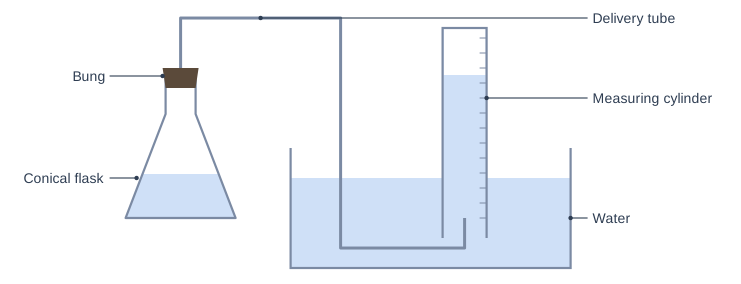
A student made oxygen by adding hydrogen peroxide solution to a catalyst in a conical flask. She collected the gas in an upside-down measuring cylinder of water, as shown in the diagram. She started collecting the gas as soon as she added the hydrogen peroxide.

The student then put a glowing splint into the gas she had collected. The splint did not relight.

Suggest two reasons why the splint did not relight.

Diagram of collecting a gas over water in an upside-down measuring cylinder. Labelled parts: Delivery tube, Measuring cylinder, Water, Bung, Conical flask.

Model answer

The first gas she collected was mostly air that had been pushed out of the flask, so there was not much oxygen in the cylinder. Also, some of the oxygen may have escaped before she put the splint in.

Explanation

Hydrogen peroxide does decompose to give oxygen, so the problem must be with the method. The gas that comes out first is the air that was already in the flask and delivery tube, so the first sample is mostly air. Waiting a short time before collecting, or discarding the first cylinder of gas, solves this.

Mark scheme
  1. 1 mark

    the first gas collected was (mostly) air pushed out of the flask (not oxygen)

    allow there was air in the flask / delivery tube that was collected first. Any two of the points on this mark scheme, 1 mark each: max 2. Each wrong or contradictory extra reason cancels a correct one (right + wrong = wrong).

  2. 1 mark

    not enough oxygen had been collected / the reaction had not produced enough oxygen

    allow the reaction was too slow.

  3. 1 mark

    the oxygen escaped (into the air) before the splint was put in

    allow the gas escaped when the cylinder was taken out of the water.

  4. 1 mark

    the splint was not glowing enough / had gone out

    allow the splint was not put far enough into the gas. ignore she used the wrong splint (unless explained). do not accept the gas was hydrogen / carbon dioxide (the reaction produces oxygen).

Question 4

4 marks

A student electrolysed dilute sulfuric acid. The electrolysis breaks water down into hydrogen and oxygen. The student collected the gas from each electrode in a separate test tube.

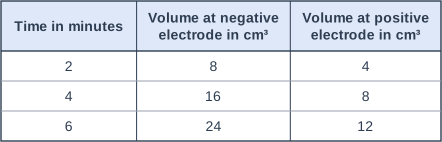
The table shows the volumes of gas collected.

Calculate the ratio of the volume of gas at the negative electrode to the volume of gas at the positive electrode after 6 minutes. Give the ratio in its simplest form.

The gas at the positive electrode is oxygen. Describe the test for oxygen and give the result.

Table with columns "Time in minutes", "Volume at negative electrode in cm³", "Volume at positive electrode in cm³". Time in minutes: 2; Volume at negative electrode in cm³: 8; Volume at positive electrode in cm³: 4 | Time in minutes: 4; Volume at negative electrode in cm³: 16; Volume at positive electrode in cm³: 8 | Time in minutes: 6; Volume at negative electrode in cm³: 24; Volume at positive electrode in cm³: 12.

Model answer

ratio = 24 : 12
= 2 : 1
Test: put a glowing splint into the test tube of gas.
Result: the splint relights.

Explanation

After 6 minutes there is 24 cm³ of hydrogen and 12 cm³ of oxygen, so the ratio is 24 : 12, which simplifies to 2 : 1. The order matters: negative electrode first. In the test for oxygen the splint must be glowing (not burning) and it is put into the tube; the result is that it relights.

Mark scheme
  1. 1 mark

    (ratio =) 24 : 12

    allow 24 ÷ 12. A correct answer with no working scores full marks for the ratio (2 marks for 2 : 1). Full marks are not awarded for a correct final answer from incorrect working.

  2. 1 mark

    = 2 : 1

    allow 2 to 1. do not accept 2 on its own (not a ratio). do not accept 1 : 2 (the wrong way round).

  3. 1 mark

    put a glowing splint into the test tube (of gas)

    glowing must be mentioned. do not accept a burning / lit splint.

  4. 1 mark

    the splint relights

    allow the splint bursts into flame. This mark can only be given for a test that uses a glowing splint. ignore 'it burns brighter' on its own.

Ready to try the rest? Every answer you write is marked against the mark scheme, so you can see exactly where the marks are.

Study Helper Hints first, answers after you try

Stuck on this one? Ask for a hint and I’ll point you in the right direction, without giving the answer away. Once you’ve checked your answer, I’ll show you how the marks are awarded.