Practise 19 exam-style questions on Cracking and alkenes for AQA GCSE Combined Science (Foundation Chemistry Paper 2). Write your answer as you would in the exam and get it marked in seconds against the mark scheme, point by point, with the Study Helper on hand if you get stuck.
19 questions
1–6 marks each
Instant marking
No sign-up needed
19 questions, marked as you go
Sample questions with model answers
Here are 4 of the questions in this topic, each with a model answer, an explanation of why it earns the marks and the mark scheme an examiner would use.
Question 1
1 mark
Steam cracking is one method of cracking hydrocarbons.
Which conditions are used in steam cracking?
Choose your answer.
Passed over a catalyst at room temperature
Mixed with steam at a very high temperature
Mixed with cold water and then filtered
Burned in air to release lots of energy
Model answer
Mixed with steam at a very high temperature
Explanation
In steam cracking the hydrocarbons are vaporised, mixed with steam and heated to a very high temperature. In catalytic cracking the hydrocarbon vapour is passed over a hot catalyst. Both methods need high temperatures; vague words such as 'heat' are not enough in an answer about conditions.
Mark scheme
1 mark
Mixed with steam at a very high temperature
If more than one option is given, 0 marks. Passed over a catalyst at room temperature is wrong: catalytic cracking passes the vapour over a hot catalyst, and steam cracking uses no catalyst. Mixed with cold water and then filtered is wrong: cracking needs a very high temperature and filtering cannot break molecules. Burned in air is wrong: that is combustion, which destroys the hydrocarbons.
Question 2
2 marks
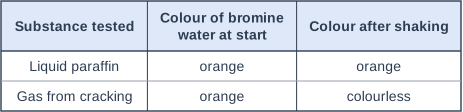
A student cracked some liquid paraffin, which is a mixture of alkanes. She shook samples of the liquid paraffin and of the gas she collected with bromine water.
The table shows her results.
Explain what the results show.
Model answer
The bromine water stayed orange with the liquid paraffin, so the liquid paraffin contains no alkenes: alkanes do not react with bromine water. The gas turned the bromine water from orange to colourless, so the gas contains an alkene, which must have been made by cracking.
Explanation
Testing the starting material as well as the product shows that the alkene was made by cracking and was not there before. Alkanes leave bromine water orange; alkenes decolourise it. Describing the colours without saying what they show does not score.
Mark scheme
1 mark
the liquid paraffin did not react with bromine water / contains no alkenes / alkanes do not decolourise bromine water
Allow 'the liquid paraffin is unreactive / is (only) alkanes'.
1 mark
the gas contains an alkene / cracking produced alkenes (because the gas decolourised the bromine water)
Allow 'the gas is an alkene'. Do not accept 'the gas is an alkane'. Ignore 'the gas is reactive' alone.
Question 3
2 marks
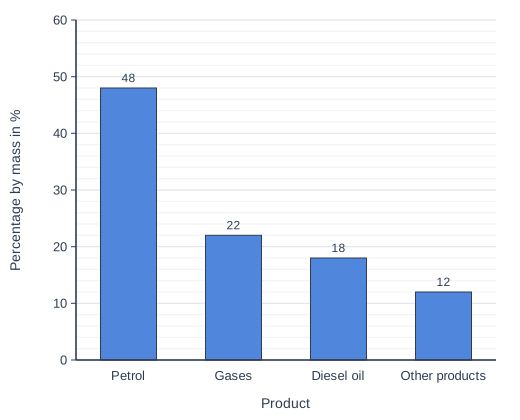
A refinery cracks heavy fuel oil in a catalytic cracking unit. The bar chart shows the percentage by mass of each product.
The unit cracks 2500 tonnes of heavy fuel oil each day.
Calculate the mass of petrol produced each day.
Model answer
Mass of petrol = 48 ÷ 100 × 2500 = 1200 tonnes
Explanation
Read the percentage for petrol from the bar chart (48%), then find 48% of 2500 tonnes by dividing by 100 and multiplying by 2500. Nearly half of the heavy fuel oil becomes petrol, a fuel with small molecules that is in high demand.
Mark scheme
1 mark
48 ÷ 100 × 2500
A correct answer with no working scores full marks. Full marks are not awarded for a correct final answer from incorrect working. Allow 0.48 × 2500.
1 mark
1200 (tonnes)
Do not accept 52 (2500 ÷ 48) or 5208 (2500 ÷ 0.48).
Question 4
4 marks
One molecule of C₁₆H₃₄ can be cracked to give one molecule of C₁₀H₂₂ and three molecules of an alkene, X:
C₁₆H₃₄ → C₁₀H₂₂ + 3X
Work out the formula of X.
Explain how the formula C₁₀H₂₂ shows that this product is an alkane.
Model answer
Carbon: 16 - 10 = 6 carbon atoms in 3X, so each X has 6 ÷ 3 = 2. Hydrogen: 34 - 22 = 12 hydrogen atoms in 3X, so each X has 12 ÷ 3 = 4. X = C₂H₄ C₁₀H₂₂ fits the general formula of the alkanes, CₙH₂ₙ₊₂: with n = 10, 2 × 10 + 2 = 22 hydrogen atoms.
Explanation
Subtract the atoms in C₁₀H₂₂ from those in C₁₆H₃₄, then share what is left between the three X molecules. The most common mistake is to forget the 3 and write C₆H₁₂. To show a formula is an alkane, check it against CₙH₂ₙ₊₂, not just that it contains carbon and hydrogen.
Mark scheme
1 mark
carbon atoms in 3X = 16 - 10 = 6, so 2 carbon atoms in each X
A correct answer with no working scores full marks. Full marks are not awarded for a correct final answer from incorrect working.
1 mark
hydrogen atoms in 3X = 34 - 22 = 12, so 4 hydrogen atoms in each X
Allow ecf for the division by 3 from their subtraction.
1 mark
X = C₂H₄
Allow C2H4 written without subscripts. C₆H₁₂ (3 not divided out) scores the first two marks only.
1 mark
C₁₀H₂₂ fits the general formula CₙH₂ₙ₊₂ / 2 × 10 + 2 = 22
Allow 'the number of hydrogen atoms is twice the number of carbon atoms plus 2'. Ignore 'it contains only carbon and hydrogen' alone (this shows only that it is a hydrocarbon).
Ready to try the rest? Every answer you write is marked against the mark scheme, so you can see exactly where the marks are.
Ctrl + Enter to check
Study HelperHints first, answers after you try
Stuck on this one? Ask for a hint and I’ll point you in the right direction, without giving the answer away. Once you’ve checked your answer, I’ll show you how the marks are awarded.