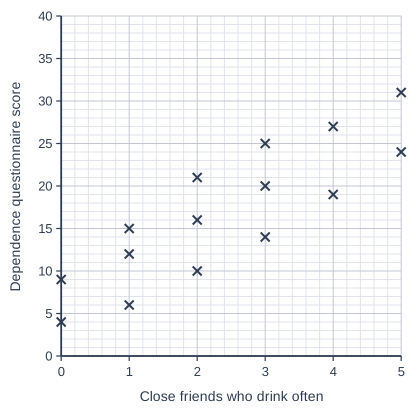
A psychologist, Dr Adjei (fictional), wanted to find out whether adults whose close friends drink alcohol often are more likely to show signs of alcohol dependence. She asked 15 adults how many of their five closest friends drink alcohol at least three times a week. Each adult also completed a questionnaire measuring signs of alcohol dependence (score 0 to 40). The scatter diagram shows her results.
Explain the strengths and weaknesses of using correlations in psychological research. In your answer, refer to Dr Adjei's study of friends' drinking and signs of alcohol dependence.
Model answer
A strength of using a correlation in Dr Adjei's study is that it lets her investigate a relationship that could not ethically be tested in an experiment: she could not make some people's friends drink more alcohol to see whether their own signs of dependence increased. Instead, she measures both variables as they naturally occur. The scatter diagram shows a positive correlation, as adults with more friends who drink often tend to have higher dependence scores, so the correlation shows the direction of the relationship and suggests that peer influence is worth investigating further.
However, the main weakness is that correlations cannot show cause and effect. The positive correlation could mean that friends' drinking leads to dependence, as peer influence suggests, but it could equally mean that people who are becoming dependent choose friends who drink often. A third variable, such as stress or a family history of alcohol problems, might cause both. In addition, the dependence scores come from a questionnaire, so people may under-report their signs of dependence, and with only 15 participants the findings may not generalise.
Overall, correlations are useful for identifying relationships, such as the link Dr Adjei found between friends' drinking and signs of dependence, but other methods are needed before concluding that peers cause addiction.
Explanation
Level 3 answers explain at least one strength and one weakness of correlations in depth and apply them to the study, for example explaining why friends' drinking could not ethically be manipulated. The most important weakness is that correlation does not show causation, and the best answers explain the possible alternatives (reverse direction or a third variable) in the context of the study. Generic points with no reference to Dr Adjei's study are limited for AO2.