
Level:
Correct: 0
Incorrect: 0
Marks: 0/0
Exam Practice
Course:
Topics:
AQA GCSE Psychology (Paper 2) Smart practice A mixed round aimed at your weak spots
Unit 1
Social influence
Conformity
Conformity
Obedience
Obedience
Prosocial behaviour
Prosocial behaviour
Crowd and collective behaviour
Unit 2
Language, thought and communication
The possible relationship between language and thought; the effect of language and thought on our view of the world
The possible relationship between language and thought
Differences between human and animal communication
Non-verbal communication
Explanations of non-verbal behaviour
Unit 3
Brain and neuropsychology
Structure and function of the nervous system
Neuron structure and function
Structure and function of the brain
An introduction to neuropsychology
Unit 4
Psychological problems
An introduction to mental health; how the incidence of significant mental health problems changes over time
An introduction to mental health
Effects of significant mental health problems on individuals and society
Effects of mental health problems on individuals and society
Characteristics of clinical depression
Theories of depression
Interventions or therapies for depression
Characteristics of addiction
Theories of addiction
Interventions or therapies for addiction
Avg
score:
–
Topics
done:
0/20

Interventions or therapies for addiction

Practise 26 exam-style questions on Interventions or therapies for addiction for AQA GCSE Psychology (Paper 2). Write your answer as you would in the exam and get it marked in seconds against the mark scheme, point by point, with the Study Helper on hand if you get stuck.

  • 26 questions
  • 1–9 marks each
  • Instant marking
  • No sign-up needed
20 questions, marked as you go

Sample questions with model answers

Here are 4 of the questions in this topic, each with a model answer, an explanation of why it earns the marks and the mark scheme an examiner would use.

Question 1

1 mark

Which one of these best describes a self-management programme for addiction, such as a self-help group?

Choose your answer.

  • A person tries to stop using the substance alone at home without help
  • People with the same problem meet regularly to support each other's recovery
  • A doctor prescribes medication and decides when the person should stop it
  • A therapist pairs the substance with an unpleasant feeling until it is avoided

Model answer

People with the same problem meet regularly to support each other's recovery

Explanation

In a self-management programme, such as a self-help group or 12 step programme, people with the same addiction meet regularly and support each other to manage their own recovery. AQA's June 2024 Paper 2 report notes that many students wrongly thought it meant managing an addiction alone at home. Pairing the substance with an unpleasant feeling describes aversion therapy.

Mark scheme
  1. 1 mark

    People with the same problem meet regularly to support each other's recovery

    If more than one option is given, 0 marks.
Question 2

2 marks

A self-help group leader recorded how many of the group's 10 weekly meetings each of nine members attended (invented data):

4, 10, 7, 9, 2, 10, 6, 8, 5

Calculate the median number of meetings attended. Show your workings.

Model answer

In order: 2, 4, 5, 6, 7, 8, 9, 10, 10
The middle (5th) value is 7, so the median is 7 meetings.

Explanation

To find the median, put the values in order and pick the middle one: with nine values, the middle is the 5th, which is 7. Forgetting to order the values first gives 2, the middle number of the original list. The mean (about 6.8) and the mode (10) are different averages.

Mark scheme
  1. 2 marks

    2 marks for the correct answer: 7. 1 mark for correct workings but incorrect/no answer.

    A correct answer with no workings scores 2 marks. Workings: the values in order (2, 4, 5, 6, 7, 8, 9, 10, 10) or identifying the 5th value as the middle one. Do not accept the mean (61 รท 9 = 6.8), the mode (10) or the middle value of the unordered list (2).

Question 3

4 marks

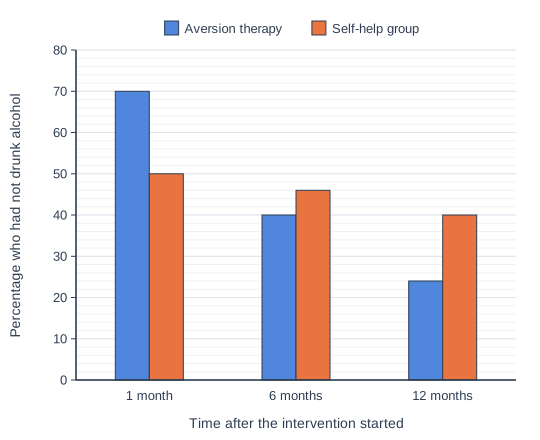
A psychologist, Dr Nakamura (fictional), compared two groups of adults with alcohol dependence. One group received aversion therapy and the other group attended a self-help group. The graph shows the percentage of each group who had not drunk any alcohol at 1 month, 6 months and 12 months after the intervention started (invented data).

Explain how the results shown in the graph can be used to evaluate aversion therapy as an intervention for addiction.

Dual bar chart of percentage who had not drunk alcohol for each time after the intervention started, comparing Aversion therapy and Self-help group (a key above the chart shows which bar is which). 1 month: Aversion therapy 70, Self-help group 50; 6 months: Aversion therapy 40, Self-help group 46; 12 months: Aversion therapy 24, Self-help group 40.

Model answer

At 1 month, 70% of the aversion therapy group had not drunk alcohol, compared with 50% of the self-help group, which suggests that aversion therapy is effective in the short term. However, this fell to 40% at 6 months and only 24% at 12 months, so most of the people who had stopped drinking after aversion therapy had started again within a year. This supports the criticism that the learned association fades over time and that aversion therapy does not deal with the underlying causes of addiction. In contrast, the self-help group fell only from 50% to 40%, so it was more effective in the long term. However, we do not know how many people were in each group or whether the groups were similar to begin with, so the comparison may not be fair.

Explanation

Top answers use specific figures from the graph to show both the short-term success of aversion therapy (70% at 1 month) and its decline (24% at 12 months), and link the decline to reasons such as extinction of the association or untreated causes. Answers that evaluate aversion therapy without using the graph are limited to 1 mark. Noting what the graph does not tell you, such as group sizes, shows good analysis.

Mark scheme
  1. 4 marks

    Levels of response (4 marks). AO3 - 4 marks.
    Level 2 Clear (3-4 marks): Analysis of how the results shown in the graph can be used to evaluate aversion therapy as an intervention for addiction is effective. Any conclusions drawn are sound and fully expressed. Relevant terminology is used consistently throughout. The answer demonstrates a high level of substantiated reasoning, and is clear, coherent and focused.
    Level 1 Basic (1-2 marks): Analysis of how the results shown in the graph can be used to evaluate aversion therapy as an intervention for addiction is of limited effectiveness or muddled. Any attempts to draw conclusions are not always successful. Relevant terminology is occasionally used. The answer occasionally demonstrates substantiated reasoning, but may lack clarity, coherence, focus and logical structure.
    0 marks: No relevant content.

    Possible content (not a checklist): at 1 month 70% of the aversion therapy group had not drunk alcohol compared with 50% of the self-help group, suggesting aversion therapy is effective in the short term; this fell to 40% at 6 months and 24% at 12 months, so many people relapsed - supporting the view that its benefits are short-term, that the learned association fades, and that it does not address underlying causes (reductionist); the self-help group fell only from 50% to 40%, so self-help was more effective in the long term (from 6 months onwards it was higher); limitations: group sizes and allocation are not given, so the groups may have differed (e.g. in motivation or severity); drop-outs may not be included; abstinence may be self-reported. A conclusion, e.g. aversion therapy may be useful for a quick start but needs other support for lasting recovery. Credit other relevant content. NOTE: Evaluation without using the results in the graph (MAX 1 mark).

Question 4

6 marks

Read the information about Dana.

Dana, 38, developed a dependence on alcohol after her divorce, when she felt lonely and stressed. First she had aversion therapy. She stopped drinking for a few weeks, but started again when she felt lonely. Later she joined a 12 step programme. Through regular meetings and her sponsor she made new friends, talked about her divorce and repaired her relationship with her sister. She has not drunk alcohol for over a year.

How can the reductionist and holistic perspectives be used to explain why the two interventions had different effects for Dana? Refer to Dana in your answer.

Model answer

The reductionist perspective is the view that behaviour is best understood by breaking it down into its simplest parts, so a reductionist intervention targets one part of the problem. The holistic perspective is the view that all parts of a person's life are connected, so an intervention should treat the whole person, including their emotions, relationships and circumstances.

Dana's aversion therapy was reductionist: it targeted only the learned link between alcohol and pleasure, by pairing drinking with an unpleasant feeling. This explains why it worked for a few weeks, as the new association reduced her desire to drink. However, it did nothing about the loneliness and stress after her divorce that had led to her drinking, so when she felt lonely again she started drinking again. Her 12 step programme was holistic. As well as helping her to stop drinking, it dealt with the causes: she made new friends, which reduced her loneliness, she talked about her divorce, and she repaired her relationship with her sister, while her sponsor gave her ongoing support. Because the reasons for her drinking were addressed, her recovery has lasted over a year.

The perspectives explain Dana's outcomes well, but other factors could be involved. By the time she joined the programme she may have been more motivated, or more time had passed since her divorce, so we cannot be certain that the holistic approach alone caused the difference. Overall, the holistic perspective suggests that treating the whole person, as the 12 step programme did, is more likely to lead to lasting recovery than treating the behaviour alone.

Explanation

Level 3 answers define both perspectives accurately, show which intervention matches each, and use specific details about Dana to explain why the holistic programme led to longer-lasting change. Good AO3 also considers other explanations for her outcomes, such as greater motivation later on. A common error, noted in AQA's June 2022 Paper 2 report, is to think 'reductionist' means reducing the addictive behaviour.

Mark scheme
  1. 6 marks

    Levels of response (6 marks). AO1 - 2 marks, AO2 - 2 marks and AO3 - 2 marks.
    Level 3 Detailed (5-6 marks): AO1: Relevant knowledge and understanding of the reductionist and holistic perspectives is accurate with detail. AO2: Clear and accurate application of knowledge and understanding of the reductionist and holistic perspectives as referred to in the information about Dana. AO3: Analysis of how the reductionist and holistic perspectives can be used to explain Dana's outcomes is effective. Any conclusions drawn are sound and fully expressed. Relevant terminology is used consistently throughout. The answer demonstrates a high level of substantiated reasoning, and is clear, coherent and focused.
    Level 2 Clear (3-4 marks): AO1: Relevant knowledge and understanding of the reductionist and holistic perspectives is present but there are occasional inaccuracies/omissions. AO2: Reasonable application of knowledge and understanding of the reductionist and holistic perspectives as referred to in the information about Dana. AO3: There may be some effective analysis of how the reductionist and holistic perspectives can be used to explain Dana's outcomes. There may be an attempt to draw conclusions. Relevant terminology is occasionally used. The answer occasionally demonstrates substantiated reasoning, but may lack clarity, coherence, focus and logical structure.
    Level 1 Basic (1-2 marks): AO1: Knowledge and understanding of the reductionist and holistic perspectives is present but limited. AO2: Limited or muddled application of knowledge and understanding of the reductionist and holistic perspectives as referred to in the information about Dana. AO3: Analysis of how the reductionist and holistic perspectives can be used to explain Dana's outcomes is of limited effectiveness or muddled or may be absent. Any attempts to draw conclusions are not always successful or present. Relevant terminology may not be used at all or may be muddled.
    0 marks: No relevant content.

    Possible content (not a checklist): AO1 - reductionist perspective: behaviour is best understood by breaking it down into its simplest parts, so a reductionist intervention targets one part (e.g. the link between the substance and pleasure); holistic perspective: all parts of a person's life are connected and behaviour can only be understood by looking at the whole person / bigger picture, so a holistic intervention addresses emotions, relationships, environment and past experiences. AO2 - aversion therapy (reductionist) only targeted Dana's drinking; it worked for a few weeks but did not deal with her loneliness and stress after the divorce, so she relapsed when lonely; the 12 step programme (holistic) addressed the causes: new friends (loneliness), talking about her divorce, repairing her relationship with her sister, ongoing support from her sponsor; she has not drunk for over a year. AO3 - the perspectives explain the outcomes well; but other factors may explain the difference, e.g. she may have been more motivated later, or more time had passed since the divorce, so we cannot be sure the holistic approach caused it; aversion therapy combined with other support could be more holistic; a conclusion. Credit other relevant content. NOTE: Reference to Dana's case is not enough by itself for relevant content because it is part of the question stem. NOTE: Answers that define reductionist as 'reducing the behaviour' are inaccurate.

Ready to try the rest? Every answer you write is marked against the mark scheme, so you can see exactly where the marks are.

Study Helper Hints first, answers after you try

Stuck on this one? Ask for a hint and I’ll point you in the right direction, without giving the answer away. Once you’ve checked your answer, I’ll show you how the marks are awarded.