Level:
Correct: 0
Incorrect: 0
Marks: 0/0
Exam Practice
Course:
Topics:
AQA GCSE Psychology (Paper 2) Smart practice A mixed round aimed at your weak spots
Unit 1
Social influence
Conformity
Conformity
Obedience
Obedience
Prosocial behaviour
Prosocial behaviour
Crowd and collective behaviour
Unit 2
Language, thought and communication
The possible relationship between language and thought; the effect of language and thought on our view of the world
The possible relationship between language and thought
Differences between human and animal communication
Non-verbal communication
Explanations of non-verbal behaviour
Unit 3
Brain and neuropsychology
Structure and function of the nervous system
Neuron structure and function
Structure and function of the brain
An introduction to neuropsychology
Unit 4
Psychological problems
An introduction to mental health; how the incidence of significant mental health problems changes over time
An introduction to mental health
Effects of significant mental health problems on individuals and society
Effects of mental health problems on individuals and society
Characteristics of clinical depression
Theories of depression
Interventions or therapies for depression
Characteristics of addiction
Theories of addiction
Interventions or therapies for addiction
Avg
score:
–
Topics
done:
0/20

Effects of mental health problems on individuals and society

Practise 22 exam-style questions on Effects of mental health problems on individuals and society for AQA GCSE Psychology (Paper 2). Write your answer as you would in the exam and get it marked in seconds against the mark scheme, point by point, with the Study Helper on hand if you get stuck.

  • 22 questions
  • 1–9 marks each
  • Instant marking
  • No sign-up needed
20 questions, marked as you go

Sample questions with model answers

Here are 4 of the questions in this topic, each with a model answer, an explanation of why it earns the marks and the mark scheme an examiner would use.

Question 1

1 mark

Increased crime rates are given as one social effect of significant mental health problems.

Which one of the following statements about this effect is most accurate?

Choose your answer.

  • Most people with significant mental health problems commit crimes
  • Mental health problems are the only cause of rising crime rates
  • Crime rates can rise when mental health problems lead to difficulties such as unemployment, poverty or substance misuse
  • People with mental health problems are less likely than other people to be victims of crime

Model answer

Crime rates can rise when mental health problems lead to difficulties such as unemployment, poverty or substance misuse

Explanation

The link between mental health problems and crime is usually indirect, through factors such as unemployment, poverty or substance misuse, and most people with significant mental health problems never commit a crime. A 2013 report, 'At risk, yet dismissed', by Victim Support and Mind with university researchers, found that people with severe mental illness were more likely than the general population to be victims of crime, so the last option is the reverse of the evidence.

Mark scheme
  1. 1 mark

    Crime rates can rise when mental health problems lead to difficulties such as unemployment, poverty or substance misuse

    If more than one option is given, 0 marks.
Question 2

2 marks

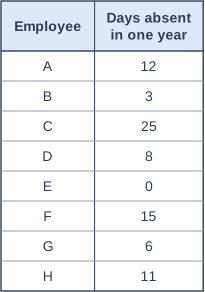
An employer recorded the number of days that eight employees with a diagnosed mental health problem were absent from work over one year. The table shows the results.

Calculate the mean number of days absent. Show your workings.

Table with columns "Employee", "Days absent in one year". Employee: A; Days absent in one year: 12 | Employee: B; Days absent in one year: 3 | Employee: C; Days absent in one year: 25 | Employee: D; Days absent in one year: 8 | Employee: E; Days absent in one year: 0 | Employee: F; Days absent in one year: 15 | Employee: G; Days absent in one year: 6 | Employee: H; Days absent in one year: 11.

Model answer

12 + 3 + 25 + 8 + 0 + 15 + 6 + 11 = 80
80 ÷ 8 = 10 days

Explanation

Add the eight values to get 80 and divide by 8, the number of employees. A common mistake is to ignore Employee E's 0 and divide by 7, but a value of 0 still counts as one of the scores. The data also show wide variation, from 0 to 25 days, so mental health problems affect different people's ability to work very differently.

Mark scheme
  1. 2 marks

    2 marks for the correct answer: 10 (days). 1 mark for correct workings but incorrect/no answer: (12 + 3 + 25 + 8 + 0 + 15 + 6 + 11) ÷ 8, or 80 ÷ 8.

    A correct answer with no workings scores 2 marks. Do not accept 11.4 (dividing by 7, leaving out the employee with 0 days) or 9.5 (the median).

Question 3

3 marks

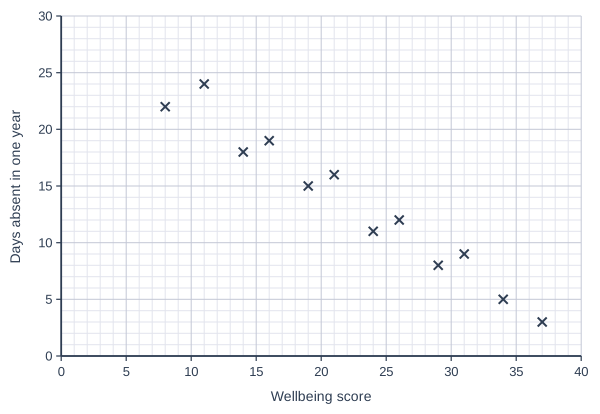
A psychologist asked 12 employees to complete a wellbeing questionnaire, scored from 0 to 40, where a higher score means better wellbeing. She also recorded how many days each employee had been absent from work in the past year. The scatter graph shows the results.

Describe the correlation shown in the scatter graph, and explain why the psychologist cannot conclude that poor wellbeing causes absence from work.

Scatter graph on a grid of small squares. The horizontal axis is "Wellbeing score", from 0 to 40, numbered every 5, with 5 small squares between numbered values (each small square is 1). The vertical axis is "Days absent in one year", from 0 to 30, numbered every 5, with 5 small squares between numbered values (each small square is 1). 12 points are plotted as crosses: (8, 22), (11, 24), (14, 18), (16, 19), (19, 15), (21, 16), (24, 11), (26, 12), (29, 8), (31, 9), (34, 5) and (37, 3).

Model answer

The scatter graph shows a strong negative correlation: employees with higher wellbeing scores had fewer days absent. However, a correlation only shows that two variables are related, not that one causes the other. The relationship could work the other way, as being absent from work for a long time could lead to isolation and money worries that lower wellbeing. A third variable, such as a long-term physical illness, could also cause both low wellbeing and more days off.

Explanation

The mark for the correlation needs its direction (negative); 'strong' is a useful extra. For the explanation, go beyond the phrase 'correlation does not mean causation' by giving a reason in context, such as the reverse direction or a third variable that could affect both wellbeing and absence.

Mark scheme
  1. 1 mark

    1 mark for describing the correlation: negative (correlation).

    Accept 'strong negative correlation' or 'as wellbeing scores increase, days absent decrease'. Do not accept 'positive' or 'no correlation'.

  2. 2 marks

    Up to 2 marks for explaining why the psychologist cannot conclude that poor wellbeing causes absence. 2 marks: a clear and accurate explanation. 1 mark: a limited or muddled explanation.

    Possible content: a correlation only shows that two variables are related, not that one causes the other; the relationship could work the other way, eg being absent from work could lead to isolation and money worries that lower wellbeing; a third variable could cause both, eg a physical illness, problems at work or caring responsibilities could lower wellbeing and increase absence; the variables were measured, not manipulated, so other variables were not controlled. Credit other relevant content. NOTE: For 2 marks the answer must go beyond stating that 'correlation does not show causation' by explaining an alternative, eg the reverse direction or a third variable, in the context of this study.

Question 4

6 marks

A newspaper headline reads: 'Mental health problems are driving up crime.'

Describe how significant mental health problems may be linked to increased crime rates, and evaluate the newspaper's claim.

Model answer

Increased crime rates are listed in the specification as one social effect of significant mental health problems, but the link is usually indirect. A significant mental health problem can make it hard to keep a job, which can lead to unemployment, poverty and even homelessness, and these are linked to some kinds of crime, such as theft. Some people use alcohol or drugs to cope with how they feel, and substance misuse is also linked to crime. In a small number of cases, offences may happen when a person's mental health problem is untreated and they are in crisis. Each of these adds to the cost of policing and the justice system.

However, the headline greatly overstates this link. Most people with significant mental health problems never commit a crime. A 2013 report by Victim Support and Mind, with university researchers, found that people with severe mental illness were more likely than the general population to be victims of crime. The evidence for a link is also correlational: poverty or substance misuse could cause both mental health problems and crime, so mental health problems may not be the cause at all. Crime rates are also affected by many other factors, such as the economy and policing. Finally, headlines like this increase stigma, which may stop people from seeking help.

Overall, there is a limited and indirect link, but the claim that mental health problems are 'driving up' crime is not supported by the evidence.

Explanation

Top answers describe the indirect routes that can link mental health problems to crime (unemployment, poverty, substance misuse, lack of treatment) and then challenge the headline with evidence, such as people with severe mental illness being more likely to be victims of crime. Avoid suggesting that people with mental health problems are dangerous, which is inaccurate and stigmatising.

Mark scheme
  1. 6 marks

    Levels of response (6 marks). AO1 - 3 marks and AO3 - 3 marks.
    Level 3 Detailed (5-6 marks): AO1: Relevant knowledge and understanding of how significant mental health problems may be linked to increased crime rates is accurate with detail. AO3: Analysis and evaluation of the claim that mental health problems are driving up crime is effective. Any conclusions drawn are sound and fully expressed. Relevant terminology is used consistently throughout. The answer demonstrates a high level of substantiated reasoning, is clear, coherent and focused.
    Level 2 Clear (3-4 marks): AO1: Relevant knowledge and understanding of how significant mental health problems may be linked to increased crime rates is present but there are occasional inaccuracies/omissions. AO3: There may be some effective analysis and evaluation of the claim that mental health problems are driving up crime. There may be an attempt to draw conclusions. Relevant terminology is occasionally used. The answer occasionally demonstrates substantiated reasoning, but may lack clarity, coherence, focus and logical structure.
    Level 1 Basic (1-2 marks): AO1: Knowledge and understanding of how significant mental health problems may be linked to increased crime rates is present but limited. AO3: Analysis and evaluation of the claim that mental health problems are driving up crime is of limited effectiveness or may be absent. Any attempts to draw conclusions are not always successful or present. Relevant terminology may not be used at all or may be muddled.
    0 marks: No relevant content.

    Possible content (not a checklist): AO1 - Increased crime rates are given as one of the social effects of significant mental health problems; the link is usually indirect: mental health problems can lead to unemployment, poverty and homelessness, which are linked to some types of crime; some people use alcohol or drugs to cope, and substance misuse is linked to crime; a small number of offences may occur when a person's mental health problem is untreated and they are in crisis; there are costs to society from increased demands on the police and the justice system. AO3 - The headline overstates the link: most people with significant mental health problems never commit a crime; a 2013 report by Victim Support and Mind with university researchers ('At risk, yet dismissed') found that people with severe mental illness were more likely than the general population to be victims of crime; the evidence is correlational, so third variables such as poverty, substance misuse or difficult life experiences may explain both mental health problems and crime; crime rates are affected by many factors (eg policing, the economy), so mental health problems cannot be the main driver; headlines like this increase stigma, which may stop people seeking help and so make outcomes worse; however, the link is recognised in the specification, and treatment and support could reduce the small amount of crime associated with untreated problems. Conclusion, eg there is a limited, indirect link, but the claim that mental health problems are 'driving up' crime is not supported. Credit other relevant content. NOTE: Answers that rely on stereotypes of people with mental health problems as dangerous are not creditworthy.

Ready to try the rest? Every answer you write is marked against the mark scheme, so you can see exactly where the marks are.

Study Helper Hints first, answers after you try

Stuck on this one? Ask for a hint and I’ll point you in the right direction, without giving the answer away. Once you’ve checked your answer, I’ll show you how the marks are awarded.