Level:
Correct: 0
Incorrect: 0
Marks: 0/0
Exam Practice
Course:
Topics:
AQA GCSE Psychology (Paper 2) Smart practice A mixed round aimed at your weak spots
Unit 1
Social influence
Conformity
Conformity
Obedience
Obedience
Prosocial behaviour
Prosocial behaviour
Crowd and collective behaviour
Unit 2
Language, thought and communication
The possible relationship between language and thought; the effect of language and thought on our view of the world
The possible relationship between language and thought
Differences between human and animal communication
Non-verbal communication
Explanations of non-verbal behaviour
Unit 3
Brain and neuropsychology
Structure and function of the nervous system
Neuron structure and function
Structure and function of the brain
An introduction to neuropsychology
Unit 4
Psychological problems
An introduction to mental health; how the incidence of significant mental health problems changes over time
An introduction to mental health
Effects of significant mental health problems on individuals and society
Effects of mental health problems on individuals and society
Characteristics of clinical depression
Theories of depression
Interventions or therapies for depression
Characteristics of addiction
Theories of addiction
Interventions or therapies for addiction
Avg
score:
–
Topics
done:
0/20

An introduction to mental health

Practise 26 exam-style questions on An introduction to mental health for AQA GCSE Psychology (Paper 2). Write your answer as you would in the exam and get it marked in seconds against the mark scheme, point by point, with the Study Helper on hand if you get stuck.

  • 26 questions
  • 1–9 marks each
  • Instant marking
  • No sign-up needed
20 questions, marked as you go

Sample questions with model answers

Here are 4 of the questions in this topic, each with a model answer, an explanation of why it earns the marks and the mark scheme an examiner would use.

Question 1

1 mark

Records show that more people are being diagnosed with mental health problems than 20 years ago. A psychologist argues that this does not necessarily mean that more people are experiencing mental health problems.

Which one of the following best supports the psychologist's argument?

Choose your answer.

  • More people live alone than 20 years ago
  • Less social stigma means more people now ask their doctor for help
  • Many people work longer hours than 20 years ago
  • Young people spend more time on social media than 20 years ago

Model answer

Less social stigma means more people now ask their doctor for help

Explanation

If stigma has lessened, people who would once have hidden their difficulties now seek help, so more are diagnosed and recorded even if the true number has not changed. The other three options are increased challenges of modern living, which would explain a real rise in mental health problems, so they do not support the psychologist's argument. The key skill is separating a rise in recorded rates from a rise in the number of people actually affected.

Mark scheme
  1. 1 mark

    Less social stigma means more people now ask their doctor for help

    If more than one option is given, 0 marks.

Question 2

2 marks

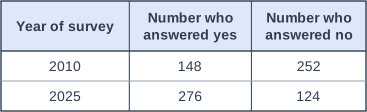
Researchers asked a random sample of 400 adults in 2010, and a different random sample of 400 adults in 2025: 'Would you feel comfortable talking to a friend about a mental health problem?' The table shows the results.

Calculate the percentage of adults in the 2025 sample who answered 'yes'. Show your workings.

Table with columns "Year of survey", "Number who answered yes", "Number who answered no". Year of survey: 2010; Number who answered yes: 148; Number who answered no: 252 | Year of survey: 2025; Number who answered yes: 276; Number who answered no: 124.

Model answer

276 ÷ 400 = 0.69
0.69 × 100 = 69%

Explanation

Divide the number who answered 'yes' in 2025 by the size of that sample (400), then multiply by 100. A common mistake is to divide by 800, the total of both samples, but each year's sample must be used on its own. Compared with 37% in 2010, the result suggests that people have become more willing to talk about mental health, which fits the idea of lessening social stigma.

Mark scheme
  1. 2 marks

    2 marks for the correct answer: 69(%). 1 mark for correct workings but incorrect/no answer: 276/400 × 100.

    A correct answer with no workings scores 2 marks. Accept 69% or 69. Accept other creditworthy workings, eg 276 ÷ 4, or 0.69 × 100. Do not accept 37 (the 2010 percentage) or 34.5 (276 divided by 800, both samples together). NOTE: Credit may be given for a correct answer written in the workings.

Question 3

3 marks

Briefly explain how a lessening of social stigma could lead to an increase in the recorded rates of mental health problems.

Model answer

Social stigma means negative attitudes and discrimination towards people with mental health problems. When stigma was high, many people hid their difficulties and did not see a doctor because they were afraid of being judged or treated differently, for example at work. As stigma lessens, people feel more able to talk openly and seek help, so more of them are diagnosed. This means the recorded rate of mental health problems rises, even if the actual number of people affected has not changed, because problems that were once hidden are now being counted.

Explanation

For full marks, link each step: less stigma, so more people seek help, so more are diagnosed, so recorded rates rise even if the true number has not changed. AQA's June 2024 Paper 2 report notes that a common error was mixing up the rise in the recorded rates of mental health problems with the fall in discrimination, so be clear about which one is increasing.

Mark scheme
  1. 3 marks

    Up to 3 marks for an explanation of how a lessening of social stigma could lead to an increase in the recorded rates of mental health problems. 3 marks: a clear and detailed explanation. 2 marks: a limited explanation. 1 mark: a very limited/muddled explanation.

    Possible content: Social stigma refers to negative attitudes, stereotypes and discrimination towards people with mental health problems, which can make them feel ashamed. When stigma is high, people may hide their difficulties and avoid seeking help because they fear being judged, being treated differently by friends or family, or losing their job. As stigma lessens (eg through awareness campaigns, public figures talking openly and education in schools), more people feel able to talk about their mental health and ask a doctor for help. More people are then diagnosed, so the recorded rate rises. The actual number of people with mental health problems may not have changed: problems that were previously hidden are now being recorded. Credit other relevant content. NOTE: For 3 marks the answer must link less stigma to more people seeking help AND to more cases being diagnosed or recorded. NOTE: Answers that say less stigma causes more people to develop mental health problems are inaccurate.

Question 4

6 marks

Read the following article.

Is modern life making us unwell?

A report on one English town has found that the number of adults being treated for mental health problems has risen sharply over the past ten years. Over the same period, more people in the town have started living alone, many now commute long distances to work, and a large local employer has closed. The report also notes that GPs in the town have held mental health awareness events, and more people say they now feel able to talk about their mental health.

How can the increased challenges of modern living be used to explain the rise in the number of adults being treated for mental health problems in the town? Refer to the article in your answer.

Model answer

The increased challenges of modern living are features of life today that can make it harder to stay mentally healthy, such as isolation, work and financial pressures, and the pressures of social media. They can increase stress while reducing the social support that helps people to cope effectively with challenges.

The article describes several of these challenges. More people in the town now live alone, so more may be isolated, with nobody to talk to when problems arise. Many commute long distances, leaving less time for friends, family and activities that protect wellbeing. The closure of a large employer is likely to have caused unemployment and money worries, and losing a job also removes daily routine and contact with colleagues. Together these changes could mean that more people in the town are actually developing mental health problems.

However, the rise may not be entirely due to modern living. The article says GPs have held awareness events and more people feel able to talk about their mental health. This suggests that increased recognition and less stigma mean that more people are now seeking treatment for problems that were previously hidden, so some of the rise may be in recorded cases rather than in real cases. Also, the report only shows that these changes happened at the same time, which does not prove that modern living caused the rise. Overall, the challenges of modern living probably explain part of the rise, alongside more people seeking help.

Explanation

Top answers explain how each challenge in the article (living alone, long commutes, job losses) could affect mental health, then weigh this against the article's evidence that more people are seeking help because of awareness and less stigma. Concluding that part of the rise may be in recorded cases, and that changes happening together do not prove cause, gives the analysis needed for Level 3.

Mark scheme
  1. 6 marks

    Levels of response (6 marks). AO1 - 2 marks, AO2 - 2 marks and AO3 - 2 marks.
    Level 3 Detailed (5-6 marks): AO1: Relevant knowledge and understanding of the increased challenges of modern living is accurate with detail. AO2: Clear and accurate application of knowledge and understanding of the increased challenges of modern living as referred to in the article. AO3: Analysis of how the increased challenges of modern living can be used to explain the rise described in the article is effective. Any conclusions drawn are sound and fully expressed. Relevant terminology is used consistently throughout. The answer demonstrates a high level of substantiated reasoning, and is clear, coherent and focused.
    Level 2 Clear (3-4 marks): AO1: Relevant knowledge and understanding of the increased challenges of modern living is present but there are occasional inaccuracies/omissions. AO2: Reasonable application of knowledge and understanding of the increased challenges of modern living as referred to in the article. AO3: There may be some effective analysis of how the increased challenges of modern living can be used to explain the rise described in the article. There may be an attempt to draw conclusions. Relevant terminology is occasionally used. The answer occasionally demonstrates substantiated reasoning, but may lack clarity, coherence, focus and logical structure.
    Level 1 Basic (1-2 marks): AO1: Knowledge and understanding of the increased challenges of modern living is present but limited. AO2: Limited or muddled application of knowledge and understanding of the increased challenges of modern living as referred to in the article. AO3: Analysis of how the increased challenges of modern living can be used to explain the rise described in the article is of limited effectiveness or muddled or may be absent. Any attempts to draw conclusions are not always successful or present. Relevant terminology may not be used at all or may be muddled.
    0 marks: No relevant content.

    Possible content (not a checklist): AO1 - Modern living brings challenges that can harm mental health: isolation and loneliness (living alone, moving away from family, less contact with neighbours), work pressures (long hours, long commutes, job insecurity, unemployment), financial pressures and the pressures of social media; these increase stress and reduce social support, making it harder to cope effectively with challenges. AO2 - More people in the town live alone, so isolation may have increased; long commutes leave less time for friends, family and activities; the closure of a large employer may have caused unemployment, money worries and the loss of daily routine and social contact. AO3 - These challenges could mean that more people in the town are actually developing mental health problems; however, the article also describes awareness events and people feeling more able to talk, so increased recognition and a lessening of stigma could mean that more people are seeking treatment for problems that already existed; the report shows that these changes happened at the same time, but this does not prove that modern living caused the rise; a likely conclusion is that both explanations play a part. Credit other relevant content. NOTE: AO2 may be embedded in AO1 or AO3, or may be separate. All are equally acceptable. NOTE: Answers that only use increased recognition or lessening of stigma, with no reference to the challenges of modern living, cannot go above Level 1.

Ready to try the rest? Every answer you write is marked against the mark scheme, so you can see exactly where the marks are.

Study Helper Hints first, answers after you try

Stuck on this one? Ask for a hint and I’ll point you in the right direction, without giving the answer away. Once you’ve checked your answer, I’ll show you how the marks are awarded.