
Level:
Correct: 0
Incorrect: 0
Marks: 0/0
Exam Practice
Course:
Topics:
AQA GCSE Psychology (Paper 2) Smart practice A mixed round aimed at your weak spots
Unit 1
Social influence
Conformity
Conformity
Obedience
Obedience
Prosocial behaviour
Prosocial behaviour
Crowd and collective behaviour
Unit 2
Language, thought and communication
The possible relationship between language and thought; the effect of language and thought on our view of the world
The possible relationship between language and thought
Differences between human and animal communication
Non-verbal communication
Explanations of non-verbal behaviour
Unit 3
Brain and neuropsychology
Structure and function of the nervous system
Neuron structure and function
Structure and function of the brain
An introduction to neuropsychology
Unit 4
Psychological problems
An introduction to mental health; how the incidence of significant mental health problems changes over time
An introduction to mental health
Effects of significant mental health problems on individuals and society
Effects of mental health problems on individuals and society
Characteristics of clinical depression
Theories of depression
Interventions or therapies for depression
Characteristics of addiction
Theories of addiction
Interventions or therapies for addiction
Avg
score:
–
Topics
done:
0/20

Structure and function of the brain

Practise 30 exam-style questions on Structure and function of the brain for AQA GCSE Psychology (Paper 2). Write your answer as you would in the exam and get it marked in seconds against the mark scheme, point by point, with the Study Helper on hand if you get stuck.

  • 30 questions
  • 1–9 marks each
  • Instant marking
  • No sign-up needed
20 questions, marked as you go

Sample questions with model answers

Here are 4 of the questions in this topic, each with a model answer, an explanation of why it earns the marks and the mark scheme an examiner would use.

Question 1

1 mark

Which area of the brain is mainly involved in producing speech?

Choose your answer.

  • Auditory area
  • Broca's area
  • Visual area
  • Wernicke's area

Model answer

Broca's area

Explanation

Broca's area, in the frontal lobe (usually in the left hemisphere), is involved in producing speech. The most common error is choosing Wernicke's area, which is in the temporal lobe and is involved in understanding language rather than producing it.

Mark scheme
  1. 1 mark

    Broca's area

    If more than one option is given, 0 marks.
Question 2

2 marks

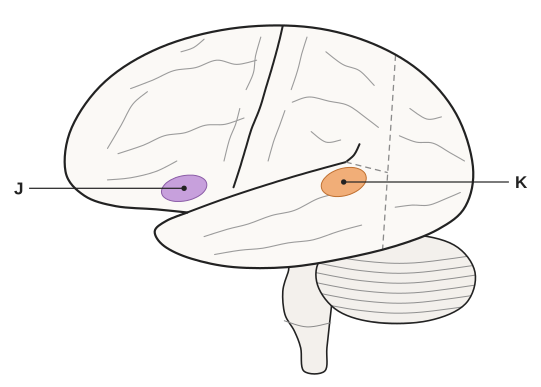
Figure 1 shows the left side of the brain. Two language areas are shaded and labelled J and K.

Which letter, J or K, shows the area mainly involved in understanding language? Name this area.

Side view of the left half of a brain, with the front of the head on the left. One fold runs from the top down towards the middle and a long fold rises from low at the front towards the back; faint dashed lines mark off the back end and the region behind the long fold. A small ridged structure is tucked under the back, and a stalk runs down from under the middle. Two coloured patches are drawn on the surface. Label J points to a shaded patch low down in the front region, just above the front end of the long fold. Label K points to a shaded patch just below the back end of the long fold, where the lower side region meets the top back region.

Model answer

K. It is Wernicke's area.

Explanation

Wernicke's area (K) is at the back of the upper temporal lobe, usually in the left hemisphere, and is involved in understanding language; Broca's area (J), in the lower back part of the frontal lobe, is involved in producing speech. Students often swap the two, so link Wernicke's area with understanding and Broca's area with producing speech.

Mark scheme
  1. 1 mark

    K

    Do not accept J (this is Broca's area, which is involved in producing speech).

  2. 1 mark

    Wernicke's area

    Award this mark for naming Wernicke's area even if the letter given is wrong. Accept recognisable misspellings, e.g. 'Wernickes area', 'Vernicke's area'. Do not accept 'Broca's area' or 'temporal lobe' on its own.

Question 3

3 marks

Read the following information.

On Saturday, Callum decided to bake a cake for his sister's birthday. He worked out the order in which to do each step so that it would be ready by six o'clock. While the cake was baking, he climbed onto a stool and kept his balance as he reached up to the top shelf for the candles. Then he heard the oven timer beeping in the kitchen.

From the information, identify one example of behaviour involving the frontal lobe, one example involving the cerebellum and one example involving the temporal lobe.

Model answer

Frontal lobe: Callum working out the order of the steps so that the cake would be ready by six o'clock (planning).
Cerebellum: keeping his balance on the stool as he reached up for the candles.
Temporal lobe: hearing the oven timer beeping (processing sound).

Explanation

Each example must come from the information and match the structure's function: planning in the frontal lobe, balance and coordination in the cerebellum, and processing sound in the temporal lobe. AQA's June 2023 Paper 2 report notes that marks were lost when an example was worded so that it really involved a different lobe, so phrase each one carefully.

Mark scheme
  1. 1 mark

    Frontal lobe: deciding to bake the cake / working out the order of the steps so it would be ready by six o'clock (planning, problem solving, decision making) / climbing or reaching up (voluntary movement controlled by the motor area).

    NOTE: If the candidate has written more than one answer for a structure, only mark the first one. NOTE: Answers worded in a way that links the behaviour to the wrong structure are not creditworthy (e.g. 'hearing the timer' given for the frontal lobe).

  2. 1 mark

    Cerebellum: keeping his balance on the stool (as he reached up) / coordinating his movements.

    Do not accept 'deciding to climb onto the stool' (decision making is the frontal lobe).

  3. 1 mark

    Temporal lobe: hearing the oven timer beeping (processing sound in the auditory area).

    Accept 'recognising the beeping as the oven timer' (memory).

Question 4

6 marks

Read the following information.

Kai is playing in a football match. He sees the ball coming towards him and hears a teammate shout 'Man on!'. He quickly works out where to pass the ball, keeps his balance as he turns, and passes it accurately to a teammate on the wing.

Describe the basic function of each of the four lobes of the brain and of the cerebellum. Refer to Kai in your answer.

Model answer

The occipital lobe, at the back of the brain, processes visual information such as colour, shape, movement and distance. Kai uses it when he sees the ball coming towards him and judges how far away it is. The temporal lobe, at the side of the brain below the frontal and parietal lobes, contains the auditory area, which processes sound, and Wernicke's area, which is involved in understanding language; it is also involved in memory. This lets Kai hear his teammate shout 'Man on!' and understand that an opponent is close behind him. The frontal lobe, at the front, is responsible for thinking, planning, problem solving and decision making, so Kai uses it to work out quickly where to pass. It also contains the motor area, which controls voluntary movement, so it sends the messages that make his leg kick the ball. The parietal lobe, at the top towards the back, contains the somatosensory area, which processes touch, pressure, pain and temperature, and it combines information from the senses so that we know where our body is. Kai uses it to feel the ball at his feet and to know where his body is as he turns. Finally, the cerebellum, tucked under the back of the brain, coordinates movement and controls balance and posture. It keeps Kai balanced as he turns and helps him make a smooth, accurate pass to his teammate on the wing.

Explanation

Detailed answers describe a clear function for each of the five structures and link each one to a specific moment in the match. AQA's June 2025 Paper 2 report notes that many answers on the lobes lost marks by not addressing every part of the question, so check that every structure is covered, not just the ones Kai obviously uses.

Mark scheme
  1. 6 marks

    Levels of response (6 marks). AO1 - 4 marks and AO2 - 2 marks.
    Level 3 Detailed (5-6 marks): AO1: Relevant knowledge and understanding of the basic functions of the four lobes and the cerebellum is accurate with detail. AO2: Clear and accurate application of knowledge and understanding of the basic functions of the four lobes and the cerebellum to Kai. Relevant terminology is used consistently throughout. The answer demonstrates a high level of substantiated reasoning, and is clear, coherent and focused.
    Level 2 Clear (3-4 marks): AO1: Relevant knowledge and understanding of the basic functions of the four lobes and the cerebellum is present but there are occasional inaccuracies/omissions. AO2: Reasonable application of knowledge and understanding of the basic functions of the four lobes and the cerebellum to Kai. Relevant terminology is usually used. The answer frequently demonstrates substantiated reasoning and is clear, generally coherent and focused although structure may lack some logic.
    Level 1 Basic (1-2 marks): AO1: Knowledge and understanding of the basic functions of the four lobes and the cerebellum is present but limited. AO2: Limited application of knowledge and understanding of the basic functions of the four lobes and the cerebellum to Kai. Relevant terminology is occasionally used. The answer occasionally demonstrates substantiated reasoning, but may lack clarity, coherence, focus and logical structure.
    0 marks: No relevant content.

    Possible content (not a checklist): AO1 - frontal lobe (front of the brain): thinking, planning, problem solving, decision making and social behaviour; contains the motor area, which controls voluntary movement, and Broca's area (producing speech); parietal lobe (top, towards the back, behind the central sulcus): contains the somatosensory area, which processes touch, pressure, pain and temperature; combines information from the senses, e.g. awareness of where the body is in space; temporal lobe (side, below the frontal and parietal lobes): processing sound (auditory area), understanding language (Wernicke's area), memory and emotion; occipital lobe (back): processing visual information such as colour, shape, movement and distance (visual area); cerebellum (back, underneath the cerebrum): coordination of movement, balance and posture. AO2 - occipital lobe: Kai seeing the ball and judging how far away it is; temporal lobe: hearing and understanding his teammate's shout; frontal lobe: working out (deciding) where to pass, and the motor area controlling the kick; parietal lobe: feeling the ball at his feet and awareness of his body position as he turns; cerebellum: keeping his balance as he turns and coordinating an accurate pass. Credit other relevant content. NOTE: The AO2 may be embedded in the AO1 or separate; both are equally acceptable. NOTE: For Level 3, the basic function of all five structures must be described (not every structure needs to be applied to Kai). NOTE: Answers that only state which structure Kai uses for each action, without describing functions (MAX 2 marks).

Ready to try the rest? Every answer you write is marked against the mark scheme, so you can see exactly where the marks are.

Study Helper Hints first, answers after you try

Stuck on this one? Ask for a hint and I’ll point you in the right direction, without giving the answer away. Once you’ve checked your answer, I’ll show you how the marks are awarded.