Level:
Correct: 0
Incorrect: 0
Marks: 0/0
Exam Practice
Course:
Topics:
AQA GCSE Psychology (Paper 2) Smart practice A mixed round aimed at your weak spots
Unit 1
Social influence
Conformity
Conformity
Obedience
Obedience
Prosocial behaviour
Prosocial behaviour
Crowd and collective behaviour
Unit 2
Language, thought and communication
The possible relationship between language and thought; the effect of language and thought on our view of the world
The possible relationship between language and thought
Differences between human and animal communication
Non-verbal communication
Explanations of non-verbal behaviour
Unit 3
Brain and neuropsychology
Structure and function of the nervous system
Neuron structure and function
Structure and function of the brain
An introduction to neuropsychology
Unit 4
Psychological problems
An introduction to mental health; how the incidence of significant mental health problems changes over time
An introduction to mental health
Effects of significant mental health problems on individuals and society
Effects of mental health problems on individuals and society
Characteristics of clinical depression
Theories of depression
Interventions or therapies for depression
Characteristics of addiction
Theories of addiction
Interventions or therapies for addiction
Avg
score:
–
Topics
done:
0/20

Structure and function of the nervous system

Practise 28 exam-style questions on Structure and function of the nervous system for AQA GCSE Psychology (Paper 2). Write your answer as you would in the exam and get it marked in seconds against the mark scheme, point by point, with the Study Helper on hand if you get stuck.

  • 28 questions
  • 1–9 marks each
  • Instant marking
  • No sign-up needed
20 questions, marked as you go

Sample questions with model answers

Here are 4 of the questions in this topic, each with a model answer, an explanation of why it earns the marks and the mark scheme an examiner would use.

Question 1

1 mark

Ahmed is walking through a park when a large dog runs towards him, barking. His heart starts to pound before he has had time to think about what is happening.

Which part of the nervous system is directly responsible for Ahmed's pounding heart?

Choose your answer.

  • Central nervous system
  • Parasympathetic division
  • Somatic nervous system
  • Sympathetic division

Model answer

Sympathetic division

Explanation

A threat activates the sympathetic division of the autonomic nervous system, which triggers the fight or flight response, including a faster heart rate. The change happens automatically, so it is not the somatic nervous system (voluntary movement), and the parasympathetic division does the opposite by calming the body once the threat has gone.

Mark scheme
  1. 1 mark

    Sympathetic division

    If more than one option is given, 0 marks.

Question 2

2 marks

Fear and excitement can both make a person's heart beat faster.

Use this information to explain one weakness of the James-Lange theory of emotion.

Model answer

The James-Lange theory says that an emotion is simply our interpretation of physical changes in the body, so every emotion would need its own unique pattern of arousal. But fear and excitement both produce a faster heart rate, so the physical change alone could not tell a person which emotion they are feeling. This suggests that thinking about the situation must also play a part, which the theory ignores.

Explanation

Full marks need the link between the information and the theory: the theory needs a different bodily pattern for each emotion, but the same arousal occurs in different emotions. Simply saying 'the theory is wrong because fear and excitement feel the same' is limited.

Mark scheme
  1. 2 marks

    Up to 2 marks for an explanation of one weakness of the James-Lange theory of emotion. 2 marks: a clear and accurate explanation. 1 mark: a limited or muddled explanation.

    Possible content: the theory says an emotion is our interpretation of physical changes in the body, so each emotion would need its own unique pattern of physical arousal; however, very different emotions such as fear and excitement produce the same arousal (a faster heart rate), so the physical changes alone cannot tell us which emotion we are feeling; this suggests that a cognitive element/interpretation of the situation is also needed (as Schachter and Singer's two-factor theory argues), so the theory is too simple. Credit other relevant content. NOTE: Answers that do not explain why the information is a problem for the theory (MAX 1).

Question 3

3 marks

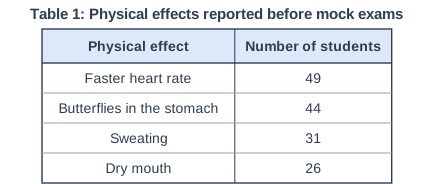
In a survey, 70 Year 11 students were asked which physical effects they noticed just before their mock exams. Students could choose more than one effect. The results are shown in Table 1.

Calculate the percentage of the 70 students who reported a dry mouth. Give your answer to two significant figures. Show your workings.

Table 1: Physical effects reported before mock exams. Table with columns "Physical effect", "Number of students". Physical effect: Faster heart rate; Number of students: 49 | Physical effect: Butterflies in the stomach; Number of students: 44 | Physical effect: Sweating; Number of students: 31 | Physical effect: Dry mouth; Number of students: 26.

Model answer

26 ÷ 70 = 0.3714...
0.3714... × 100 = 37.14...%
To two significant figures: 37%

Explanation

Divide the number reporting a dry mouth by the number of students (70), multiply by 100 and round to two significant figures. Common errors are dividing by the column total (150), which counts some students more than once, or stopping at 37.1, which is three significant figures.

Mark scheme
  1. 3 marks

    Up to 3 marks. 3 marks for the correct percentage to two significant figures: 37(%). 2 marks for the correct percentage but not rounded to two significant figures (e.g. 37.1 or 37.14) OR 2 marks for the 'correct' percentage but rounded incorrectly (e.g. 38). 1 mark for correct workings but incorrect/no answer: 26 ÷ 70 × 100.

    A correct answer scores 3 marks even without workings. Accept 37 with or without the % sign. 26 ÷ 70 = 0.37 (or 0.371) with no conversion to a percentage scores 1 mark (correct workings). Do not accept 17 (26 ÷ 150 × 100): students could choose more than one effect, so the total number of students is 70, not the column total of 150. Do not accept 270 or 269 (70 ÷ 26 × 100).

Question 4

6 marks

Tariq is cycling to school. He sees a car pull out in front of him, so he squeezes his brakes hard and stops just in time. He notices that his heart is pounding and he is breathing fast. A few minutes later, he has calmed down and carries on cycling.

Describe the divisions of the human nervous system and their basic functions. Refer to Tariq in your answer.

Model answer

The human nervous system has two main divisions. The central nervous system (CNS) is made up of the brain and spinal cord. It receives and processes incoming sensory information, coordinates it, makes decisions about how the body should respond and sends out instructions. When Tariq sees the car, sensory information from his eyes reaches his brain, which decides that he must stop.

The peripheral nervous system (PNS) is made up of all the nerves outside the brain and spinal cord, and it carries messages between the CNS and the rest of the body. It has two parts. The somatic nervous system controls voluntary movements of the skeletal muscles and carries sensory information to the CNS. Tariq's decision to brake is carried by motor neurons in his somatic nervous system to the muscles in his hands, which squeeze the brakes.

The autonomic nervous system controls the internal organs and glands automatically, without conscious control. It has two divisions. The sympathetic division prepares the body for fight or flight, releasing adrenaline and increasing heart rate and breathing rate; this is why Tariq's heart is pounding and he is breathing fast after the near miss. The parasympathetic division returns the body to its normal resting state ('rest and digest'). Once the danger has passed, Tariq's parasympathetic division takes over, his heart rate and breathing slow down and he calms down enough to carry on cycling.

Explanation

Top answers cover every division (CNS, PNS, somatic, autonomic, sympathetic and parasympathetic) with a basic function for each, and link the main ones to Tariq's actions. A common error is to describe brain areas in detail instead of the divisions, or to say the autonomic nervous system controls Tariq's braking.

Mark scheme
  1. 6 marks

    Levels of response (6 marks). AO1 - 4 marks and AO2 - 2 marks.
    Level 3 Detailed (5-6 marks): AO1: Relevant knowledge and understanding of the divisions of the human nervous system and their basic functions is accurate with detail. AO2: Clear and accurate application of knowledge and understanding of the divisions of the human nervous system and their basic functions to Tariq. Relevant terminology is used consistently throughout. The answer demonstrates a high level of substantiated reasoning, and is clear, coherent and focused.
    Level 2 Clear (3-4 marks): AO1: Relevant knowledge and understanding of the divisions of the human nervous system and their basic functions is present but there are occasional inaccuracies/omissions. AO2: Reasonable application of knowledge and understanding of the divisions of the human nervous system and their basic functions to Tariq. Relevant terminology is usually used. The answer frequently demonstrates substantiated reasoning and is clear, generally coherent and focused although structure may lack some logic.
    Level 1 Basic (1-2 marks): AO1: Knowledge and understanding of the divisions of the human nervous system and their basic functions is present but limited. AO2: Limited application of knowledge and understanding of the divisions of the human nervous system and their basic functions to Tariq. Relevant terminology is occasionally used. The answer occasionally demonstrates substantiated reasoning, but may lack clarity, coherence, focus and logical structure.
    0 marks: No relevant content.

    Possible content (not a checklist): AO1 - the central nervous system (CNS) is made up of the brain and spinal cord; it processes and coordinates incoming sensory information, makes decisions and sends instructions; the peripheral nervous system (PNS) is all the nerves outside the CNS and carries messages between the CNS and the rest of the body; the PNS is divided into the somatic nervous system (voluntary movement of the skeletal muscles; carries sensory information from the senses to the CNS) and the autonomic nervous system (involuntary control of the internal organs and glands); the autonomic nervous system has a sympathetic division (arousal, fight or flight) and a parasympathetic division (rest and digest, returns the body to normal). AO2 - sensory information about the car travels from Tariq's eyes to his CNS; his brain decides he must stop; instructions travel through his somatic nervous system (motor neurons/neurones) to his hand muscles to squeeze the brakes; the danger activates the sympathetic division of his autonomic nervous system - pounding heart, fast breathing; when he calms down, the parasympathetic division takes over and his heart rate and breathing return to normal. Credit other relevant content. NOTE: The AO2 may be embedded in the AO1 or separate; both are equally acceptable. NOTE: To be accurate with detail, the answer should cover the central and peripheral divisions and the two parts of the peripheral nervous system.

Ready to try the rest? Every answer you write is marked against the mark scheme, so you can see exactly where the marks are.

Study Helper Hints first, answers after you try

Stuck on this one? Ask for a hint and I’ll point you in the right direction, without giving the answer away. Once you’ve checked your answer, I’ll show you how the marks are awarded.