Level:
Correct: 0
Incorrect: 0
Marks: 0/0
Exam Practice
Course:
Topics:
AQA GCSE Psychology (Paper 2) Smart practice A mixed round aimed at your weak spots
Unit 1
Social influence
Conformity
Conformity
Obedience
Obedience
Prosocial behaviour
Prosocial behaviour
Crowd and collective behaviour
Unit 2
Language, thought and communication
The possible relationship between language and thought; the effect of language and thought on our view of the world
The possible relationship between language and thought
Differences between human and animal communication
Non-verbal communication
Explanations of non-verbal behaviour
Unit 3
Brain and neuropsychology
Structure and function of the nervous system
Neuron structure and function
Structure and function of the brain
An introduction to neuropsychology
Unit 4
Psychological problems
An introduction to mental health; how the incidence of significant mental health problems changes over time
An introduction to mental health
Effects of significant mental health problems on individuals and society
Effects of mental health problems on individuals and society
Characteristics of clinical depression
Theories of depression
Interventions or therapies for depression
Characteristics of addiction
Theories of addiction
Interventions or therapies for addiction
Avg
score:
–
Topics
done:
0/20

Characteristics of addiction

Practise 22 exam-style questions on Characteristics of addiction for AQA GCSE Psychology (Paper 2). Write your answer as you would in the exam and get it marked in seconds against the mark scheme, point by point, with the Study Helper on hand if you get stuck.

  • 22 questions
  • 1–9 marks each
  • Instant marking
  • No sign-up needed
20 questions, marked as you go

Sample questions with model answers

Here are 4 of the questions in this topic, each with a model answer, an explanation of why it earns the marks and the mark scheme an examiner would use.

Question 1

1 mark

Kerry has been drinking alcohol every evening. She says: 'Every evening I tell myself I will stop after one drink, but I nearly always end up having far more than I planned.'

Which feature of addiction (dependence syndrome) in the International Classification of Diseases does Kerry's statement show most clearly?

Choose your answer.

  • Difficulty in controlling use
  • A higher priority given to alcohol than to other activities
  • Low mood and reduced energy levels
  • Harmful use on a single occasion

Model answer

Difficulty in controlling use

Explanation

Kerry plans to stop after one drink but cannot keep to it, which is difficulty in controlling use: the person struggles to control when they start, when they stop or how much they use. Her statement says nothing about giving up other activities, so 'higher priority' is not the clearest answer. Low mood and reduced energy are ICD symptoms of unipolar depression, not features of dependence syndrome.

Mark scheme
  1. 1 mark

    Difficulty in controlling use

    If more than one option is given, 0 marks.

Question 2

2 marks

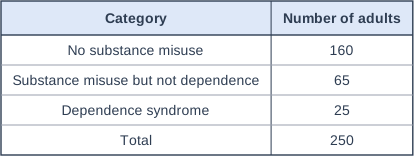
A researcher surveyed 250 adults about their use of alcohol over the past year and classified each person using the International Classification of Diseases. The table shows the results (invented data).

Calculate the percentage of the adults who showed substance misuse but not dependence. Show your workings.

Table with columns "Category", "Number of adults". Category: No substance misuse; Number of adults: 160 | Category: Substance misuse but not dependence; Number of adults: 65 | Category: Dependence syndrome; Number of adults: 25 | Category: Total; Number of adults: 250.

Model answer

65 ÷ 250 = 0.26
0.26 × 100 = 26%

Explanation

Divide the number in the group (65) by the total (250) and multiply by 100: 65 ÷ 250 × 100 = 26%. A common mistake is to divide by 100 instead of by the total, or to use the dependence figure (25) by misreading the table. Read the row labels carefully, because misuse and dependence are different categories.

Mark scheme
  1. 2 marks

    2 marks for the correct answer: 26%. 1 mark for correct workings but incorrect/no answer.

    A correct answer with no workings scores 2 marks. Workings: 65 ÷ 250 × 100 (or 65/250 = 0.26). Accept 26 without the % sign. The decimal 0.26 or the fraction 13/50 alone, not converted to a percentage, scores 1 mark (correct workings).

Question 3

3 marks

A psychologist, Dr Tremayne (fictional), wanted to study how adults who are worried about their drinking describe their use of alcohol. On one Monday morning she went to the waiting room of an alcohol advice service and asked the adults who were there if they would take part.

Identify the sampling method Dr Tremayne used. Explain one weakness of using this sampling method in her study.

Model answer

Opportunity sampling. A weakness is that the sample is unlikely to be representative of all adults who are worried about their drinking. Dr Tremayne only asked people who happened to be at one advice service on one Monday morning, so it leaves out people who have not asked for help or who work on weekday mornings, which means her findings cannot be generalised to everyone who is worried about their drinking.

Explanation

Asking whoever is available at the time is opportunity sampling, one of the four sampling methods in the specification. For 2 marks, the weakness must be linked to this study, for example explaining which groups of people the waiting-room sample would miss. A generic 'it is biased' without explanation earns only 1 mark.

Mark scheme
  1. 1 mark

    1 mark for: opportunity sampling

    Do not accept random, systematic or stratified sampling. NOTE: If the candidate has written more than one sampling method, only mark the first one.

  2. 2 marks

    Up to 2 marks for an explanation of one weakness of opportunity sampling in this study. 2 marks: a clear and accurate explanation that is linked to the study. 1 mark: a limited or muddled explanation, or a generic weakness not linked to the study.

    Possible content: the sample is unlikely to be representative of all adults worried about their drinking, because it only includes people at one advice service on one Monday morning (e.g. people who have already sought help, or who are free on weekday mornings), so the findings cannot be generalised; people who are worried but have not sought help, or who deny a problem, are not included; Dr Tremayne chose whom to approach, so researcher bias may affect who was asked. NOTE: The weakness may still be credited if the sampling method was wrongly identified, as long as it is a weakness of opportunity sampling.

Question 4

6 marks

Read the information about Dev.

Dev, 28, started vaping nicotine to cope with stress while studying. Two years later, he says he cannot get through a morning without vaping. He has developed a persistent cough and his doctor has told him to stop, but he says the urge is too strong. He has tried to cut down to vaping only in the evenings but has never managed it for more than a day or two. He now spends money meant for bills on vape refills.

Describe the characteristics of addiction (dependence syndrome) according to the International Classification of Diseases. Refer to Dev in your answer.

Model answer

The International Classification of Diseases (ICD) calls addiction 'dependence syndrome'. It is a cluster of features that develops after repeated use of a substance, rather than a single harmful episode. The first feature is a strong desire or urge to use the substance despite harmful consequences. Dev shows this because, even after developing a persistent cough and his doctor telling him to stop, he says the urge is too strong. The second feature is difficulty in controlling use, which means the person struggles to control when they start, when they stop or how much they use. Dev has tried to cut down to vaping only in the evenings but has never managed it for more than a day or two. The third feature is that a higher priority is given to the substance than to other activities or obligations. Dev spends money meant for his bills on vape refills, so vaping now comes before his responsibilities. The ICD also describes physical features: tolerance, where more of the substance is needed to get the same effect, and withdrawal symptoms when use is reduced or stopped. Dev saying that he cannot get through a morning without vaping may suggest this. His use began as a way to cope with stress and has become something he cannot control, which shows the difference between using a substance and being dependent on it, so a doctor using the ICD would be likely to diagnose dependence syndrome.

Explanation

Level 3 answers describe each ICD characteristic accurately and then show exactly which detail about Dev matches it, such as spending bill money on vape refills as a higher priority given to the substance. Copying the details about Dev without naming the characteristic they show is not creditworthy. Remember that dependence is not limited to alcohol and illegal drugs: legal substances such as nicotine can also lead to dependence.

Mark scheme
  1. 6 marks

    Levels of response (6 marks). AO1 - 4 marks and AO2 - 2 marks.
    Level 3 Detailed (5-6 marks): AO1: Relevant knowledge and understanding of the characteristics of addiction (dependence syndrome) according to the International Classification of Diseases is accurate with detail. AO2: Clear and accurate application of knowledge and understanding of the characteristics of addiction (dependence syndrome) to Dev. Relevant terminology is used consistently throughout. The answer demonstrates a high level of substantiated reasoning, and is clear, coherent and focused.
    Level 2 Clear (3-4 marks): AO1: Relevant knowledge and understanding of the characteristics of addiction (dependence syndrome) according to the International Classification of Diseases is present but there are occasional inaccuracies/omissions. AO2: Reasonable application of knowledge and understanding of the characteristics of addiction (dependence syndrome) to Dev. Relevant terminology is usually used. The answer frequently demonstrates substantiated reasoning and is clear, generally coherent and focused although structure may lack some logic.
    Level 1 Basic (1-2 marks): AO1: Knowledge and understanding of the characteristics of addiction (dependence syndrome) according to the International Classification of Diseases is present but limited. AO2: Limited application of knowledge and understanding of the characteristics of addiction (dependence syndrome) to Dev. Relevant terminology is occasionally used. The answer occasionally demonstrates substantiated reasoning, but may lack clarity, coherence, focus and logical structure.
    0 marks: No relevant content.

    Possible content (not a checklist): AO1 - the ICD calls addiction dependence syndrome: a cluster of features that develops after repeated use of a substance; a strong desire (urge, craving) to use the substance despite harmful consequences; difficulty in controlling use (starting, stopping or the amount used); a higher priority given to the substance than to other activities or obligations; tolerance (more needed for the same effect) and withdrawal symptoms may also be present; dependence differs from misuse because of the compulsion and loss of control. AO2 - Dev's urge is 'too strong' even after developing a cough and his doctor's advice (strong desire despite harm); he cannot keep to vaping only in the evenings (difficulty controlling use); money meant for bills goes on vape refills (higher priority than obligations); not getting through a morning without vaping may suggest withdrawal or dependence. Credit other relevant content. NOTE: The AO2 may be embedded in the AO1 or separate; both are equally acceptable. NOTE: Reference to Dev's behaviour is not enough by itself for relevant content because it is part of the question stem; it must be linked to an ICD characteristic.

Ready to try the rest? Every answer you write is marked against the mark scheme, so you can see exactly where the marks are.

Study Helper Hints first, answers after you try

Stuck on this one? Ask for a hint and I’ll point you in the right direction, without giving the answer away. Once you’ve checked your answer, I’ll show you how the marks are awarded.