Level:
Correct: 0
Incorrect: 0
Marks: 0/0
Exam Practice
Course:
Topics:
AQA GCSE Psychology (Paper 2) Smart practice A mixed round aimed at your weak spots
Unit 1
Social influence
Conformity
Conformity
Obedience
Obedience
Prosocial behaviour
Prosocial behaviour
Crowd and collective behaviour
Unit 2
Language, thought and communication
The possible relationship between language and thought; the effect of language and thought on our view of the world
The possible relationship between language and thought
Differences between human and animal communication
Non-verbal communication
Explanations of non-verbal behaviour
Unit 3
Brain and neuropsychology
Structure and function of the nervous system
Neuron structure and function
Structure and function of the brain
An introduction to neuropsychology
Unit 4
Psychological problems
An introduction to mental health; how the incidence of significant mental health problems changes over time
An introduction to mental health
Effects of significant mental health problems on individuals and society
Effects of mental health problems on individuals and society
Characteristics of clinical depression
Theories of depression
Interventions or therapies for depression
Characteristics of addiction
Theories of addiction
Interventions or therapies for addiction
Avg
score:
–
Topics
done:
0/20

Neuron structure and function

Practise 28 exam-style questions on Neuron structure and function for AQA GCSE Psychology (Paper 2). Write your answer as you would in the exam and get it marked in seconds against the mark scheme, point by point, with the Study Helper on hand if you get stuck.

  • 28 questions
  • 1–9 marks each
  • Instant marking
  • No sign-up needed
20 questions, marked as you go

Sample questions with model answers

Here are 4 of the questions in this topic, each with a model answer, an explanation of why it earns the marks and the mark scheme an examiner would use.

Question 1

1 mark

In synaptic transmission, what is meant by 'reuptake'?

Choose your answer.

  • The neurotransmitter binding to receptor sites on the next neuron
  • The neurotransmitter being taken back into the neuron that released it
  • The electrical impulse travelling along the axon
  • The vesicles releasing neurotransmitter into the synaptic gap

Model answer

The neurotransmitter being taken back into the neuron that released it

Explanation

After the neurotransmitter has acted on the next neuron, it is taken back into the sending neuron (reuptake), where it can be stored in vesicles and used again; this also stops the signal continuing. Binding to receptors and release from vesicles are earlier stages of synaptic transmission, which students sometimes confuse with reuptake.

Mark scheme
  1. 1 mark

    The neurotransmitter being taken back into the neuron that released it

    If more than one option is given, 0 marks.
Question 2

2 marks

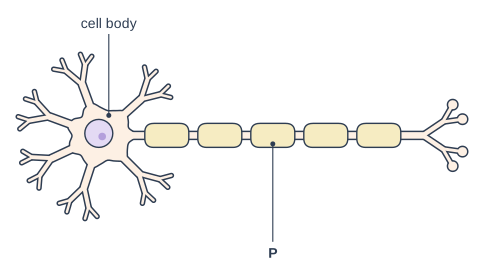
Figure 1 shows a motor neuron.

Name the part labelled P and state its function.

Diagram: a long cell drawn horizontally. On the left is a rounded central part containing a round structure, with many short branching extensions around it. A long thin fibre runs from it to the right, covered along most of its length by five sausage-shaped segments with small gaps between them, and ends in short branches with small knobs at their tips. Label P points to one of the sausage-shaped segments covering the long fibre; the label "cell body" points to the rounded central part on the left, around the round structure.

Model answer

P is the myelin sheath. It is a fatty layer that insulates the axon, so the electrical impulse travels along the axon much faster.

Explanation

The myelin sheath is the segmented fatty covering around the axon; it insulates the axon and speeds up the transmission of the impulse. A common error is to name P as the axon itself, which is the long fibre inside the sheath.

Mark scheme
  1. 1 mark

    P = myelin sheath

    Accept 'myelin'. Do not accept 'axon' (the myelin sheath covers the axon) or 'node of Ranvier' (a gap in the sheath).

  2. 1 mark

    it insulates the axon / speeds up the electrical impulse along the axon

    The function must be that of the myelin sheath. Accept 'protects the axon so the impulse travels faster'. Do not accept 'carries the impulse' on its own (the axon does this).

Question 3

3 marks

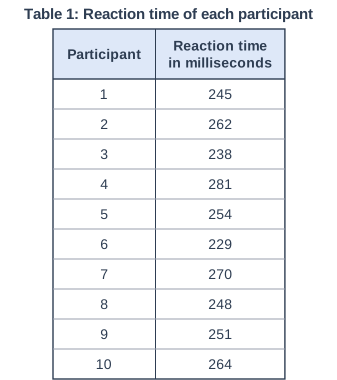
A psychologist, Dr Featherstone (fictional), measured how quickly ten participants could press a key after a red light appeared on a screen. To respond, a message has to pass from sensory neurons, through relay neurons in the brain, to motor neurons. Each participant's reaction time is shown in Table 1.

Calculate the mean reaction time. Give your answer to three significant figures. Show your workings.

Table 1: Reaction time of each participant. Table with columns "Participant", "Reaction time in milliseconds". Participant: 1; Reaction time in milliseconds: 245 | Participant: 2; Reaction time in milliseconds: 262 | Participant: 3; Reaction time in milliseconds: 238 | Participant: 4; Reaction time in milliseconds: 281 | Participant: 5; Reaction time in milliseconds: 254 | Participant: 6; Reaction time in milliseconds: 229 | Participant: 7; Reaction time in milliseconds: 270 | Participant: 8; Reaction time in milliseconds: 248 | Participant: 9; Reaction time in milliseconds: 251 | Participant: 10; Reaction time in milliseconds: 264.

Model answer

Total = 245 + 262 + 238 + 281 + 254 + 229 + 270 + 248 + 251 + 264 = 2542
Mean = 2542 ÷ 10 = 254.2
To three significant figures = 254 milliseconds

Explanation

Add all ten reaction times and divide by the number of participants (10), then round: the first three significant figures of 254.2 are 2, 5 and 4, and the next digit (2) is less than 5, so the answer is 254. Do not confuse the mean with the median (252.5), which is the middle of the ordered values.

Mark scheme
  1. 3 marks

    Up to 3 marks. 3 marks for the correct mean to three significant figures: 254 (milliseconds). 2 marks for the correct mean but not rounded to three significant figures: 254.2. 1 mark for correct workings but incorrect/no answer: 2542 ÷ 10.

    A correct answer scores 3 marks even without workings. Accept 254 with or without units. If 254.2 is seen in the workings but then rounded incorrectly (e.g. 255 or 250), award 2 marks. Do not accept 252.5 (this is the median); it scores 0 unless correct workings for the mean are also shown.

Question 4

6 marks

The nervous system contains three types of neuron: sensory neurons, relay neurons and motor neurons.

Briefly describe each type of neuron, including its structure and its basic function.

Model answer

Sensory neurons carry nerve impulses from sensory receptors, such as those in the skin, eyes or ears, to the central nervous system (CNS). They have long dendrites and a short axon, and their cell body sits to one side of the fibre, just outside the spinal cord. For example, when you touch something hot, sensory neurons carry the message from heat receptors in the skin to the spinal cord.

Relay neurons are found only inside the CNS, in the brain and spinal cord. They have short dendrites and a short axon. Their job is to pass messages between neurons within the CNS, linking sensory neurons to motor neurons and to other relay neurons, so that information can be processed and a response produced. In a reflex arc, a relay neuron in the spinal cord links the sensory neuron to the motor neuron.

Motor neurons carry nerve impulses from the CNS to effectors, which are muscles and glands. They have short dendrites and a long axon, usually covered by a myelin sheath that speeds up the impulse, and their cell body is inside the CNS. The axon ends at motor end plates on a muscle, so the impulse makes the muscle contract and produces a response, such as pulling your hand away.

All three types pass messages to each other across synapses using neurotransmitters.

Explanation

The Detailed level needs both the structure and the basic function of all three neurons, so describe the dendrites, axon and cell body of each as well as what it does. AQA's June 2025 Paper 2 report made a similar point about a 6-mark question on the lobes of the brain, where missing information was usually about structure rather than function.

Mark scheme
  1. 6 marks

    Levels of response (6 marks). AO1 - 6 marks.
    Level 3 Detailed (5-6 marks): Relevant knowledge and understanding of the structures and basic functions of all three types of neuron is accurate with detail. Relevant terminology is used consistently throughout. The answer demonstrates a high level of substantiated reasoning, and is clear, coherent and focused.
    Level 2 Clear (3-4 marks): Relevant knowledge and understanding of the structures and/or basic functions of types of neuron is present but there are occasional inaccuracies/omissions. Relevant terminology is occasionally used. The answer occasionally demonstrates substantiated reasoning, but may lack clarity, coherence, focus and logical structure.
    Level 1 Basic (1-2 marks): Knowledge and understanding of the structures and/or basic functions of type(s) of neuron is present but limited. Relevant terminology may not be used at all or may be muddled.
    0 marks: No relevant content.

    Possible content (not a checklist): AO1 - sensory neurons: carry nerve impulses from sensory receptors/sense organs to the central nervous system (CNS); long dendrites and a short axon; the cell body is to one side of the fibre, just outside the spinal cord. Relay neurons: found only in the CNS (brain and spinal cord); short dendrites and a short axon; pass messages between sensory and motor neurons (and other relay neurons), so information can be processed and a response produced. Motor neurons: carry impulses from the CNS to effectors (muscles and glands); short dendrites and a long axon, often covered by a myelin sheath that speeds up the impulse; the cell body is in the CNS; the axon ends at motor end plates/nerve endings on a muscle, causing it to contract (or a gland to secrete); all three communicate across synapses using neurotransmitters. Credit other relevant content. NOTE: The Detailed level requires both the structure and the basic function of all three types of neuron. NOTE: Accept 'neurone' throughout.

Ready to try the rest? Every answer you write is marked against the mark scheme, so you can see exactly where the marks are.

Study Helper Hints first, answers after you try

Stuck on this one? Ask for a hint and I’ll point you in the right direction, without giving the answer away. Once you’ve checked your answer, I’ll show you how the marks are awarded.