Practise 18 exam-style questions on The structure of an atom for AQA GCSE Combined Science (Foundation Physics Paper 1). Write your answer as you would in the exam and get it marked in seconds against the mark scheme, point by point, with the Study Helper on hand if you get stuck.
18 questions
1–6 marks each
Instant marking
No sign-up needed
18 questions, marked as you go
Sample questions with model answers
Here are 4 of the questions in this topic, each with a model answer, an explanation of why it earns the marks and the mark scheme an examiner would use.
Question 1
1 mark
Which statement describes where the electrons are in an atom?
Choose your answer.
Inside the nucleus with the protons
All at the same distance from the nucleus
Spread through a ball of positive charge
At different distances from the nucleus
Model answer
At different distances from the nucleus
Explanation
In the nuclear model, a small positively charged nucleus is surrounded by negatively charged electrons. The electrons are arranged at different distances from the nucleus, called energy levels. The plum pudding model, with electrons spread through a ball of positive charge, was replaced long ago.
Mark scheme
1 mark
At different distances from the nucleus
If more than one option is given, 0 marks. The nucleus contains only protons and neutrons. Electrons are not all at the same distance: they are arranged on different energy levels. A ball of positive charge with electrons spread through it is the old plum pudding model.
Question 2
1 mark
Electrons in an atom are arranged at different distances from the nucleus.
What name is given to these different distances?
Model answer
Energy levels
Explanation
The electrons are arranged at different distances from the nucleus, called energy levels (in chemistry they are often called shells). The levels further from the nucleus are higher energy levels. An electron can change level by absorbing or emitting electromagnetic radiation.
Mark scheme
1 mark
energy levels
allow (electron) shells. allow orbits. do not accept nucleus / orbitals of the nucleus.
Question 3
2 marks
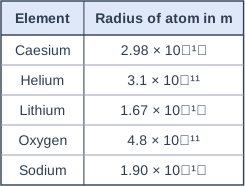
The table shows the approximate radius of an atom of each of five elements.
Which two elements in the table have atoms with a radius smaller than 1 × 10⁻¹⁰ m?
Model answer
Helium and oxygen
Explanation
1 × 10⁻¹⁰ m is the same as 10 × 10⁻¹¹ m. Helium (3.1 × 10⁻¹¹ m) and oxygen (4.8 × 10⁻¹¹ m) have smaller radii because their power of ten is -11. The other three atoms have radii between 1 × 10⁻¹⁰ m and 3 × 10⁻¹⁰ m. Comparing the front numbers alone gives the wrong answer.
Mark scheme
1 mark
helium
List rule: each wrong extra element cancels a correct one.
1 mark
oxygen
Question 4
4 marks
Some banknotes are printed with a special ink. When ultraviolet light is shone on the ink, the ink glows with visible light.
Explain, in terms of electrons and energy levels, how the ink gives out visible light.
Model answer
The atoms in the ink absorb the ultraviolet radiation. This makes electrons move further from the nucleus, to higher energy levels. The electrons then move back closer to the nucleus, to lower energy levels, and as they do the atoms emit electromagnetic radiation, which we see as visible light.
Explanation
Absorbing electromagnetic radiation moves electrons to higher energy levels, further from the nucleus; moving back to lower levels makes the atom emit electromagnetic radiation. Both steps are needed for full marks. The ink is not reflecting the ultraviolet, which we cannot see: it gives out visible light of its own.
Mark scheme
1 mark
(atoms in) the ink absorb the ultraviolet (radiation / light)
allow the electrons absorb (energy from) the ultraviolet.
1 mark
electrons move to a higher energy level / further from the nucleus
allow electrons 'jump up' an energy level.
1 mark
the electrons then move (back) to a lower energy level / closer to the nucleus
allow electrons 'fall back down'.
1 mark
and the atoms emit (visible) light / electromagnetic radiation
allow give out for emit. do not accept 'the ink reflects the ultraviolet'. 'releases energy' alone is not enough for this mark.
Ready to try the rest? Every answer you write is marked against the mark scheme, so you can see exactly where the marks are.
Ctrl + Enter to check
Study HelperHints first, answers after you try
Stuck on this one? Ask for a hint and I’ll point you in the right direction, without giving the answer away. Once you’ve checked your answer, I’ll show you how the marks are awarded.