
Level:
Correct: 0
Incorrect: 0
Marks: 0/0
Exam Practice
Course:
Topics:
AQA GCSE Combined Science (Foundation Physics Paper 1) Smart practice A mixed round aimed at your weak spots
Unit 18
Energy
Energy changes in a system, and the ways energy is stored before and after such changes
Energy stores and systems, and changes in energy
Energy changes in systems
Power
Conservation and dissipation of energy
Energy transfers in a system and efficiency
National and global energy resources
Unit 19
Electricity
Unit 20
Particle model of matter
Changes of state and the particle model
Density of materials and changes of state
Particle model and pressure
Particle motion in gases
Unit 21
Atomic structure
Avg
score:
–
Topics
done:
0/17

Standard circuit diagram symbols, electrical charge and current

Practise 22 exam-style questions on Standard circuit diagram symbols, electrical charge and current for AQA GCSE Combined Science (Foundation Physics Paper 1). Write your answer as you would in the exam and get it marked in seconds against the mark scheme, point by point, with the Study Helper on hand if you get stuck.

  • 22 questions
  • 1–6 marks each
  • Instant marking
  • No sign-up needed
20 questions, marked as you go

Sample questions with model answers

Here are 4 of the questions in this topic, each with a model answer, an explanation of why it earns the marks and the mark scheme an examiner would use.

Question 1

1 mark

Ella connects a lamp, a closed switch and an ammeter in a complete loop of wire.

The ammeter reads 0 A and the lamp does not light.

What must Ella add to the circuit so that charge flows through it?

Model answer

A source of potential difference, such as a cell or a battery.

Explanation

For charge to flow round a closed circuit, the circuit must include a source of potential difference such as a cell, a battery or a power supply. A complete loop is needed too, but on its own it does not make charge flow. A voltmeter is a common wrong answer: it measures potential difference but does not provide it.

Mark scheme
  1. 1 mark

    a source of potential difference

    Allow a cell / a battery / a power supply / a source of voltage. Do not accept a voltmeter. Ignore more wires, a resistor or 'energy' on its own.
Question 2

2 marks

The current in the bulb of a torch is 0.40 A. The torch is left on for 45 seconds.

Calculate the charge that flows through the bulb in this time.

Use the equation:

charge flow = current × time

Model answer

charge flow = 0.40 × 45
charge flow = 18 C

Explanation

Substitute the current in amperes and the time in seconds: 0.40 × 45 = 18 C. The time is already in seconds, so no conversion is needed. Dividing the two numbers instead of multiplying is the usual error.

Mark scheme
  1. 1 mark

    charge flow = 0.40 × 45

    A correct answer with no working scores full marks. Full marks are not awarded for a correct final answer from incorrect working.

  2. 1 mark

    charge flow = 18 (C)

    Do not accept 0.0089 (from 0.40 ÷ 45).

Question 3

2 marks

Some variables must be kept the same in an investigation of how the resistance of a wire depends on its length.

Name two variables that the student should keep the same.

Model answer

The material of the wire and the thickness (diameter) of the wire.

Explanation

A control variable is kept the same so that only the independent variable (the length) affects the dependent variable (the resistance). The material, the thickness and the temperature of the wire all affect its resistance, so they must be controlled. The current and the potential difference are measured to work out the resistance, so they are not control variables.

Mark scheme
  1. 1 mark

    the material / type of metal of the wire

    Any two from the three points, 1 mark each, max 2. Do not accept the length of the wire (the independent variable), the resistance (the dependent variable) or the current in the wire (it is measured, and it changes as the length changes): each of these given as an extra answer cancels a correct one. Allow 'use the same piece of wire' for 1 mark only. Ignore 'the potential difference of the power supply'.

  2. 1 mark

    the thickness / diameter / cross-sectional area of the wire

    Allow width of the wire.

  3. 1 mark

    the temperature of the wire

    Allow 'keep the temperature the same'. Ignore 'same equipment' or 'same method'.

Question 4

3 marks

A student investigated how joining two identical resistors affects the total resistance.

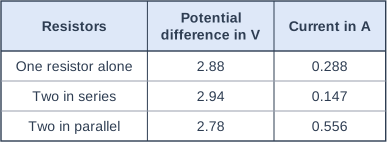
She measured the potential difference and the current for one resistor alone, for the two resistors in series and for the two resistors in parallel. The table shows her results.

Calculate the total resistance of the two resistors in parallel.

Use the equation:

potential difference = current × resistance

Compare your answer with the resistance of one resistor alone.

Table with columns "Resistors", "Potential difference in V", "Current in A". Resistors: One resistor alone; Potential difference in V: 2.88; Current in A: 0.288 | Resistors: Two in series; Potential difference in V: 2.94; Current in A: 0.147 | Resistors: Two in parallel; Potential difference in V: 2.78; Current in A: 0.556.

Model answer

2.78 = 0.556 × resistance
resistance = 2.78 ÷ 0.556 = 5.0 Ω
One resistor alone has a resistance of 2.88 ÷ 0.288 = 10 Ω, so the total resistance of the two resistors in parallel is less than the resistance of one resistor: it is half of it.

Explanation

Rearrange the equation to resistance = potential difference ÷ current = 2.78 ÷ 0.556 = 5.0 Ω. One resistor alone has a resistance of 2.88 ÷ 0.288 = 10 Ω, so adding a second resistor in parallel decreased the total resistance, while adding it in series (2.94 ÷ 0.147 = 20 Ω) increased it. Dividing the current by the potential difference is a common error.

Mark scheme
  1. 1 mark

    2.78 = 0.556 × resistance / resistance = 2.78 ÷ 0.556

    The value comes from the measurements in the 'Two in parallel' row of the table; no formula for the total resistance of resistors in parallel is needed or expected. A correct answer with no working scores full marks. Full marks are not awarded for a correct final answer from incorrect working.

  2. 1 mark

    resistance = 5.0 (Ω)

    Allow 5 (Ω). Do not accept 0.2 (from 0.556 ÷ 2.78).

  3. 1 mark

    the total resistance in parallel is less than the resistance of one resistor alone (10 Ω) / it is half the resistance of one resistor

    Allow ecf: their value correctly compared with 10 Ω. Allow 'adding a second resistor in parallel decreases the total resistance'. A value on its own with no comparison does not score.

Ready to try the rest? Every answer you write is marked against the mark scheme, so you can see exactly where the marks are.

Study Helper Hints first, answers after you try

Stuck on this one? Ask for a hint and I’ll point you in the right direction, without giving the answer away. Once you’ve checked your answer, I’ll show you how the marks are awarded.