
Level:
Correct: 0
Incorrect: 0
Marks: 0/0
Exam Practice
Course:
Topics:
AQA GCSE Combined Science (Foundation Physics Paper 1) Smart practice A mixed round aimed at your weak spots
Unit 18
Energy
Energy changes in a system, and the ways energy is stored before and after such changes
Energy stores and systems, and changes in energy
Energy changes in systems
Power
Conservation and dissipation of energy
Energy transfers in a system and efficiency
National and global energy resources
Unit 19
Electricity
Unit 20
Particle model of matter
Changes of state and the particle model
Density of materials and changes of state
Particle model and pressure
Particle motion in gases
Unit 21
Atomic structure
Avg
score:
–
Topics
done:
0/17

Domestic uses and safety

Practise 18 exam-style questions on Domestic uses and safety for AQA GCSE Combined Science (Foundation Physics Paper 1). Write your answer as you would in the exam and get it marked in seconds against the mark scheme, point by point, with the Study Helper on hand if you get stuck.

  • 18 questions
  • 1–6 marks each
  • Instant marking
  • No sign-up needed
18 questions, marked as you go

Sample questions with model answers

Here are 4 of the questions in this topic, each with a model answer, an explanation of why it earns the marks and the mark scheme an examiner would use.

Question 1

1 mark

The insulation on each wire in a three-core cable is a different colour.

Give the reason for this.

Model answer

The colours make each wire easy to identify, so that each wire is connected to the correct terminal.

Explanation

The insulation is colour coded so that the live, neutral and earth wires can be identified easily and connected correctly. 'For safety' is not enough on its own: the answer must say how the colours help, which is by identifying the wires.

Mark scheme
  1. 1 mark

    so that each wire can be identified (easily)

    allow so the wires are not mixed up / so each wire is connected to the correct terminal (in a plug or appliance). ignore 'for safety' on its own. ignore references to appearance or decoration.
Question 2

2 marks

A three-core cable contains a live wire, a neutral wire and an earth wire.

Give the colour of the insulation on each of the three wires.

Model answer

Live wire: brown
Neutral wire: blue
Earth wire: green and yellow stripes

Explanation

In a three-core cable the live wire is brown, the neutral wire is blue and the earth wire has green and yellow stripes. Older wiring used red for live and black for neutral, so 'red' and 'black' are common wrong answers. The earth wire needs both colours: 'green' on its own is not enough.

Mark scheme
  1. 1 mark

    live wire - brown

    do not accept red (an old colour code for the live wire). If more than one colour is given for the live wire, this mark is not awarded.

  2. 1 mark

    neutral wire - blue and earth wire - green and yellow (stripes)

    both wires must be correct for this mark. allow yellow and green / green-yellow for the earth wire. do not accept green on its own or yellow on its own for the earth wire. do not accept black (an old colour code) for the neutral wire.

Question 3

3 marks

A three-core cable has a live wire, a neutral wire and an earth wire.

Here are four functions, P, Q, R and S.

P: carries the alternating potential difference from the supply
Q: completes the circuit
R: breaks the circuit if the current becomes too large
S: is a safety wire that stops the appliance becoming live

Match each wire to its function. Write each wire with the letter of its function.

Model answer

Live wire: P
Neutral wire: Q
Earth wire: S

Explanation

The live wire carries the alternating potential difference from the supply, the neutral wire completes the circuit and the earth wire is a safety wire that stops the appliance becoming live. Function R describes a fuse or a circuit breaker, which is not one of the wires in the cable; giving R for the earth wire is a common mistake.

Mark scheme
  1. 1 mark

    live wire - P

    One letter for each wire: if more than one letter is given for a wire, that wire scores 0. R is not the function of any wire in the cable (it describes a fuse or a circuit breaker).

  2. 1 mark

    neutral wire - Q

  3. 1 mark

    earth wire - S

    do not accept R for the earth wire.

Question 4

4 marks

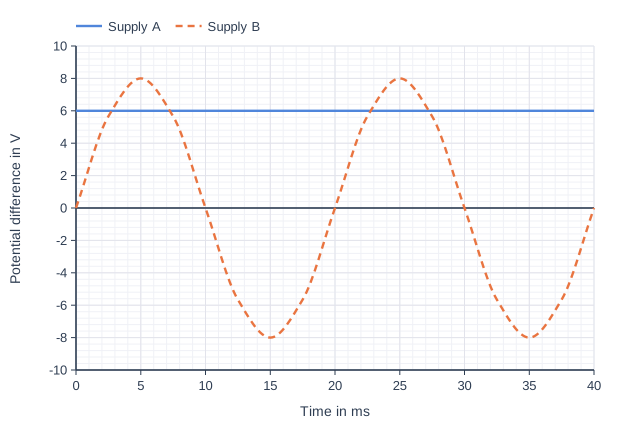
A student connected two different supplies, A and B, to a data logger. The graph shows how the potential difference of each supply changed with time.

Compare the potential difference of supply A with the potential difference of supply B.

Use data from the graph in your answer.

Line graph of Potential difference in V (y-axis, -10 to 10) against time in ms (x-axis, 0 to 40). "Supply A" joins the points (0, 6), (40, 6). "Supply B" (dashed) is a smooth curve through (0, 0), (2.5, 5.66), (5, 8), (7.5, 5.66), (10, 0), (12.5, -5.66), (15, -8), (17.5, -5.66), (20, 0), (22.5, 5.66), (25, 8), (27.5, 5.66), (30, 0), (32.5, -5.66), (35, -8), (37.5, -5.66), (40, 0).

Model answer

Supply A is a direct potential difference: it stays at a constant 6 V and is always positive, so it is always in the same direction. Supply B is an alternating potential difference: it keeps changing direction, going between +8 V and -8 V.

The maximum p.d. of B, 8 V, is 2 V greater than the p.d. of A, but B is only greater than A for a short time in each cycle, and B is 0 V at 0, 10 and 20 ms, while A is never 0 V. B repeats every 20 ms, so it has a frequency of 50 Hz, the same as the UK mains, but A does not repeat because it does not change.

Explanation

A compare question needs statements about both supplies in the same sentence, such as 'B's maximum of 8 V is 2 V more than A's 6 V'. The key difference is that A is direct (constant and one direction) and B is alternating (it reverses direction). Describing each line separately, or giving no values from the graph, keeps an answer in Level 1.

Mark scheme
  1. 4 marks

    Levels of response (4 marks).
    Level 2 (3-4 marks): Scientifically relevant features are identified; the way(s) in which they are similar / different is made clear and (where appropriate) the magnitude of the similarity / difference is noted.
    Level 1 (1-2 marks): Relevant features are identified and differences noted.
    No relevant content: 0 marks.

    Indicative content (not a checklist; credit other valid points):
    Supply A
    - A is a direct p.d. (d.c.)
    - A stays constant at 6 V
    - A is always positive / always in the same direction
    Supply B
    - B is an alternating p.d. (a.c.)
    - B changes all the time, between +8 V and -8 V
    - B is positive for half of each cycle and negative for the other half / keeps changing direction (it reverses every 10 ms)
    Comparisons with data
    - the maximum p.d. of B (8 V) is 2 V more than the p.d. of A (6 V)
    - B is only greater than A for a short part of each cycle (near 5 ms and 25 ms); for most of the time it is less than A
    - B repeats every 20 ms, so its frequency is 50 Hz (the same as the UK mains); A does not repeat
    - B is 0 V at 0, 10, 20, 30 and 40 ms, but A is never 0 V
    - similarity: both supplies are positive at 5 ms (B 8 V, A 6 V) / both reach a maximum positive value of a similar size (6 V and 8 V)
    For Level 2, the answer must compare the two supplies (not describe only one) and use at least one value read from the graph with its unit.
    Start at the lowest level and use best fit; full marks only if no incorrect statement contradicts a correct response.
    Common errors: saying B is d.c. because it starts at 0 V; describing each supply separately without comparing; reading the p.d. axis as time.

Ready to try the rest? Every answer you write is marked against the mark scheme, so you can see exactly where the marks are.

Study Helper Hints first, answers after you try

Stuck on this one? Ask for a hint and I’ll point you in the right direction, without giving the answer away. Once you’ve checked your answer, I’ll show you how the marks are awarded.