
Level:
Correct: 0
Incorrect: 0
Marks: 0/0
Exam Practice
Course:
Topics:
AQA GCSE Combined Science (Foundation Physics Paper 1) Smart practice A mixed round aimed at your weak spots
Unit 18
Energy
Energy changes in a system, and the ways energy is stored before and after such changes
Energy stores and systems, and changes in energy
Energy changes in systems
Power
Conservation and dissipation of energy
Energy transfers in a system and efficiency
National and global energy resources
Unit 19
Electricity
Unit 20
Particle model of matter
Changes of state and the particle model
Density of materials and changes of state
Particle model and pressure
Particle motion in gases
Unit 21
Atomic structure
Avg
score:
–
Topics
done:
0/17

Energy transfers in everyday appliances and the National Grid

Practise 22 exam-style questions on Energy transfers in everyday appliances and the National Grid for AQA GCSE Combined Science (Foundation Physics Paper 1). Write your answer as you would in the exam and get it marked in seconds against the mark scheme, point by point, with the Study Helper on hand if you get stuck.

  • 22 questions
  • 1–6 marks each
  • Instant marking
  • No sign-up needed
20 questions, marked as you go

Sample questions with model answers

Here are 4 of the questions in this topic, each with a model answer, an explanation of why it earns the marks and the mark scheme an examiner would use.

Question 1

1 mark

The energy transferred by an electrical appliance depends on the power of the appliance.

Give one other factor that affects how much energy an appliance transfers.

Model answer

How long the appliance is switched on for.

Explanation

The energy an appliance transfers depends on its power and on how long it is switched on, as shown by energy transferred = power × time. A kettle left on for twice as long transfers twice as much energy.

Mark scheme
  1. 1 mark

    the time (for which) the appliance is switched on / how long it is used for

    allow time. ignore the potential difference / current / resistance. do not accept the size of the appliance.

Question 2

2 marks

A food mixer is plugged into the mains. Its electric motor turns the blades.

Describe how energy is transferred when the food mixer is used.

Model answer

Energy is transferred electrically from the mains to the motor, by the current in the mixer. This increases the kinetic energy store of the motor and the blades. Some energy is also dissipated to the thermal store of the surroundings.

Explanation

Mains appliances with motors transfer energy electrically from the a.c. mains to the kinetic store of the motor. The first mark is for how the energy gets to the motor (electrically, by the current) and the second is for the store that increases. Writing only 'it uses electricity' does not describe the transfer.

Mark scheme
  1. 1 mark

    energy is transferred from the mains (supply) to the motor electrically / by the current / by work done when charge flows

    allow electrical energy from the mains is transferred to the motor. ignore references to the plug or socket on their own.

  2. 1 mark

    (this increases) the kinetic (energy) store of the motor / blades

    allow the blades gain kinetic energy. ignore sound. some energy dissipated to the thermal store of the motor / surroundings is correct, but it does not score this mark on its own. do not accept the chemical store of the motor increases.

Question 3

2 marks

The diagram shows how electrical power is transferred from a power station to homes by the National Grid.

Name the devices A and B.

Flow chart of 5 boxes joined by arrows, read from left to right. The first box is "Power station", which leads to box A, which leads to "Transmission cables", which leads to box B, which leads to "Homes".

Model answer

A is a step-up transformer.
B is a step-down transformer.

Explanation

A step-up transformer increases the potential difference from the power station to the very high value used in the transmission cables. A step-down transformer then decreases it to a much lower value for use in homes. Writing 'transformer' without saying which type does not show the difference between A and B.

Mark scheme
  1. 1 mark

    A: step-up transformer

    allow 'step-up' for A. 'transformer' for both A and B, with no step-up or step-down, scores 1 mark in total.

  2. 1 mark

    B: step-down transformer

    allow 'step-down' for B. do not accept generator / pylon / substation on its own.

Question 4

4 marks

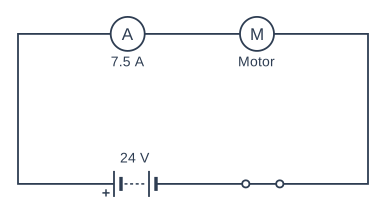
An electric wheelchair is driven by an electric motor. The motor is powered by a 24 V battery. The diagram shows the circuit.

The current in the motor is 7.5 A. The wheelchair is used for 40 minutes.

Calculate how much energy is transferred to the motor in this time.

Use the equations:

power = potential difference × current

energy transferred = power × time

Circuit diagram. All the components are connected in series in a single loop. Going round the loop from the + terminal of the battery (labelled 24 V): an ammeter (reading 7.5 A); then a motor (labelled "Motor"); then a closed switch; and back to the − terminal of the battery.

Model answer

power = 24 × 7.5 = 180 W
time = 40 × 60 = 2400 s
energy transferred = 180 × 2400
energy transferred = 432 000 J

Explanation

First find the power from power = potential difference × current (180 W), then change 40 minutes into 2400 s and use energy transferred = power × time: 180 × 2400 = 432 000 J. The energy is transferred from the chemical store of the battery to the kinetic store of the motor (and some to the surroundings). The most common error is to leave the time in minutes.

Mark scheme
  1. 1 mark

    power = 24 × 7.5 = 180 (W)

    a correct answer with no working scores full marks. allow the alternative route: charge flow = 7.5 × 2400 = 18 000 C, then energy = 18 000 × 24, for the matching marks.

  2. 1 mark

    time = 40 × 60 = 2400 (s)

  3. 1 mark

    energy transferred = 180 × 2400

    allow ecf from their power. allow a correct substitution using an incorrectly / not converted value of time, e.g. 180 × 40.

  4. 1 mark

    energy transferred = 432 000 (J)

    allow 4.32 × 10⁵ (J). allow a correct calculation using an incorrectly / not converted value of time: 7200 (J) scores 3 marks. full marks are not awarded for a correct final answer from incorrect working.

Ready to try the rest? Every answer you write is marked against the mark scheme, so you can see exactly where the marks are.

Study Helper Hints first, answers after you try

Stuck on this one? Ask for a hint and I’ll point you in the right direction, without giving the answer away. Once you’ve checked your answer, I’ll show you how the marks are awarded.