
Level:
Correct: 0
Incorrect: 0
Marks: 0/0
Exam Practice
Course:
Topics:
AQA GCSE Combined Science (Foundation Physics Paper 1) Smart practice A mixed round aimed at your weak spots
Unit 18
Energy
Energy changes in a system, and the ways energy is stored before and after such changes
Energy stores and systems, and changes in energy
Energy changes in systems
Power
Conservation and dissipation of energy
Energy transfers in a system and efficiency
National and global energy resources
Unit 19
Electricity
Unit 20
Particle model of matter
Changes of state and the particle model
Density of materials and changes of state
Particle model and pressure
Particle motion in gases
Unit 21
Atomic structure
Avg
score:
–
Topics
done:
0/17

Radioactive decay, nuclear radiation and nuclear equations

Practise 22 exam-style questions on Radioactive decay, nuclear radiation and nuclear equations for AQA GCSE Combined Science (Foundation Physics Paper 1). Write your answer as you would in the exam and get it marked in seconds against the mark scheme, point by point, with the Study Helper on hand if you get stuck.

  • 22 questions
  • 1–6 marks each
  • Instant marking
  • No sign-up needed
20 questions, marked as you go

Sample questions with model answers

Here are 4 of the questions in this topic, each with a model answer, an explanation of why it earns the marks and the mark scheme an examiner would use.

Question 1

1 mark

Which type of nuclear radiation is the most strongly ionising?

Choose your answer.

  • Gamma
  • Beta
  • Alpha
  • They are all equally ionising

Model answer

Alpha

Explanation

Alpha particles are the most strongly ionising, beta particles are less ionising and gamma rays are the least ionising. Because alpha particles ionise so strongly, they lose their energy quickly and have the shortest range. Some students confuse ionising power with penetration: gamma rays are the most penetrating but the least ionising.

Mark scheme
  1. 1 mark

    Alpha

    If more than one option is given, 0 marks. Gamma rays are the most weakly ionising and beta particles are in between. The three types are not equally ionising.
Question 2

2 marks

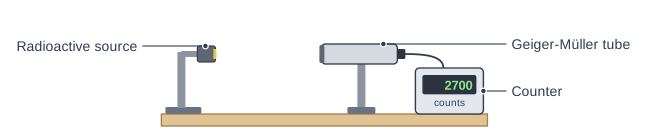
Figure 1 shows a radioactive source and a Geiger-Müller tube connected to a counter. The counter shows the number of counts recorded in 3 minutes.

Use the equation:
count-rate = number of counts ÷ time

Calculate the count-rate in counts per second.

Diagram of a radioactive source and a Geiger-Müller tube with a counter. A radioactive source on the left points at the window of a Geiger-Müller tube on the right, which is connected to a counter showing 2700. There is nothing between the source and the tube. Labelled parts: Radioactive source, Geiger-Müller tube, Counter.

Model answer

time = 3 × 60 = 180 s
count-rate = 2700 ÷ 180
count-rate = 15 counts per second

Explanation

Count-rate is the number of decays recorded each second, so the time must be in seconds: 3 minutes = 180 s, and 2700 ÷ 180 = 15 counts per second. Dividing by 3 gives counts per minute (900), which is the most common error. Multiplying instead of dividing is another.

Mark scheme
  1. 1 mark

    count-rate = 2700 ÷ 180

    allow a correct substitution using an incorrectly / not converted value (2700 ÷ 3) for this mark. A correct answer with no working scores full marks. Full marks are not awarded for a correct final answer from incorrect working.

  2. 1 mark

    15 (counts per second)

    an answer of 900 scores 1 mark (time not converted to seconds).

Question 3

2 marks

Engineers check welds in thick steel pipes for cracks. A radioactive source is placed on one side of the steel. A detector is placed on the other side. The steel is several centimetres thick.

Explain why a gamma source is used rather than an alpha source or a beta source.

Model answer

Gamma rays are very penetrating, so they can pass through several centimetres of steel and reach the detector. Alpha particles are stopped by a sheet of paper and beta particles by a few millimetres of aluminium, so they would be absorbed by the steel and nothing would reach the detector.

Explanation

Choosing a source means matching its penetration to the job: only gamma rays get through thick steel. Alpha particles are stopped by paper and beta particles by a few millimetres of metal. Answers saying gamma is 'safer' are wrong - gamma is the most penetrating, so it needs the most shielding.

Mark scheme
  1. 1 mark

    gamma rays can pass through / penetrate (several centimetres of) steel

    allow gamma is the most penetrating radiation.

  2. 1 mark

    alpha particles and beta particles would be absorbed / stopped by the steel

    allow alpha is stopped by paper (or skin) and beta is stopped by a few millimetres of aluminium / metal. Both alpha and beta must be covered for the mark. ignore gamma is less ionising / safer.

Question 4

4 marks

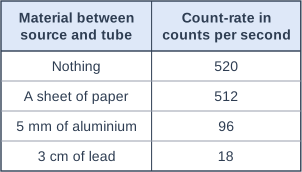
A teacher placed different materials between a radioactive source and a Geiger-Müller tube. The tube was 2 cm from the source each time.

The table shows the results.

Which types of radiation does the source emit?

Explain your answer using data from the table.

Table with columns "Material between source and tube", "Count-rate in counts per second". Material between source and tube: Nothing; Count-rate in counts per second: 520 | Material between source and tube: A sheet of paper; Count-rate in counts per second: 512 | Material between source and tube: 5 mm of aluminium; Count-rate in counts per second: 96 | Material between source and tube: 3 cm of lead; Count-rate in counts per second: 18.

Model answer

The source emits beta and gamma radiation but not alpha.
With paper, the count-rate hardly changed (520 to 512 counts per second), so there are no alpha particles, which paper would stop.
With aluminium, the count-rate fell a lot (from 512 to 96 counts per second), so beta particles were present and were stopped by the aluminium.
Some radiation still passed through the aluminium (96 counts per second) and even through the lead (18 counts per second), so gamma rays are also emitted.

Explanation

Each absorber removes one type of radiation: paper stops alpha, a few millimetres of aluminium stops beta, and gamma is only partly absorbed by thick lead. A large fall shows that the type stopped by that material was present; little or no change shows it was absent. The tube was close to the source, so alpha particles would have reached it if they were emitted.

Mark scheme
  1. 1 mark

    the source emits beta and gamma (but not alpha)

    both beta and gamma needed for this mark. do not accept if alpha is included.

  2. 1 mark

    no alpha, because paper causes (almost) no change in the count-rate (520 to 512)

    allow the count-rate is about the same with paper as with nothing. allow the small change is due to the random nature of decay.

  3. 1 mark

    beta, because aluminium causes a large fall in the count-rate (512 to 96)

    allow aluminium absorbs (most of) the radiation that passed through paper.

  4. 1 mark

    gamma, because some radiation still passes through the aluminium (96) / through the lead (18)

    allow lead only partly absorbs the radiation. Points 2 to 4 need data from the table (values or clear comparisons).

Ready to try the rest? Every answer you write is marked against the mark scheme, so you can see exactly where the marks are.

Study Helper Hints first, answers after you try

Stuck on this one? Ask for a hint and I’ll point you in the right direction, without giving the answer away. Once you’ve checked your answer, I’ll show you how the marks are awarded.